Final Sunset and Sunrise, Luxor, Egypt ~ 25°C/75°F (at 7 am)
By Paul Bryers
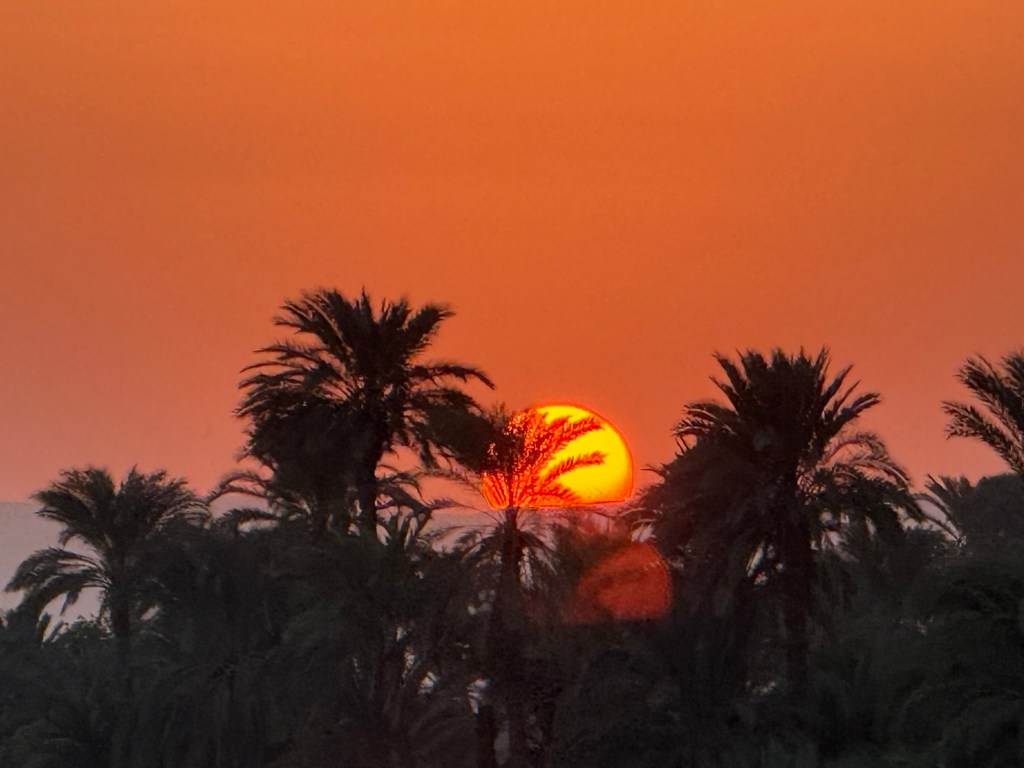
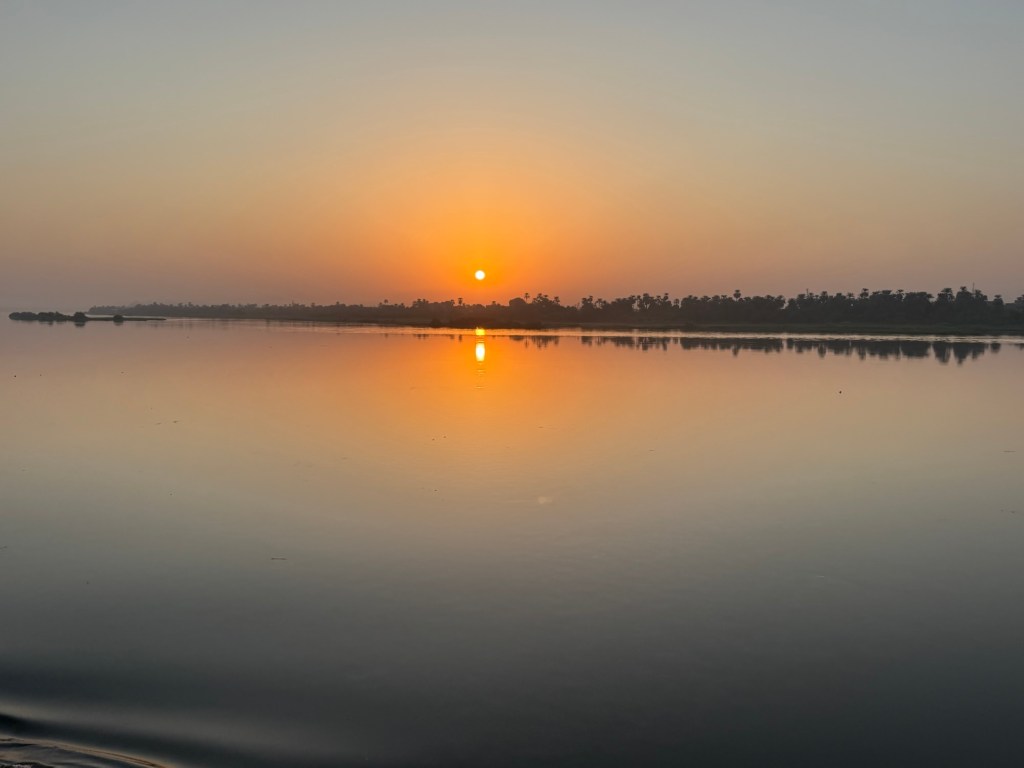
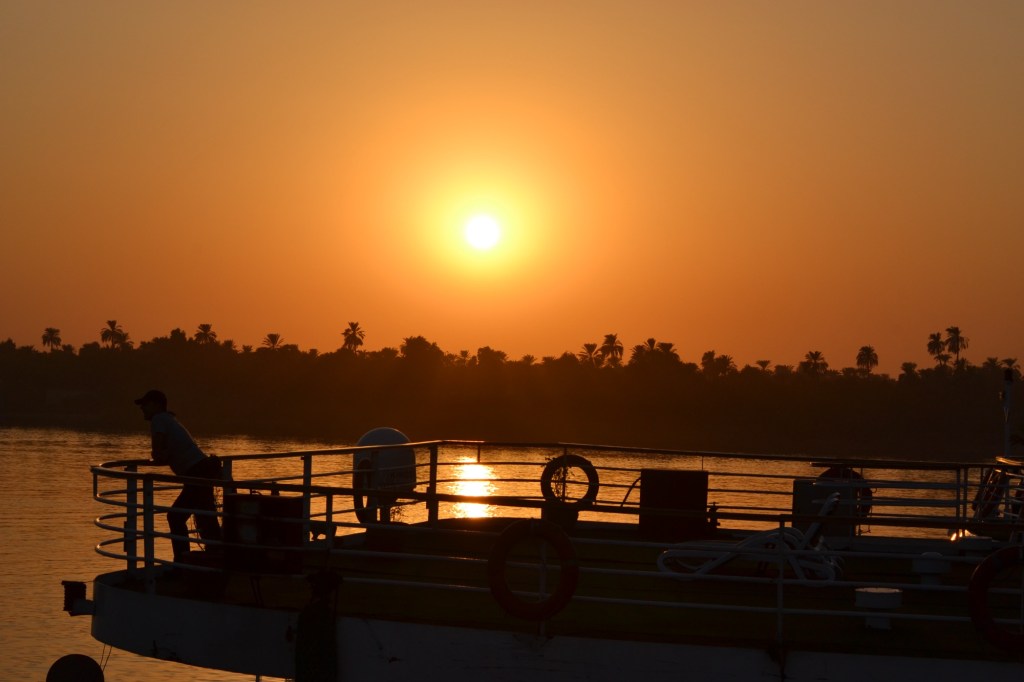
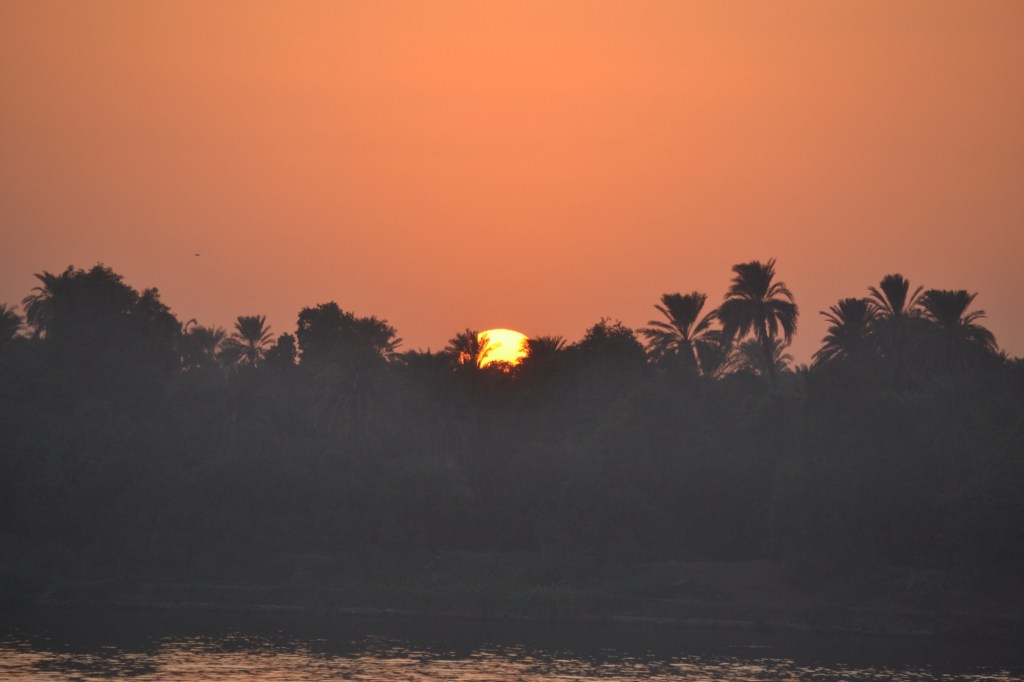
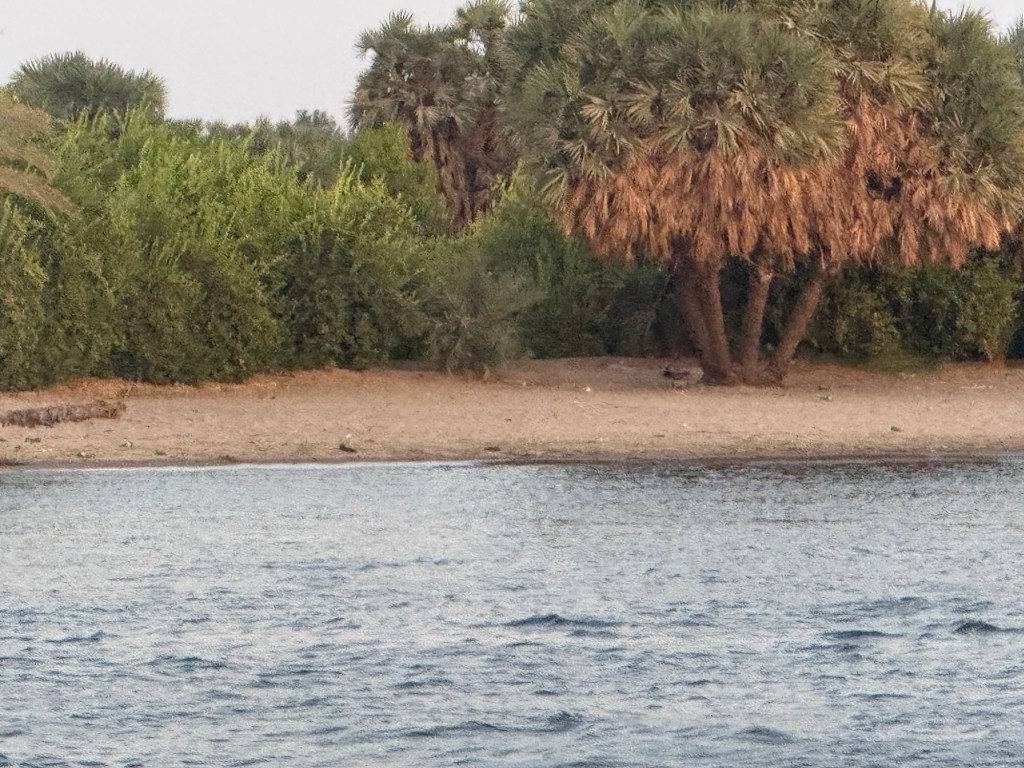
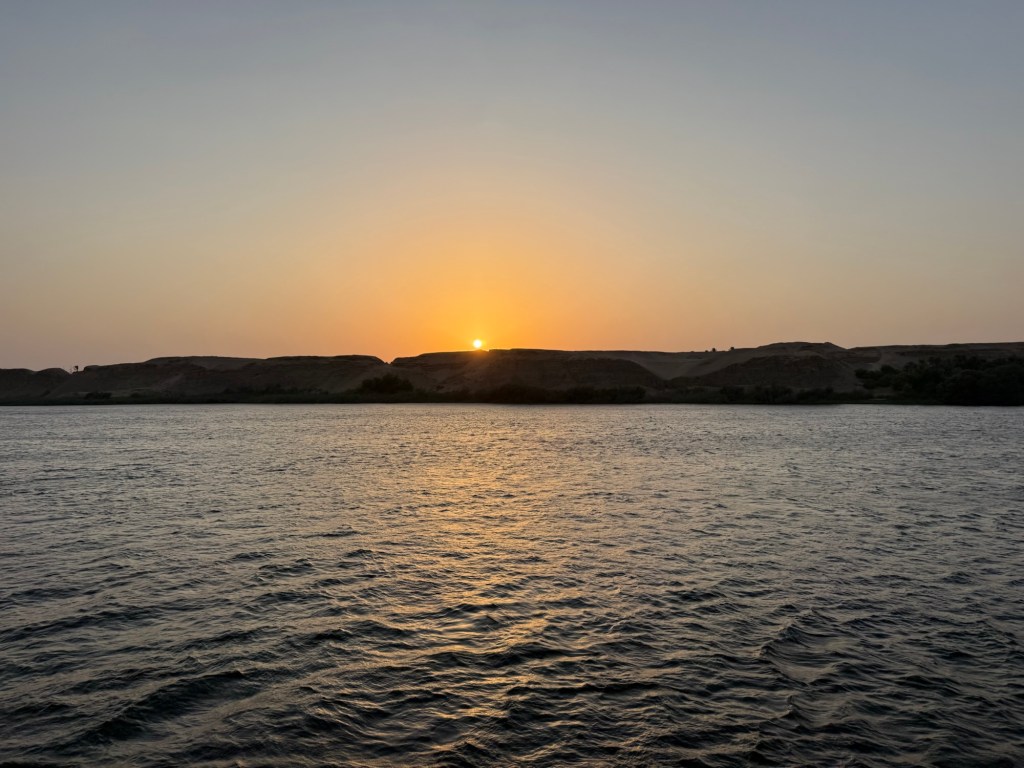
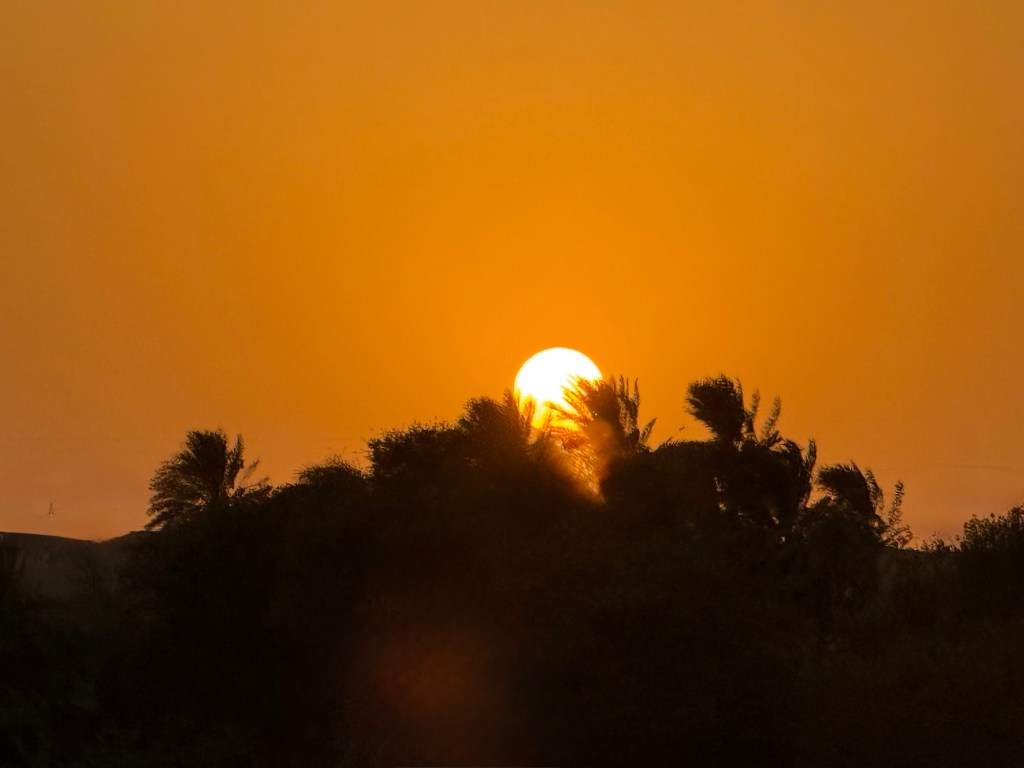
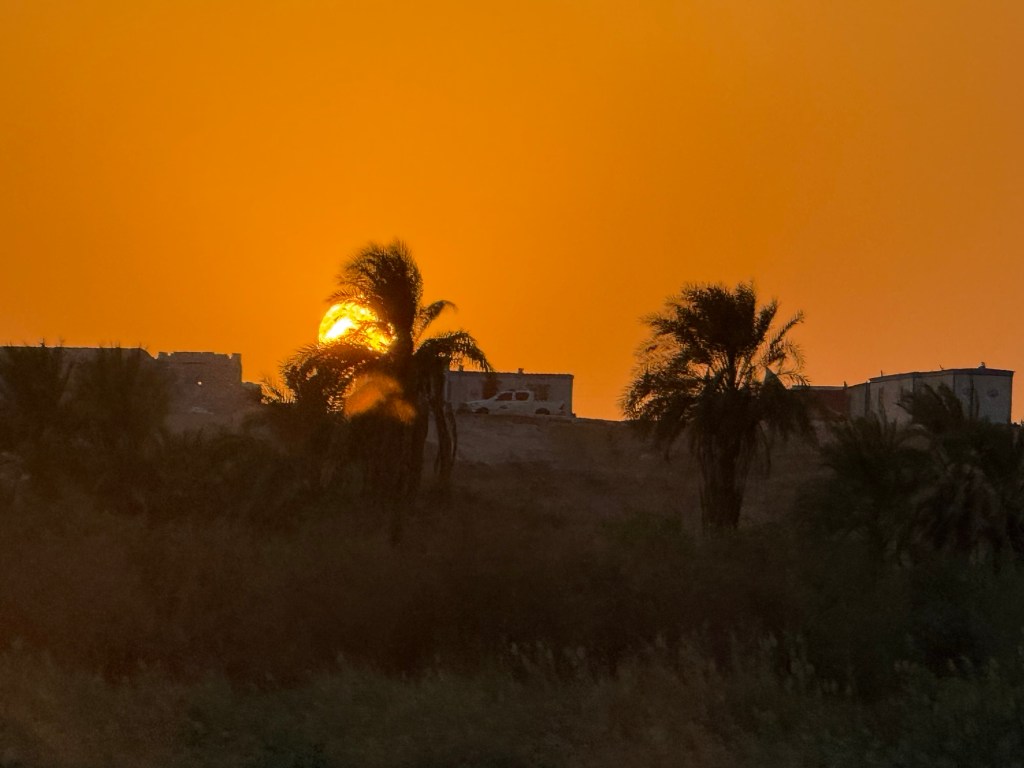
Last night we enjoyed our final sunset on the Nile near Luxor. The setting sun hid behind palm trees as it descended.
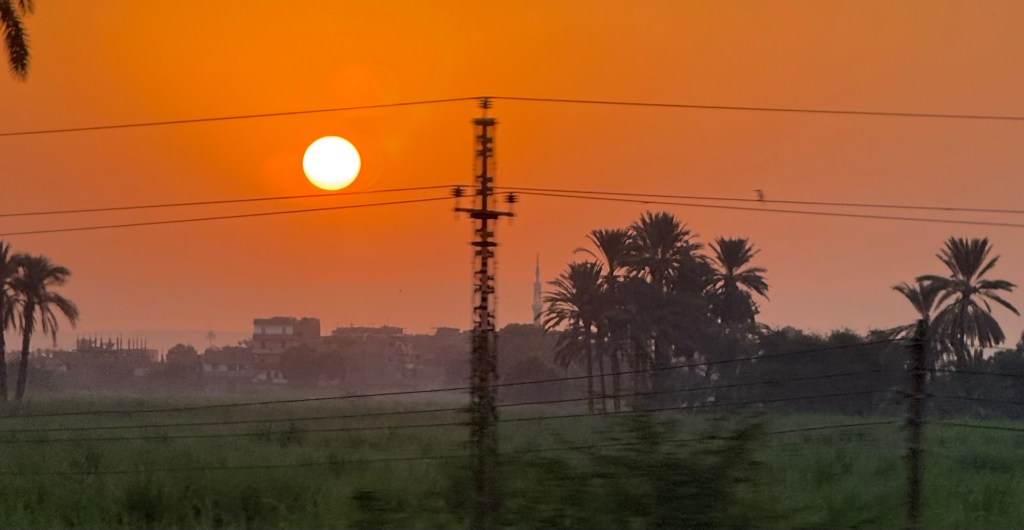
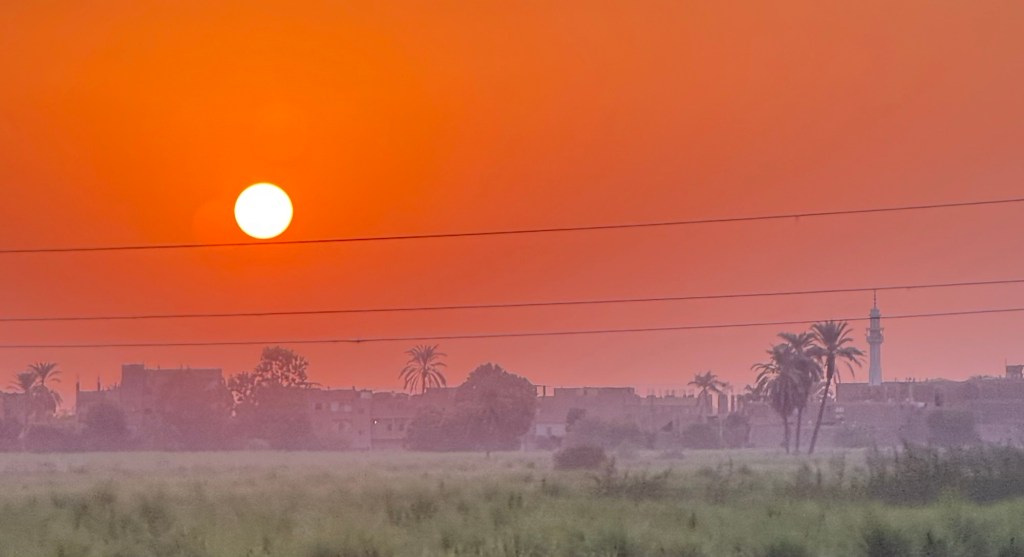
And then early this morning, the new sun greeted us on our way to the airport bound for Cairo. The rising sun appeared to hop one from suspended telegraph wire to the next….
There was an Anglo-Saxon tourist close by me today who was a real laurel spaffer…bless….
Anyway….
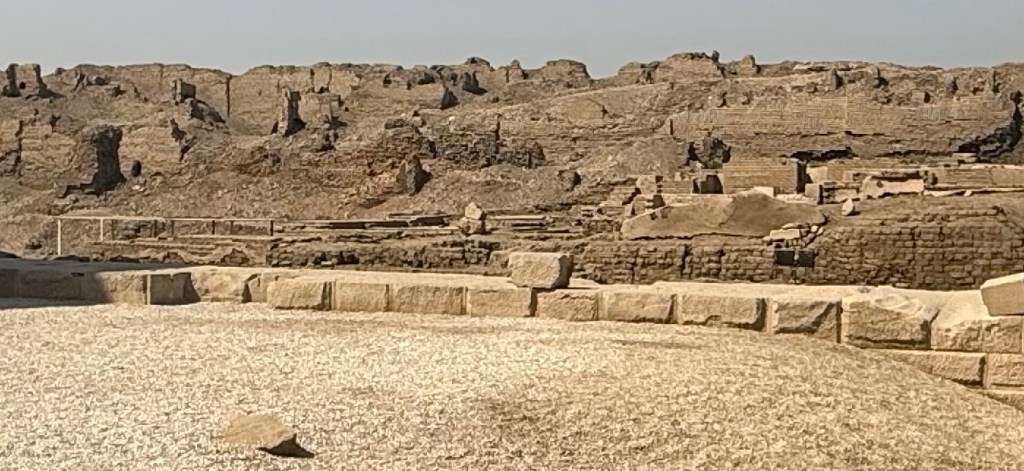
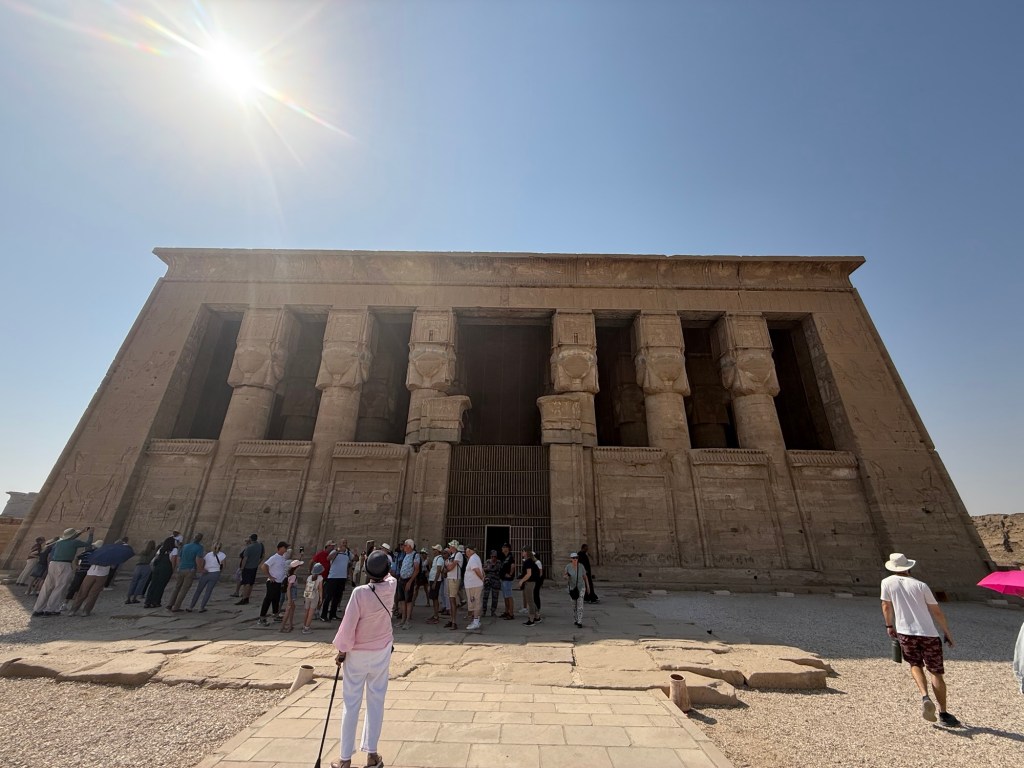
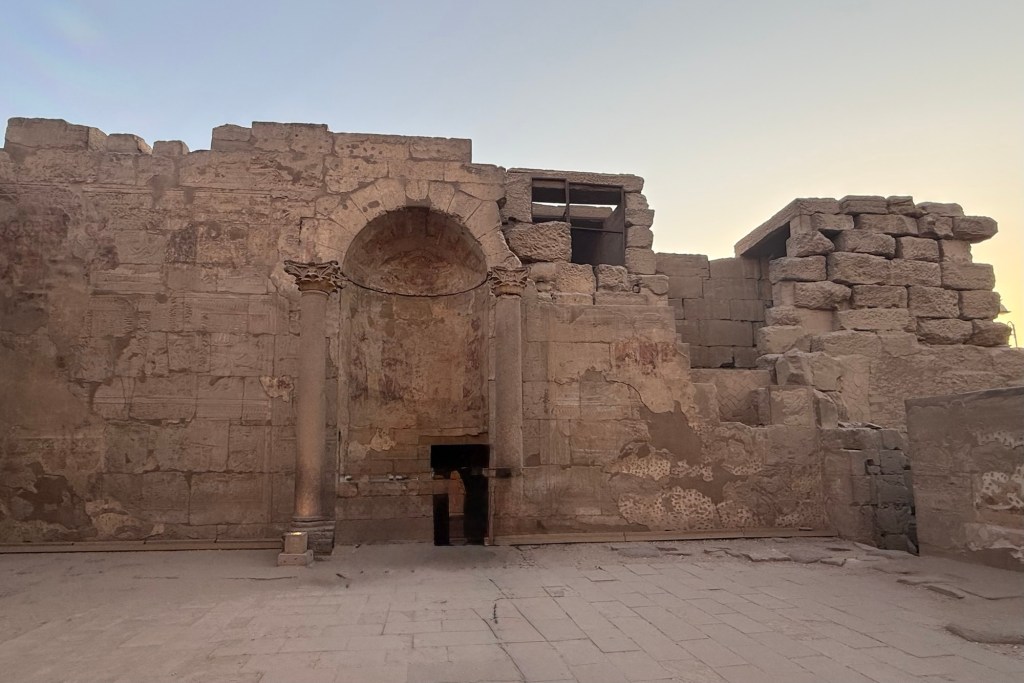
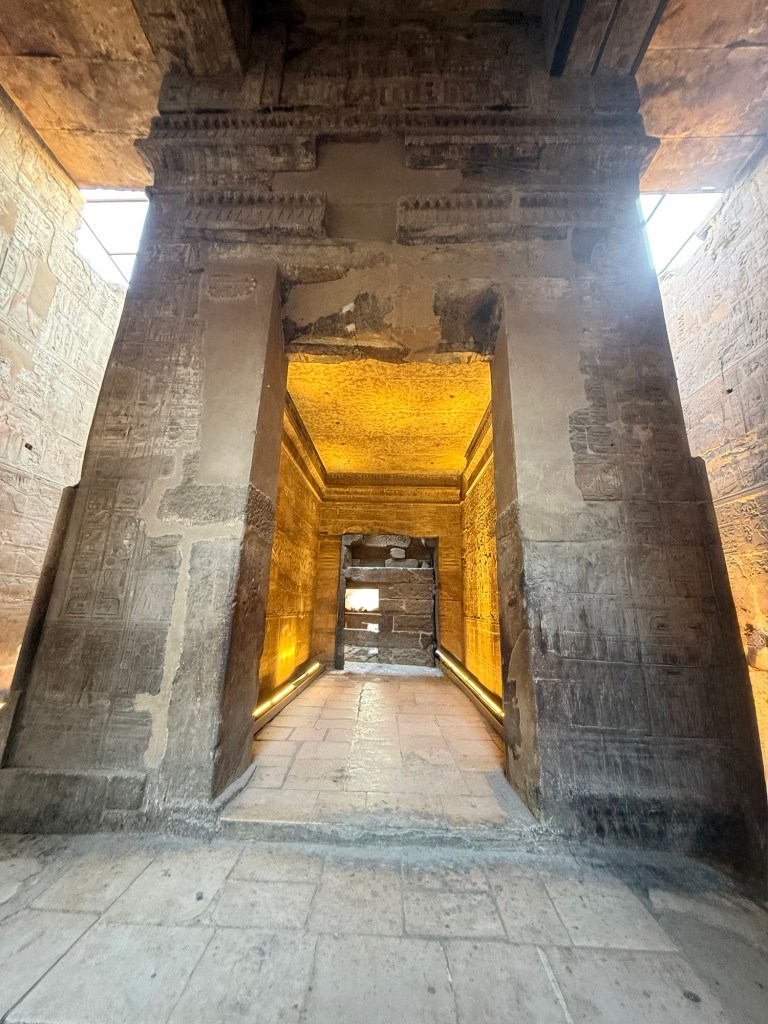
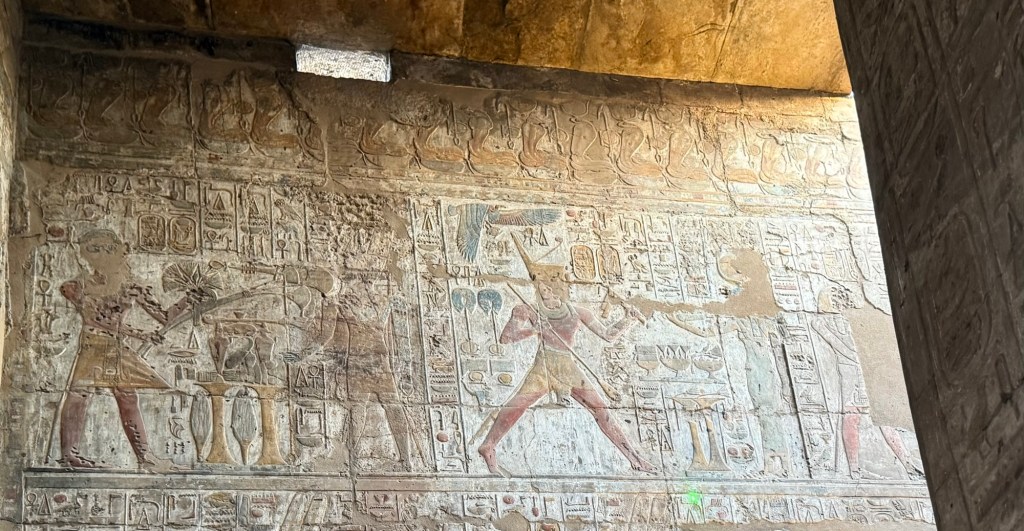
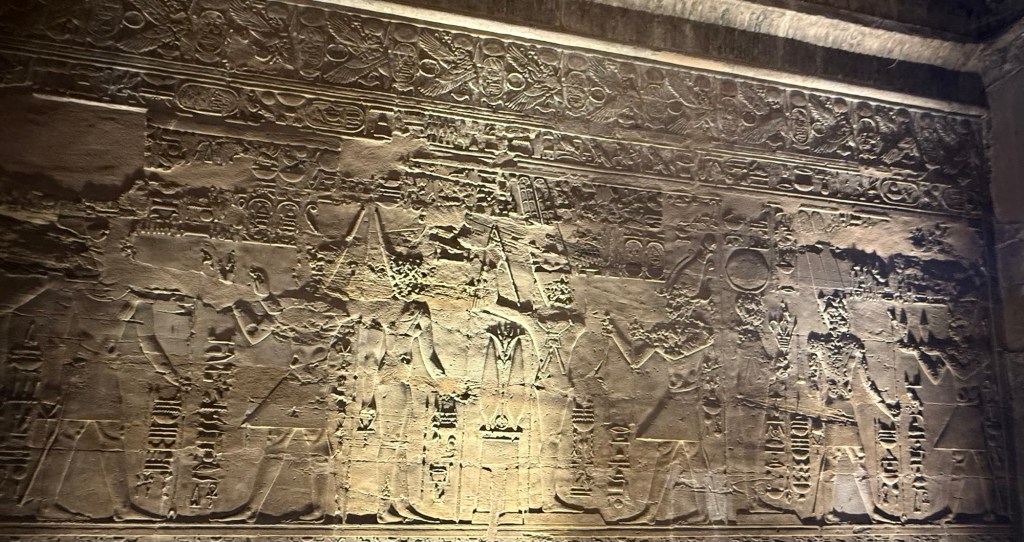
The Dendera Temple complex, situated approximately 2.5 kilometres southeast of Dendera, is one of the best-preserved temple complexes in ancient Egypt.
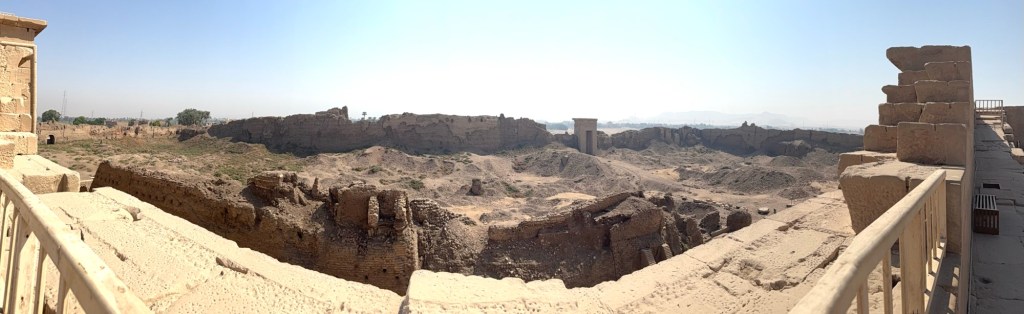
The entire complex is surrounded by a substantial mudbrick wall, which is best viewed from the roof, accessible via a hot and humid climb within the walls.
The structures throughout the complex were constructed over multiple eras, including the Middle Kingdom, the Ptolemaic Era, and the Roman provincial rule period.
Key features of the complex include:
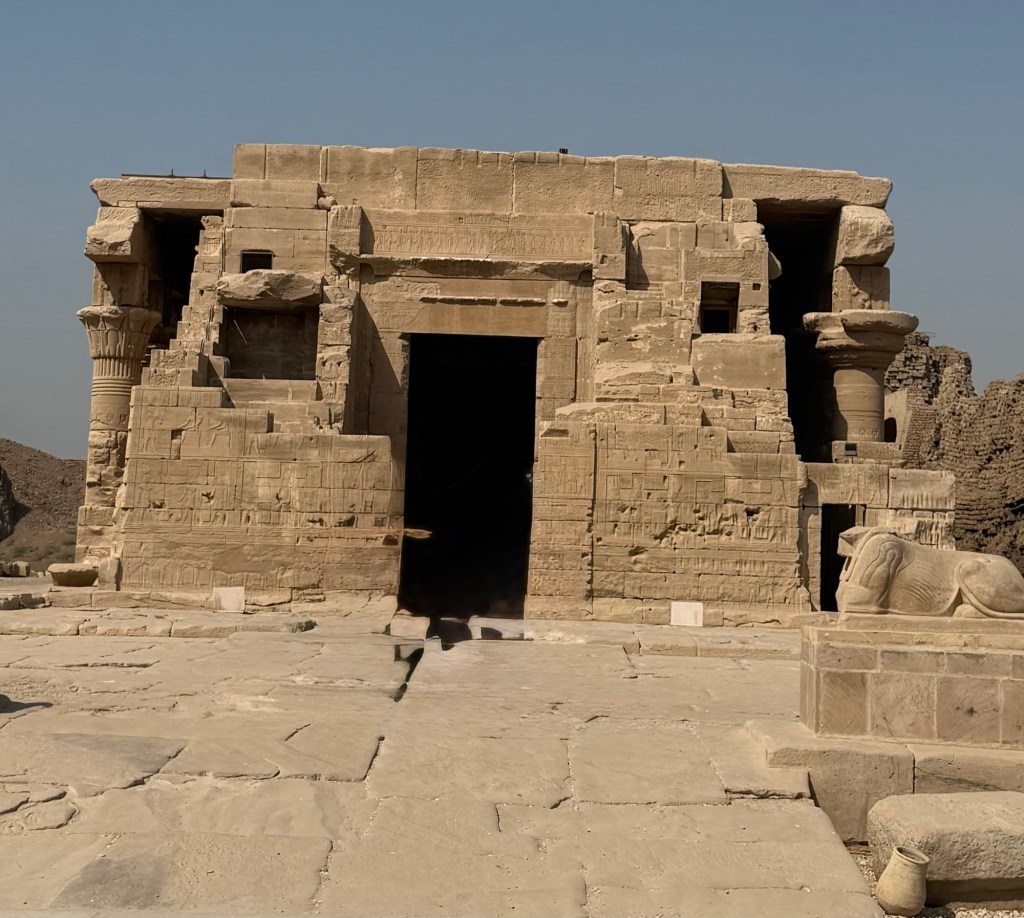
Roman Mammisi: The Roman mammisi, a subsidiary building located before the Temple of Hathor, dates back to the reigns of Trajan and Marcus Aurelius. Numerous reliefs depicting Trajan making offerings to Egyptian deities are visible.
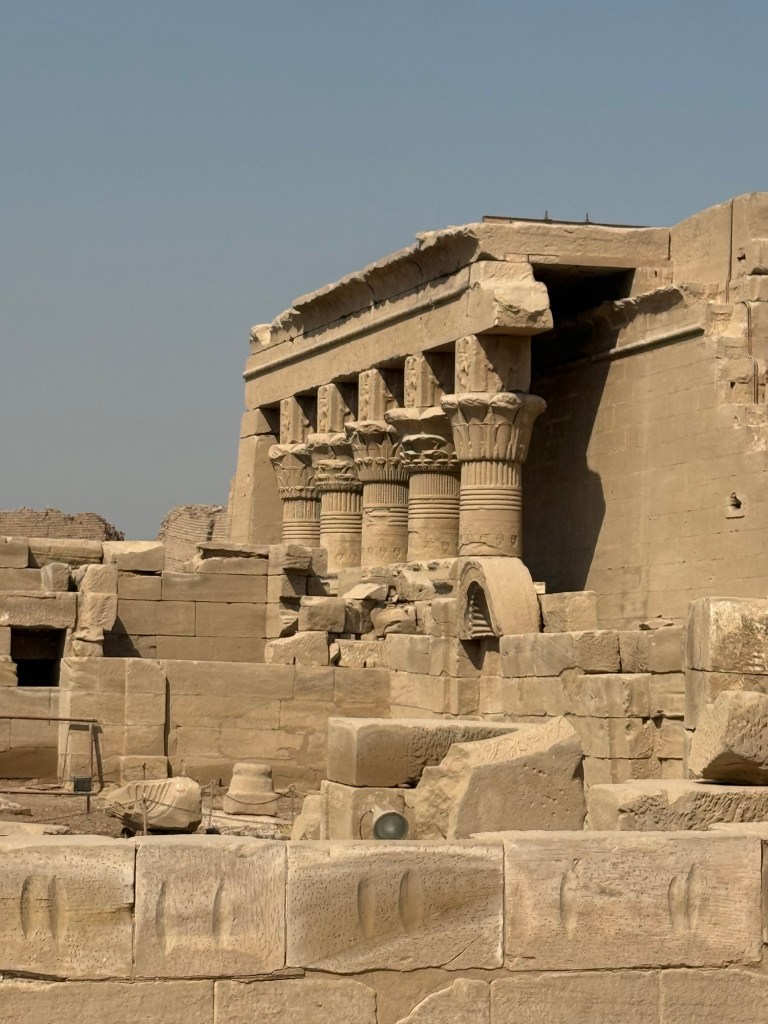
Hathor Temple: The Temple of Hathor dominates the complex, with its structure commanding attention. The original temple underwent continuous modifications throughout the Middle Kingdom and up until the beginning of Trajan’s reign.
The existing temple’s structure began construction in 54 B.C.E, during the late Ptolemaic period under Ptolemy Auletes.
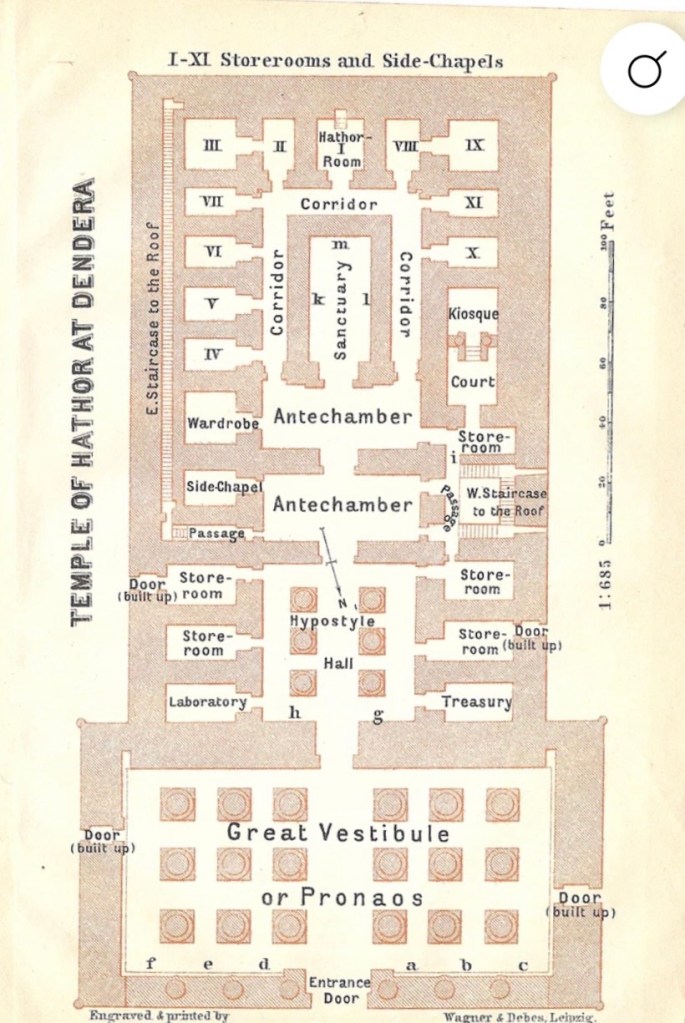
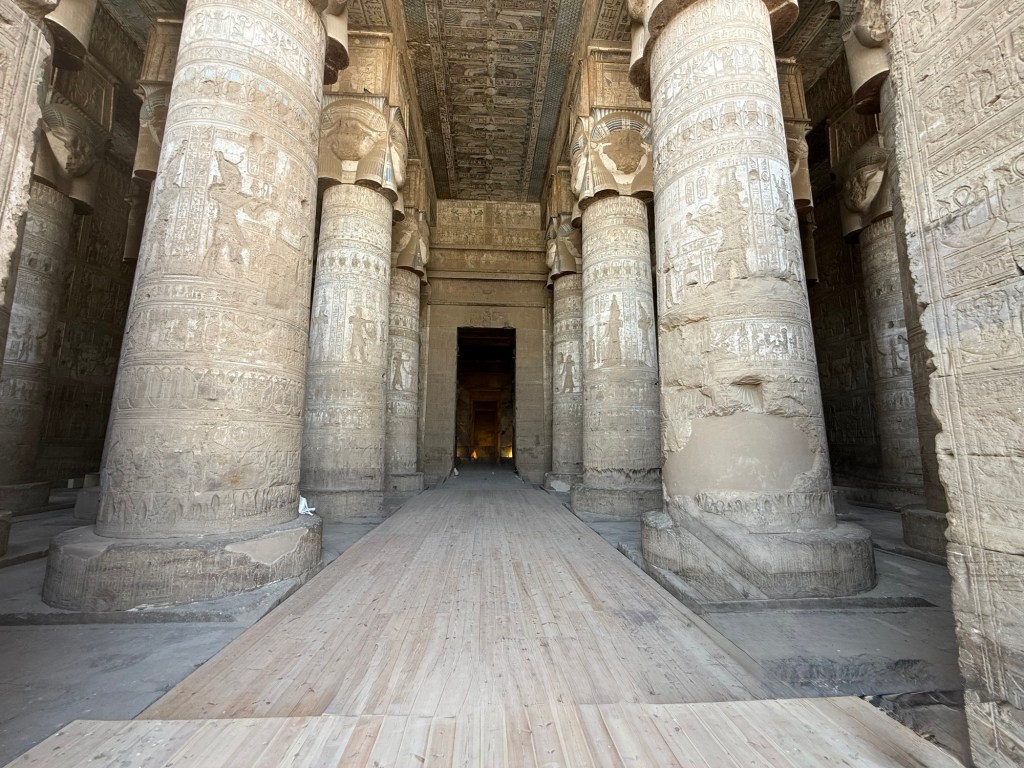
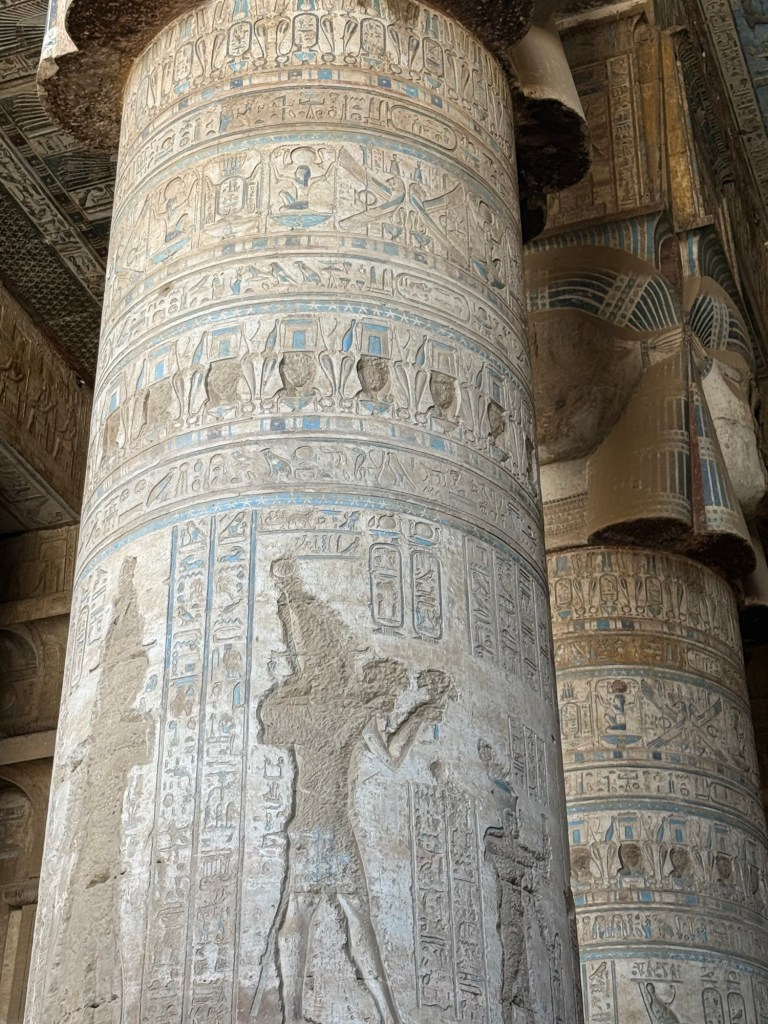
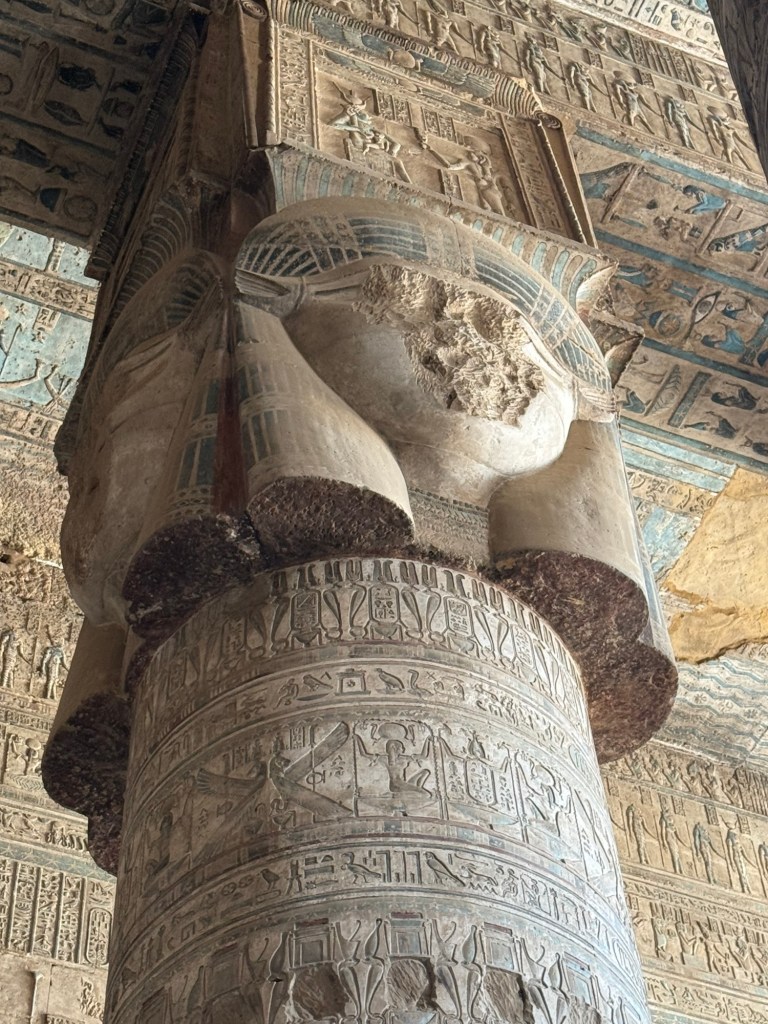
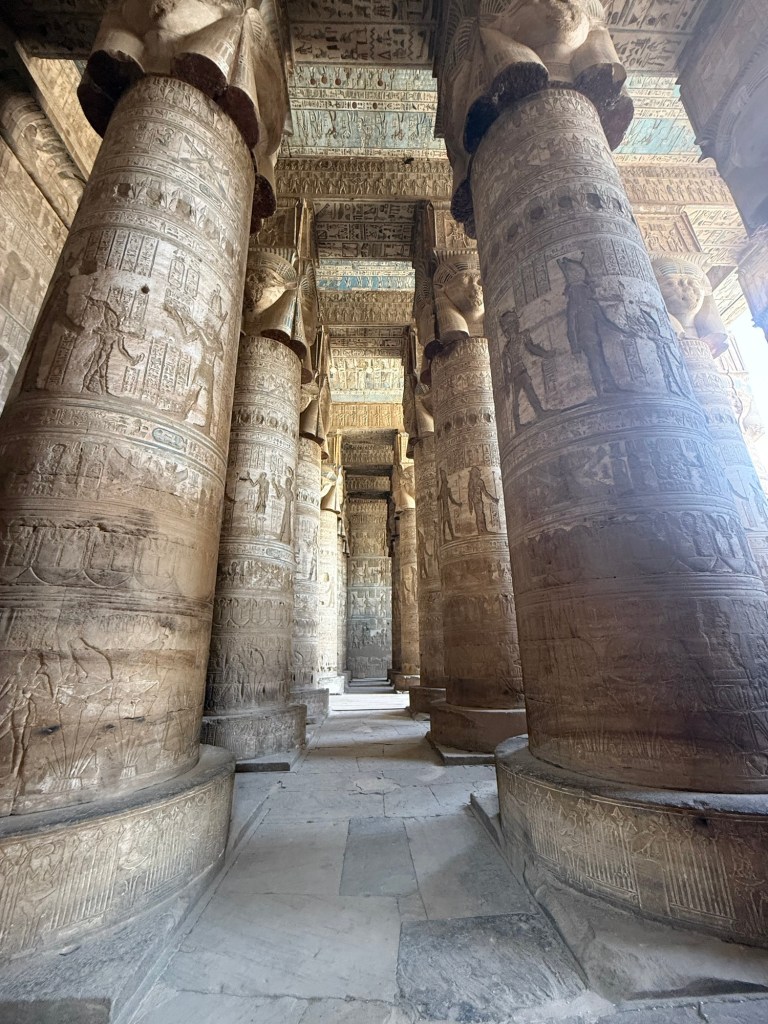
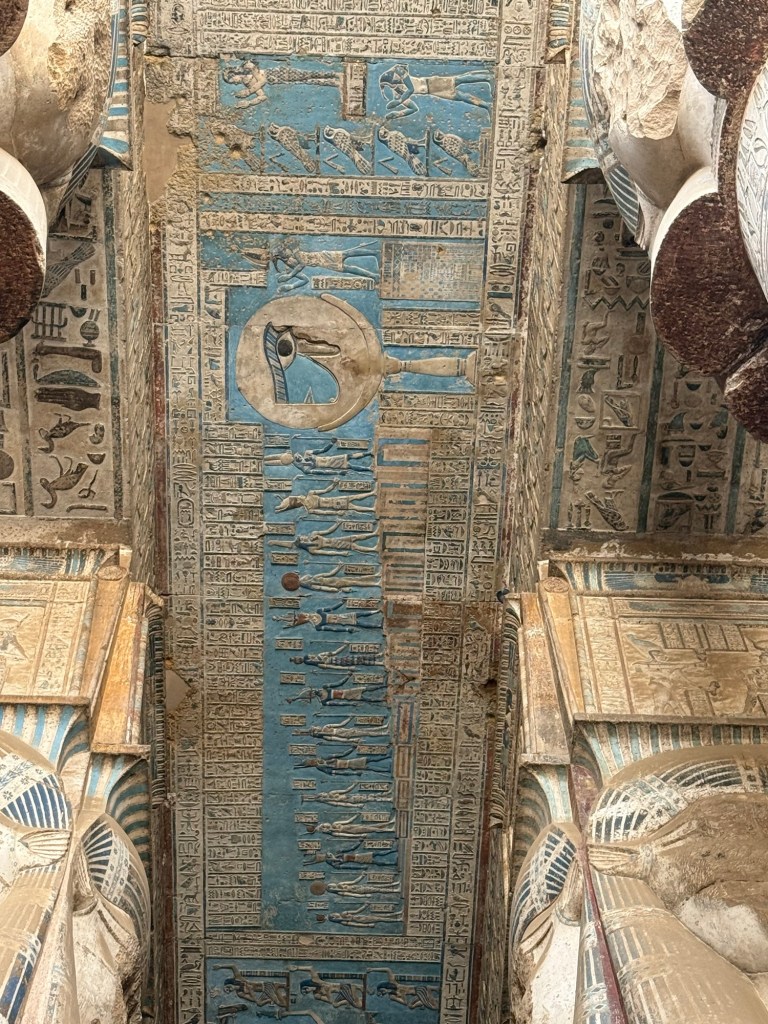
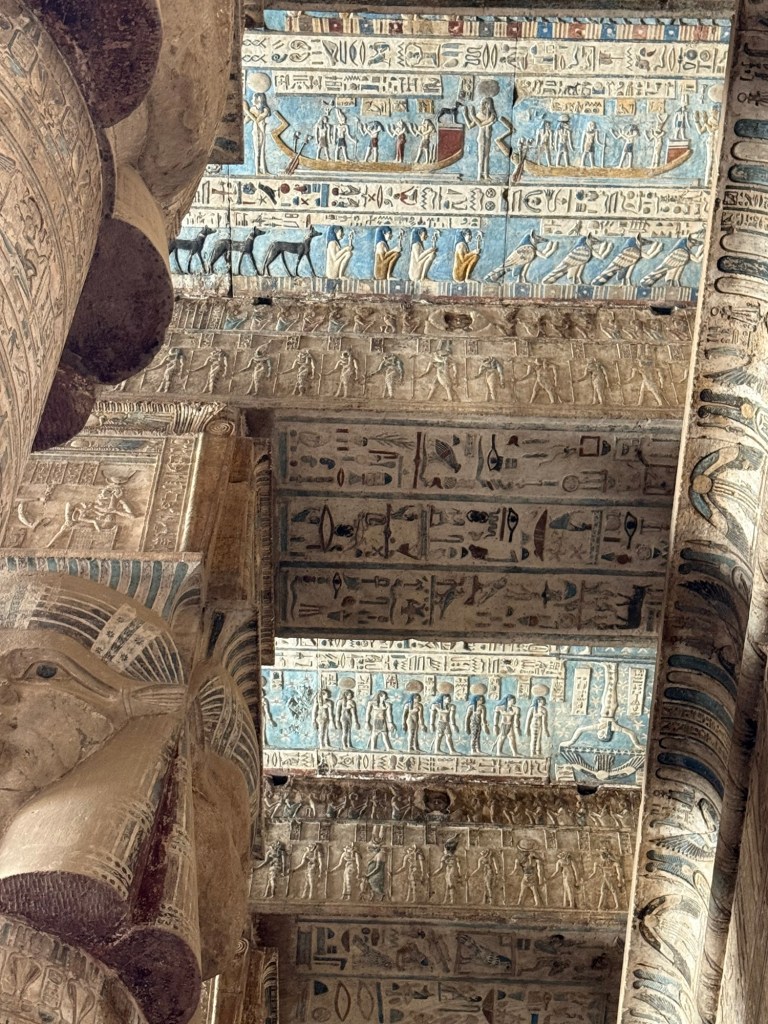
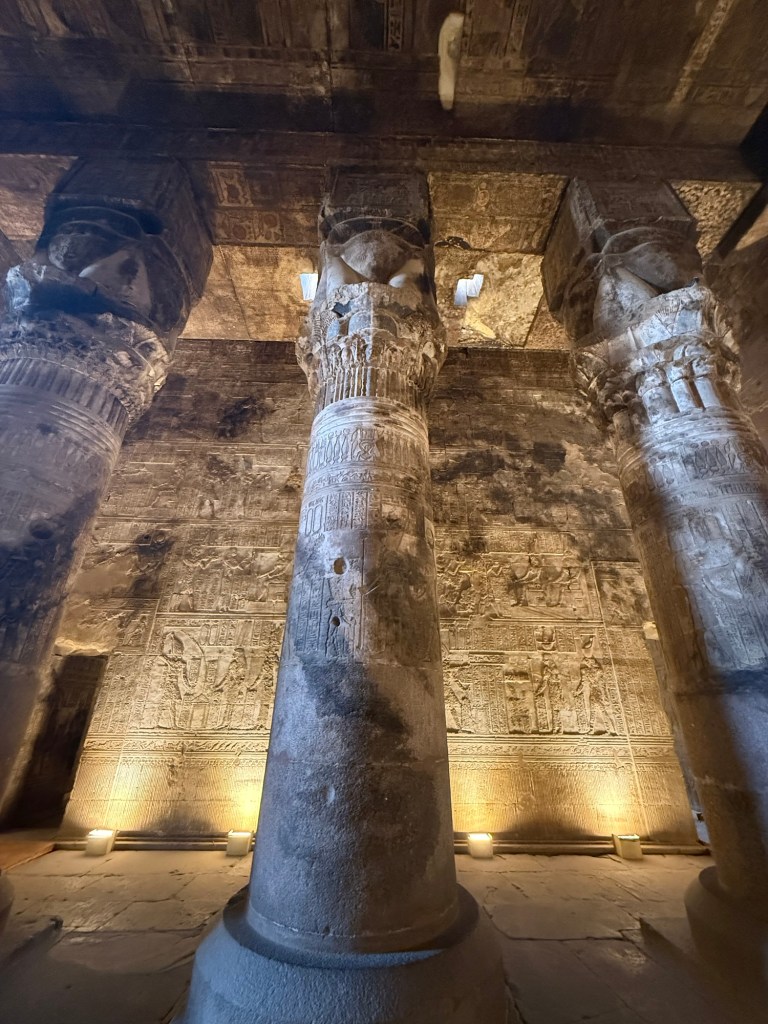
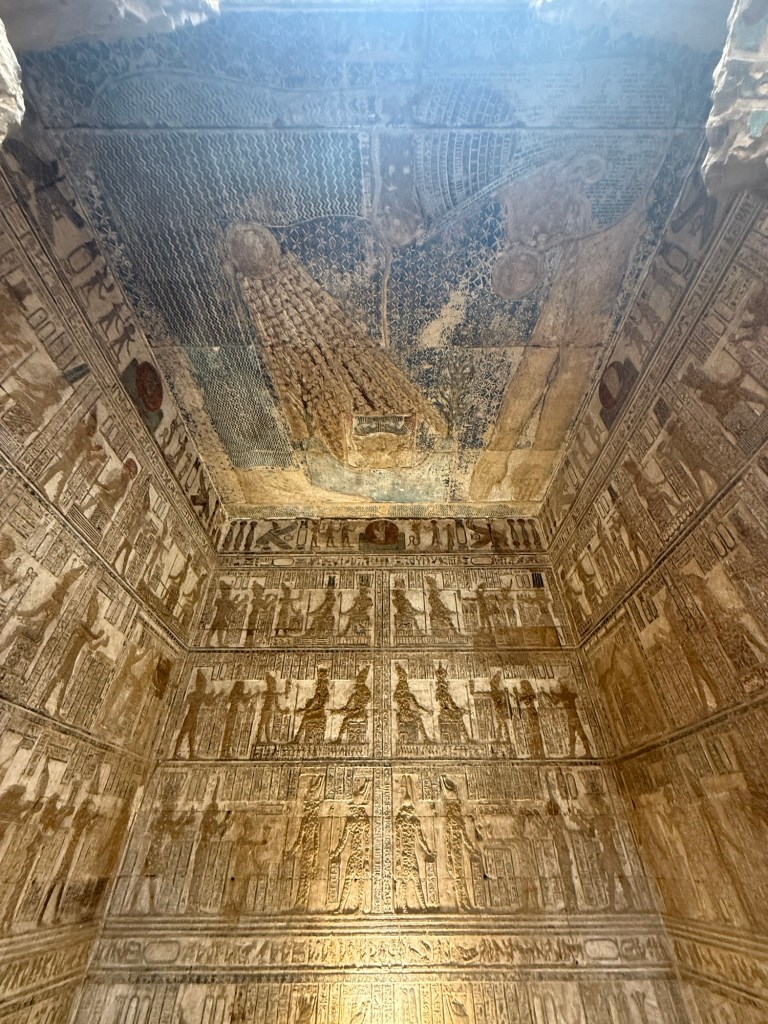
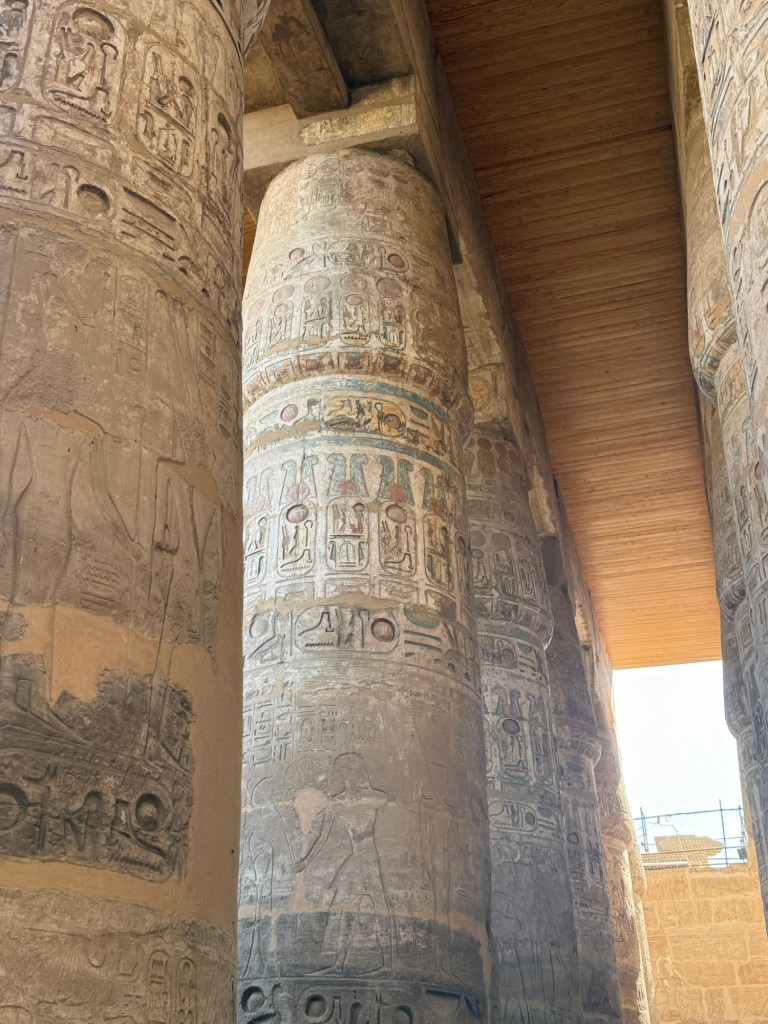
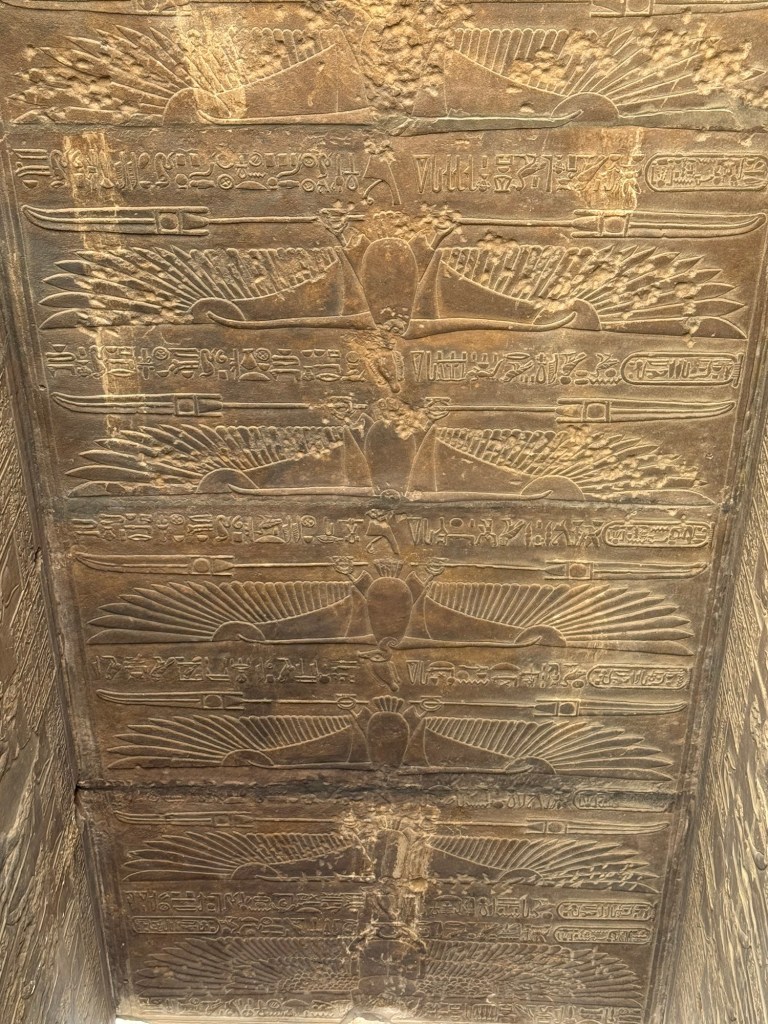
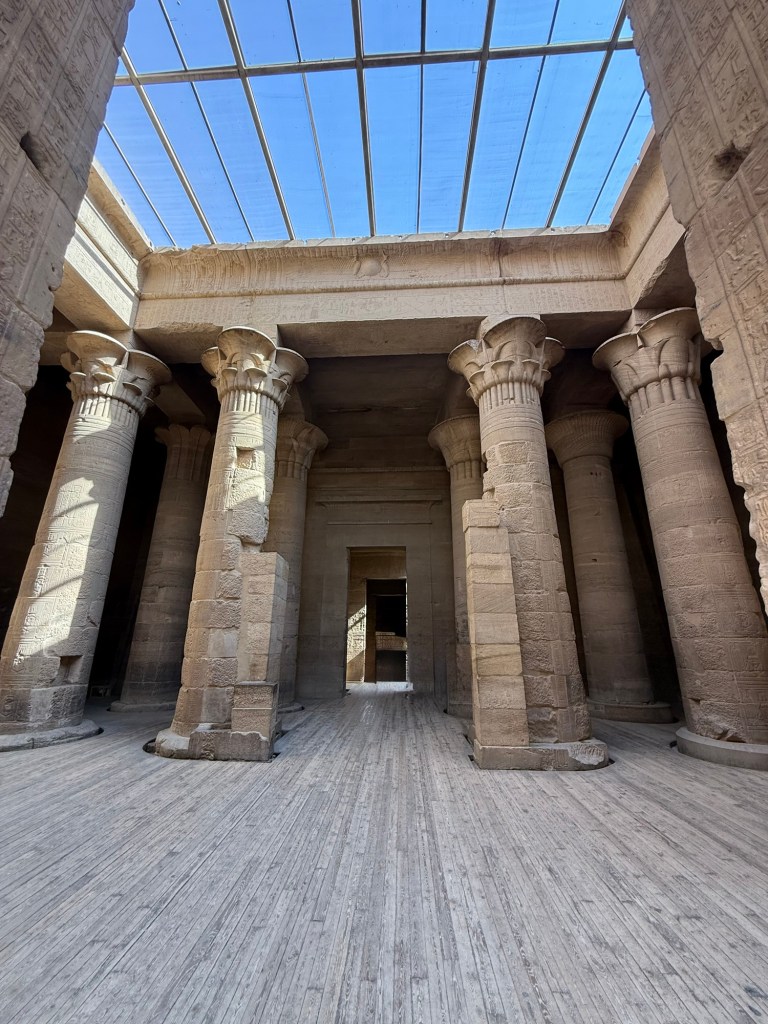
Great Vestibule of Pronaos: Upon entering the temple, one is immediately confronted with enormous rows of columns and a roof above, covered in carvings/paintings with some still bearing vibrant colors – this is in the Great Vestibule of Pronaos.
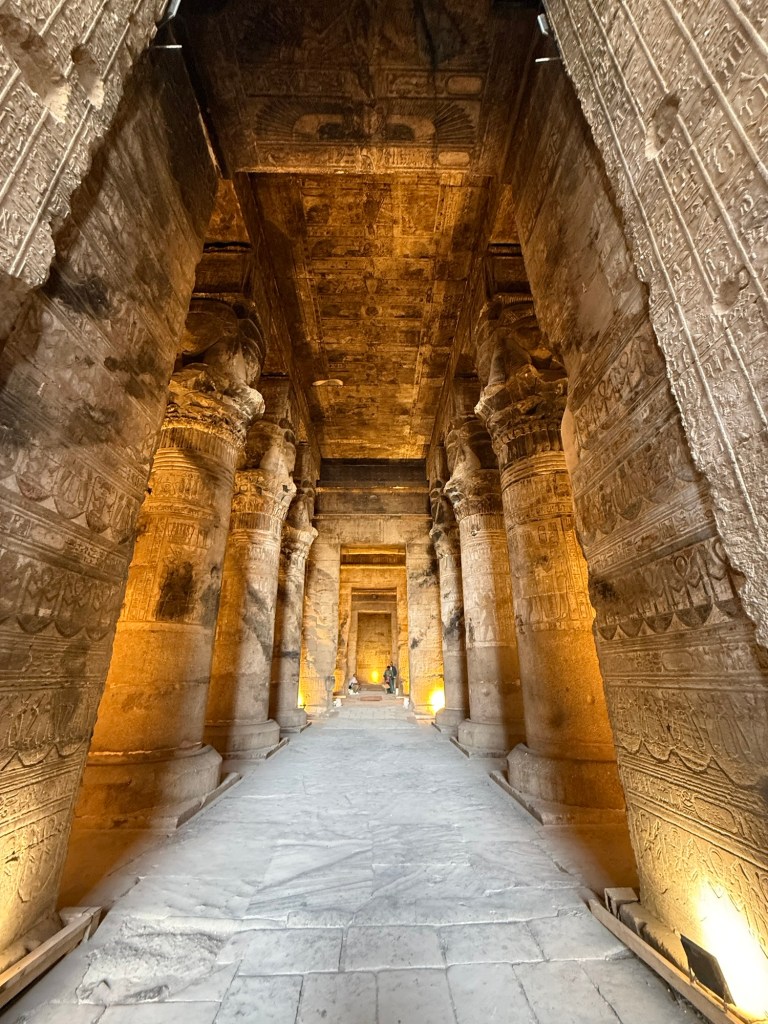
Hypostyle Hall: Following this is the Hypostyle Hall with its many columns. The hypostyle hall was built during the Roman period under Tiberius.
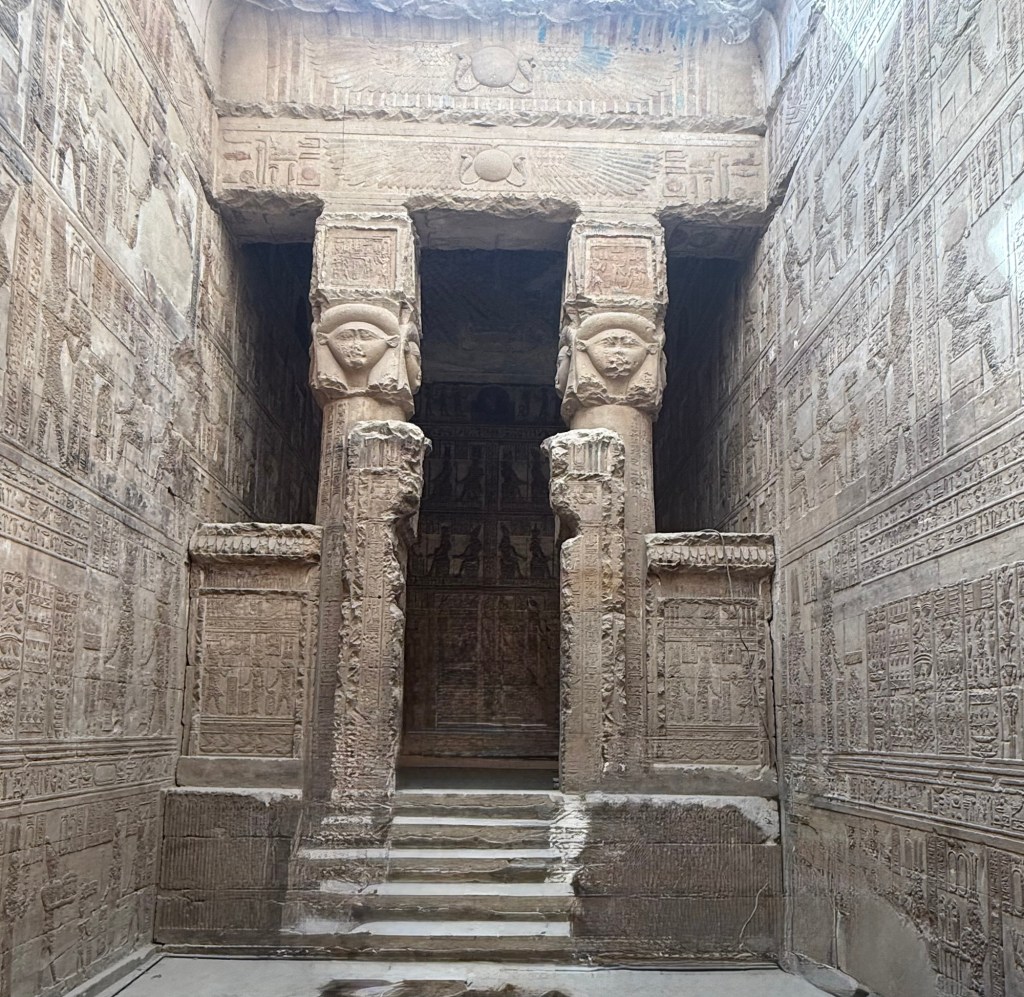
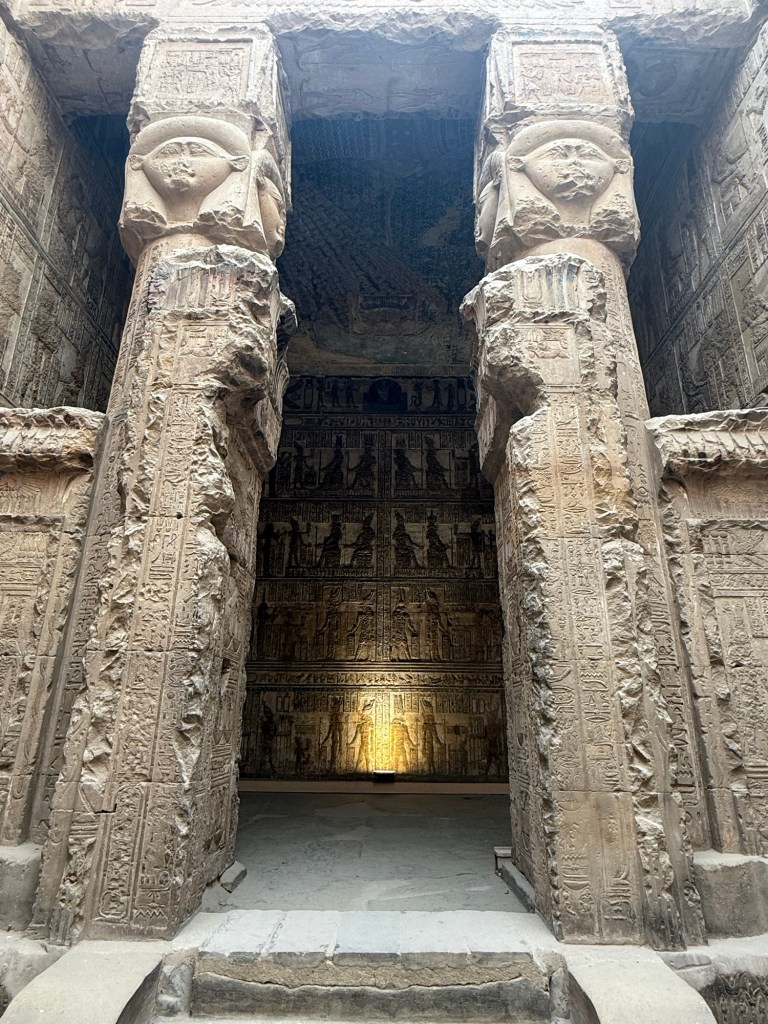
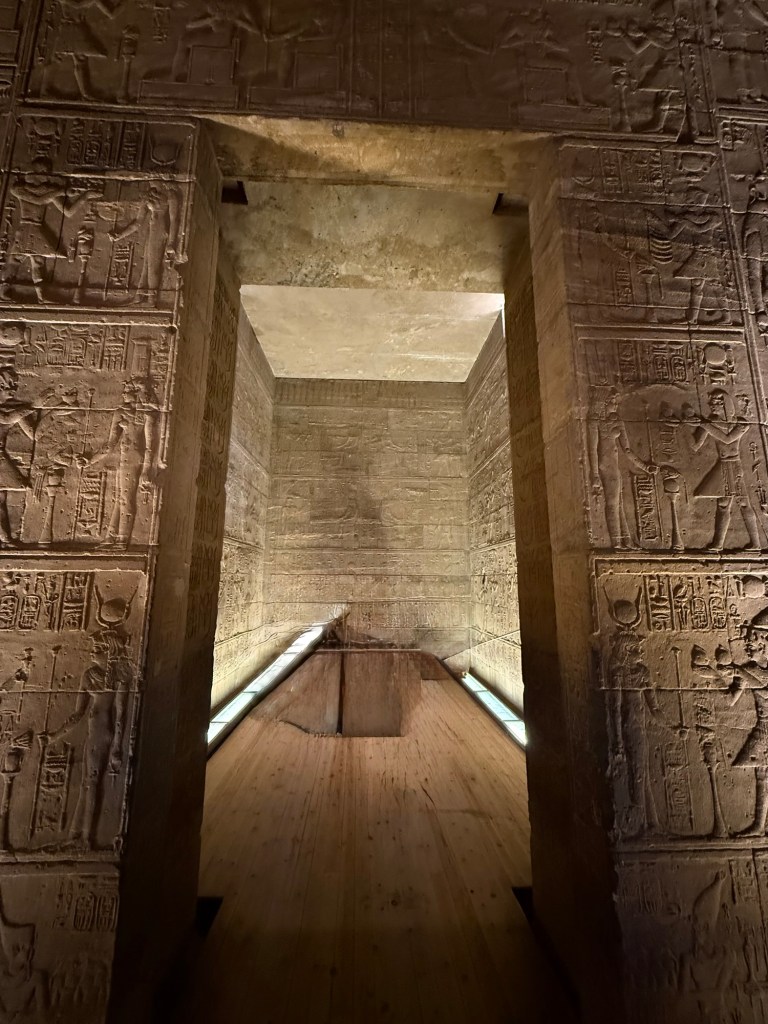
– Antichambers Then, there are two antechambers before reaching the sanctuary.
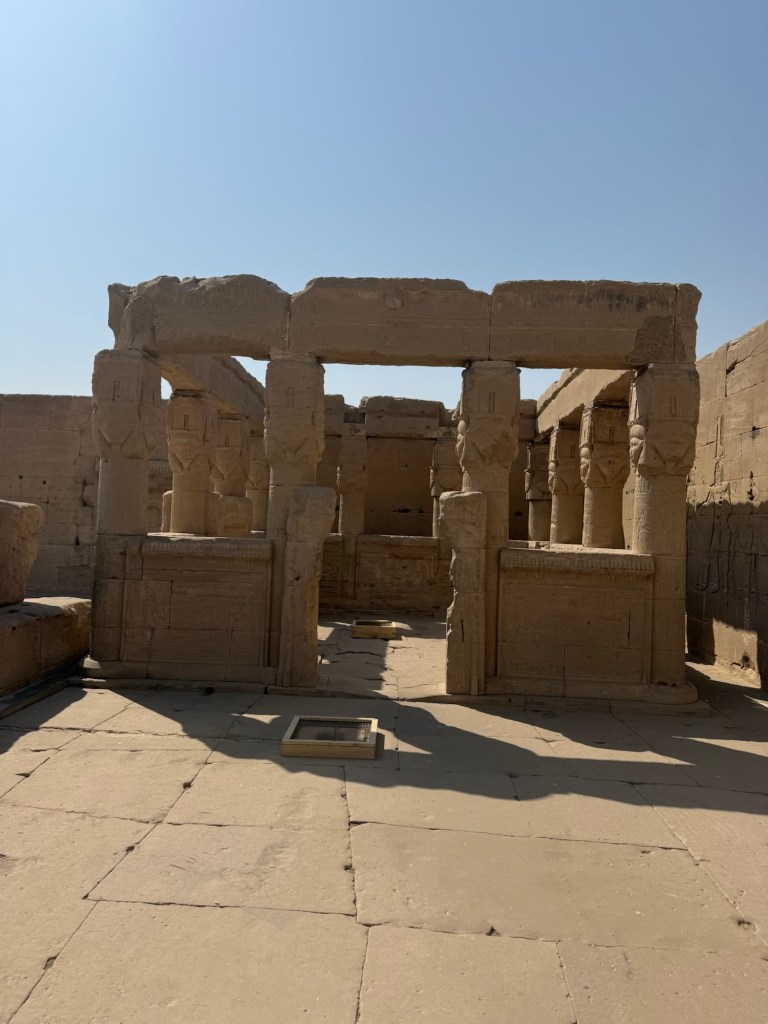
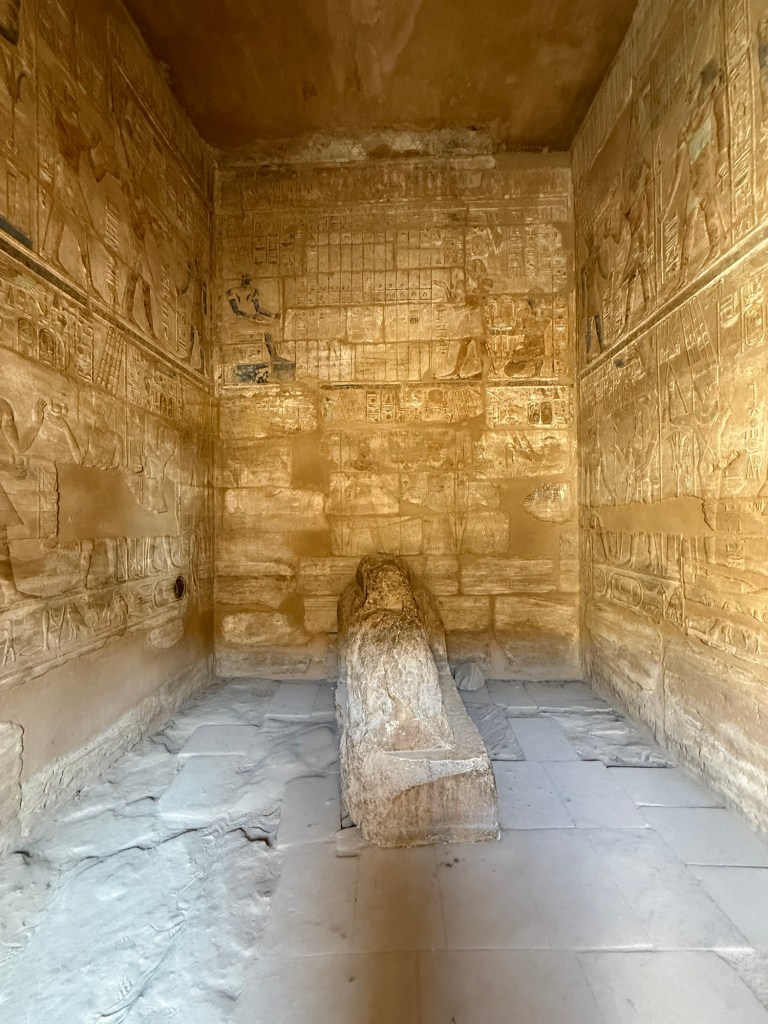
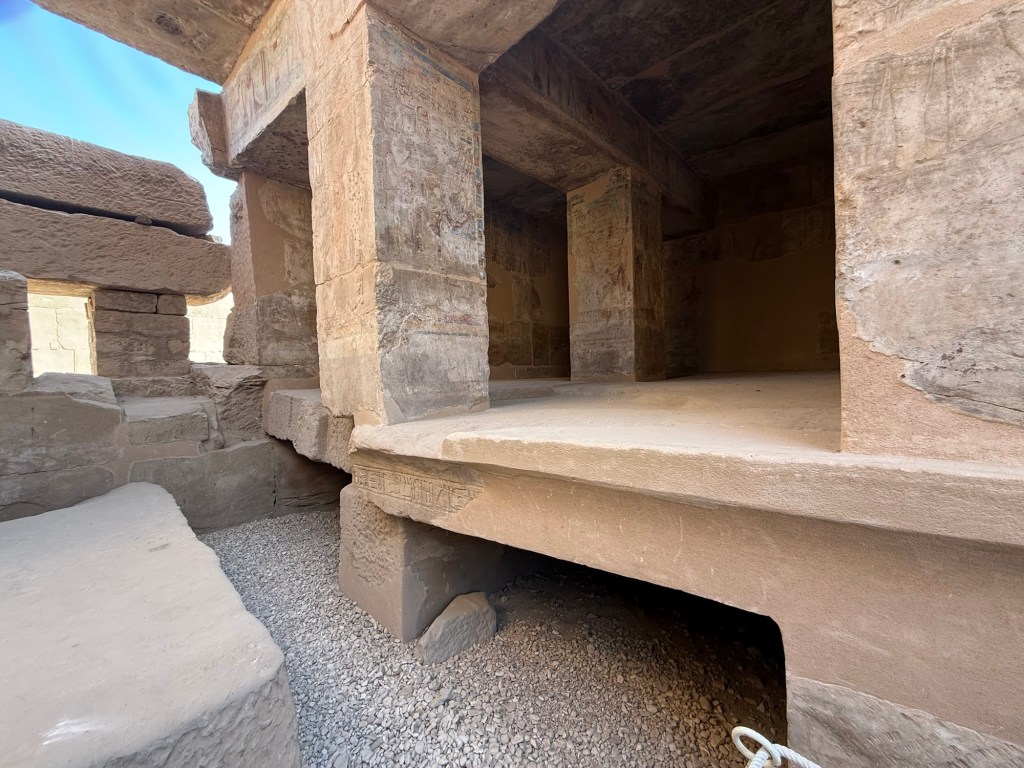
Subrooms, including Roman Kiosk There are numerous storerooms, labs, and wardrobes adjacent to these main rooms, including a lovely Roman Kiosk.
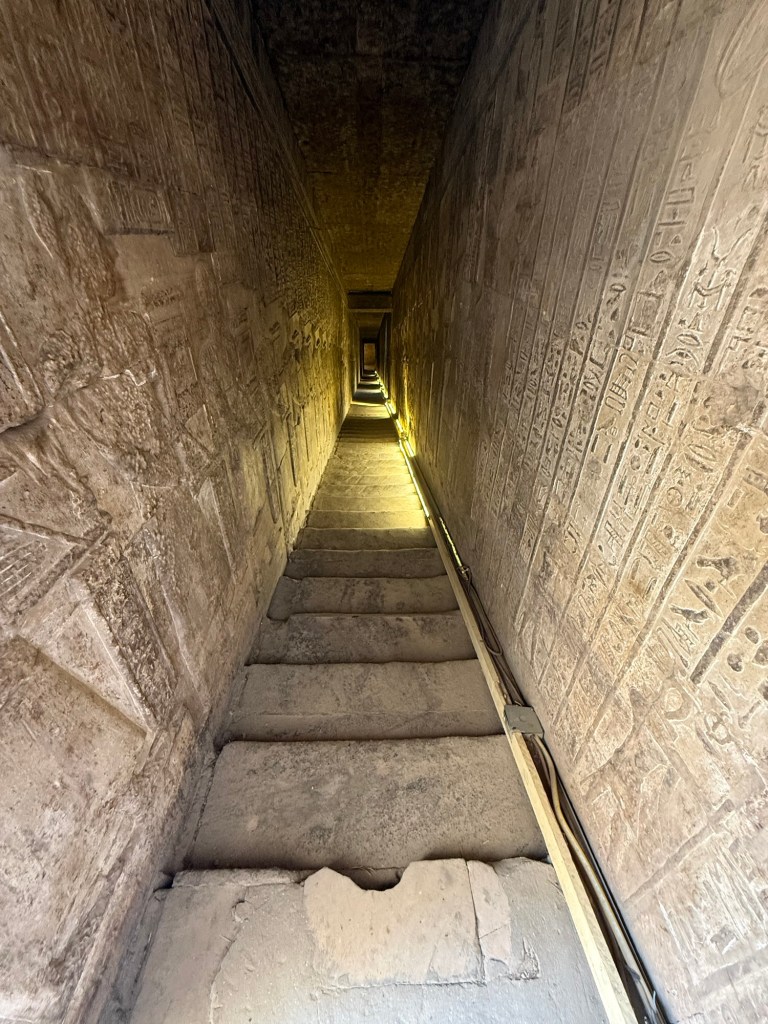
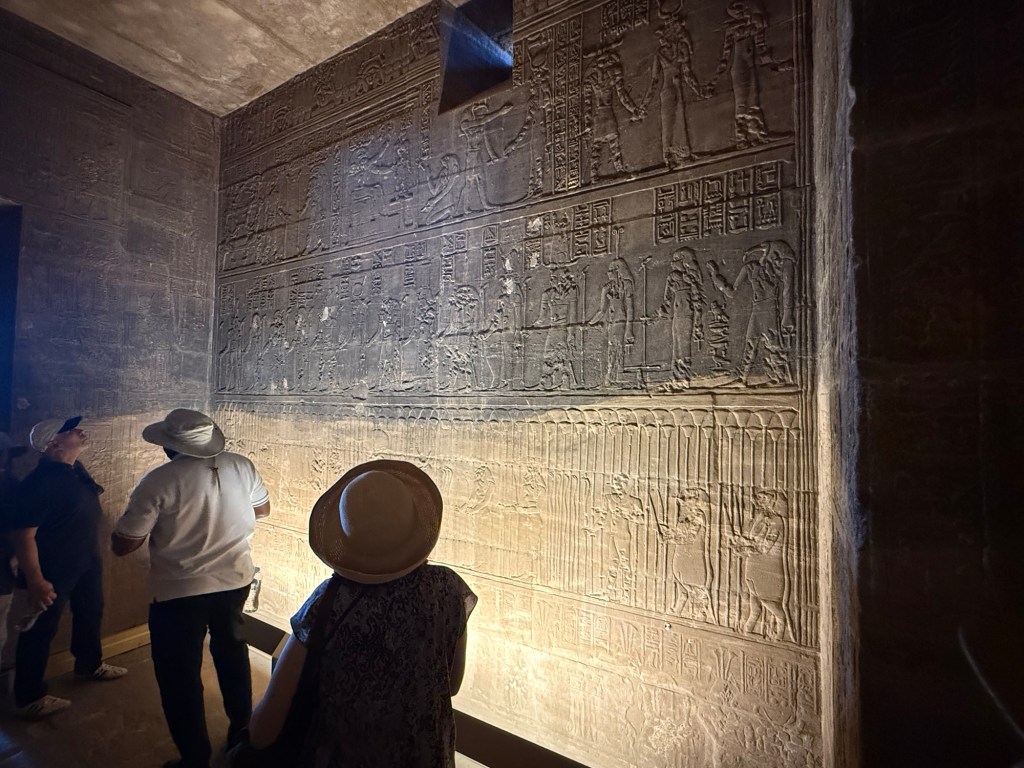
Roof A processional stairway leads to the roof of the temple, where reliefs on the walls depict scenes from rituals performed at the temple. The staircase shows wear from millennia of use and an apparent accretion of material, earning it the informal name of “the melted stairs.”
The roof offers great views as to the size of the complex and to the surrounding mud brick walls and entry gates.
You can also see the Kiosk of Hathor.
The stairwell down is a straight shot.
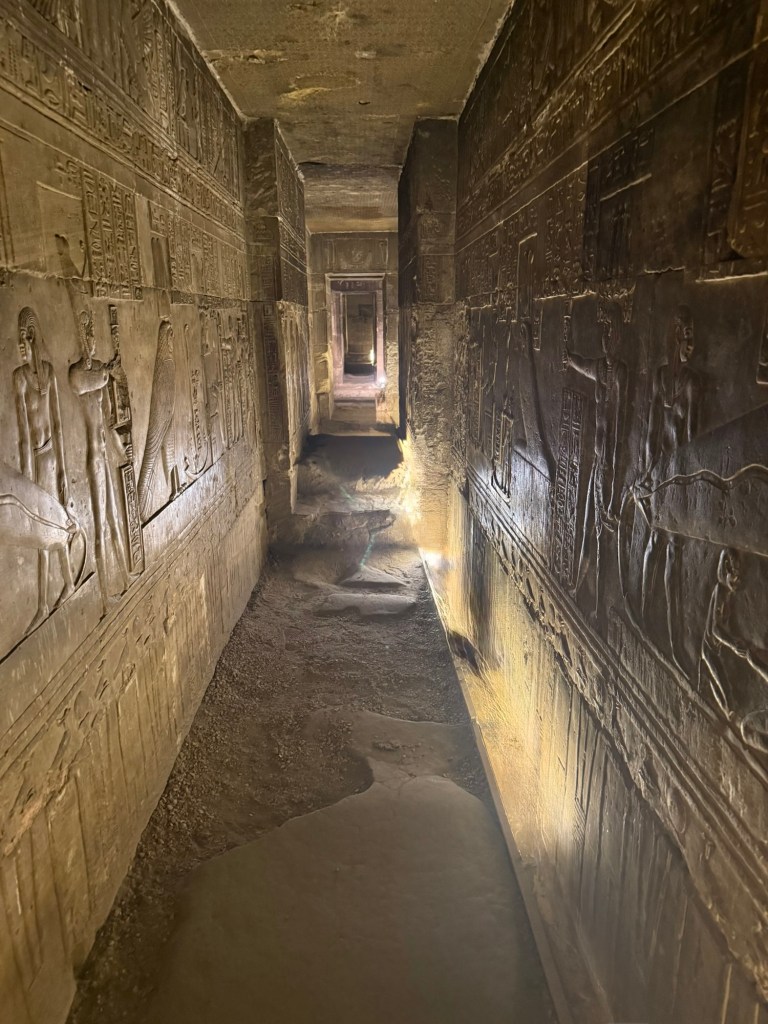
Catacombs/Crypts You have to be pretty bendy to get down here and it’s very claustrophobic. An opening in the Flame Room floor leads to a very narrow chamber with representations on the walls of the objects which were kept in them. In the second chamber, a relief depicts Pepi I offering a statuette of the God Ihy to four images of Hathor.
Sacred Lake and Sanatorium: This would have functioned similarly to a Roman bathhouse, but strictly for bathing and an overnight stay to manifest healing dreams. The waters at Dendera were sacred and were often used to bless the inscriptions on statues so that they could cure diseases.
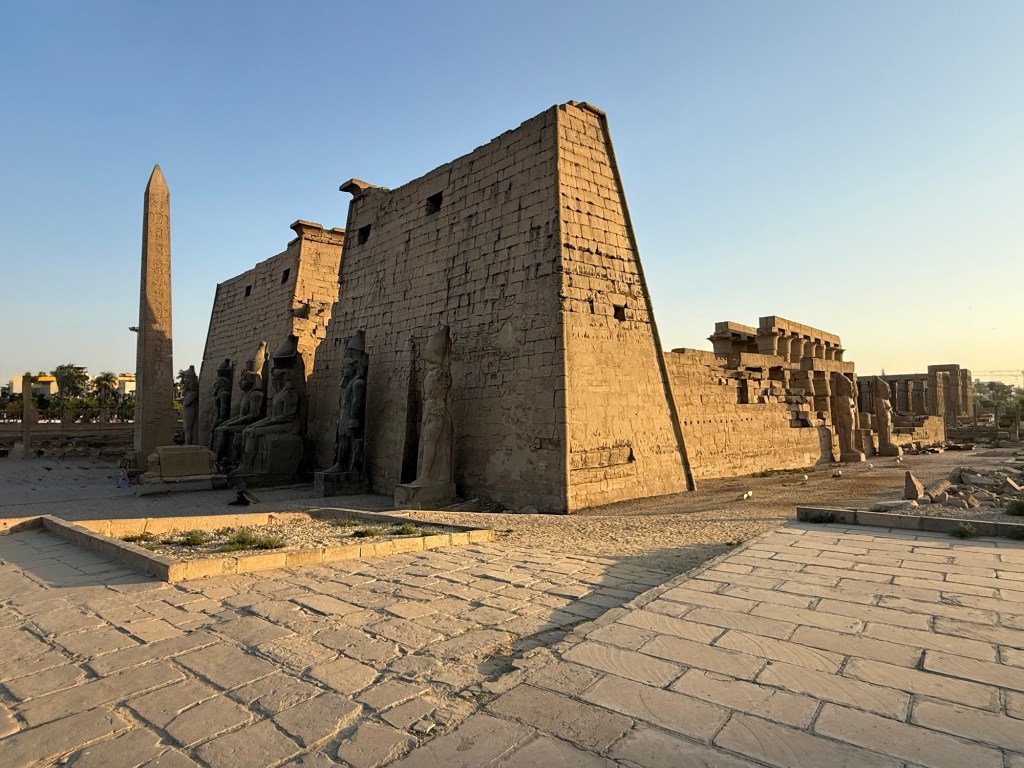
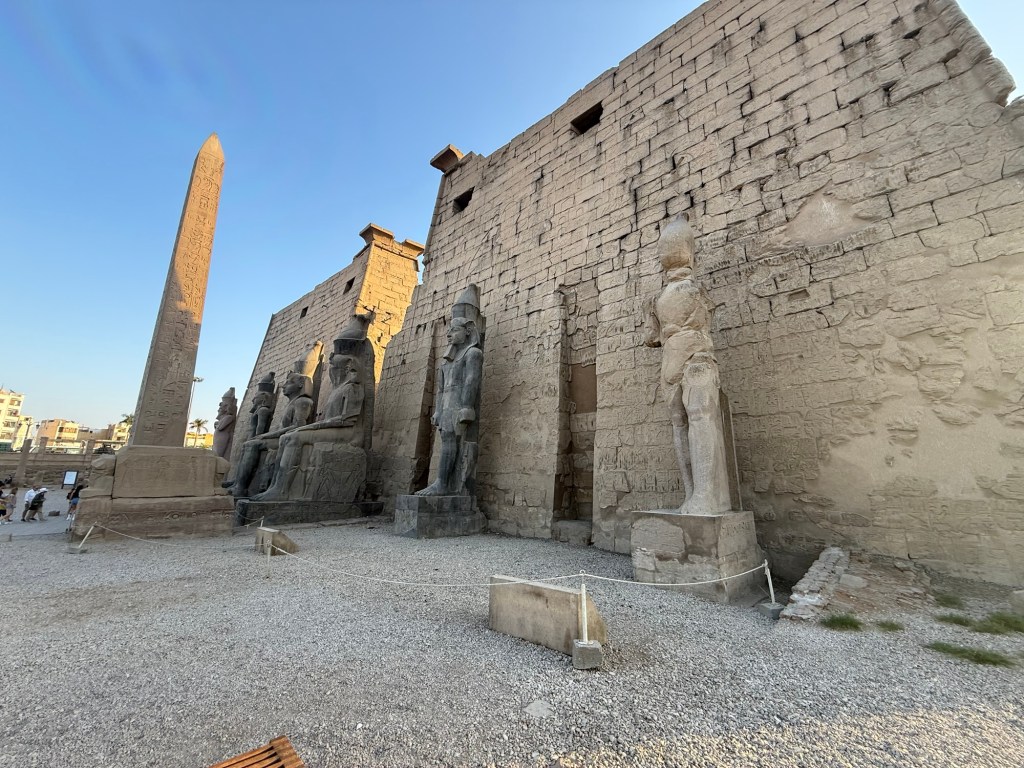
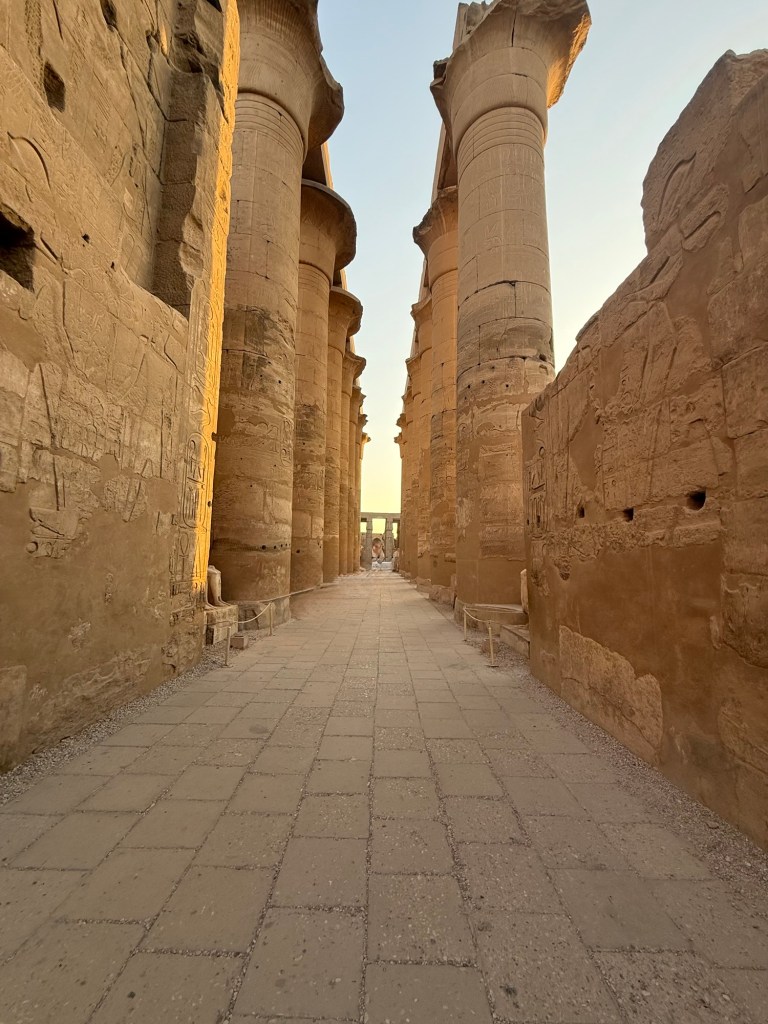
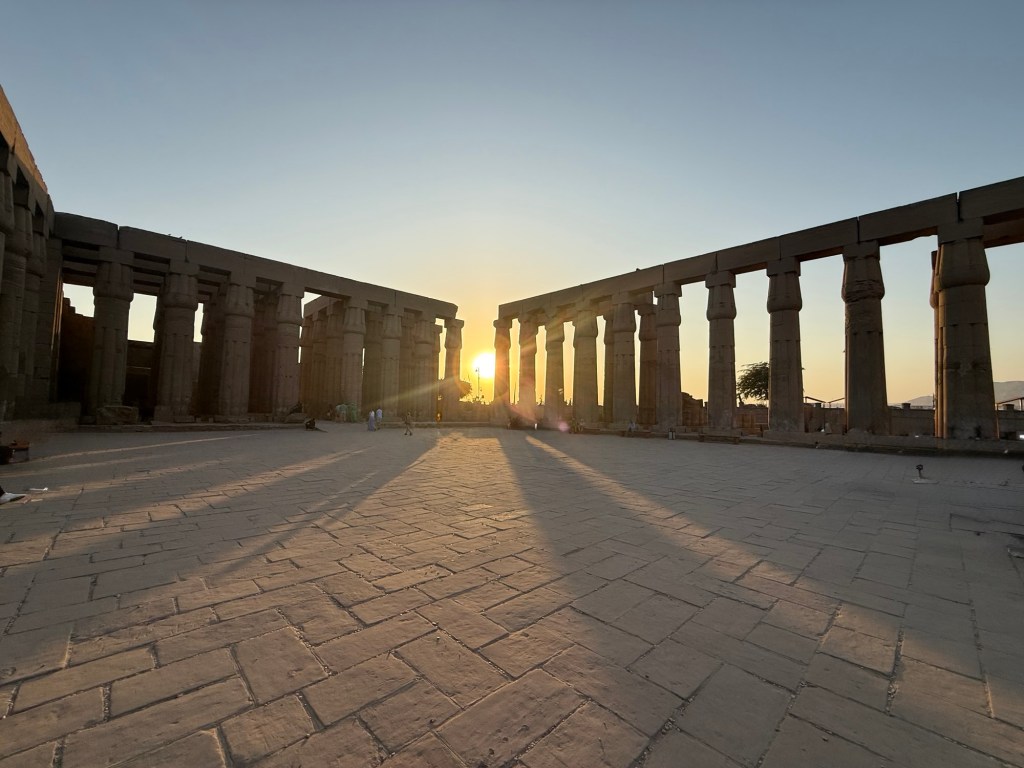
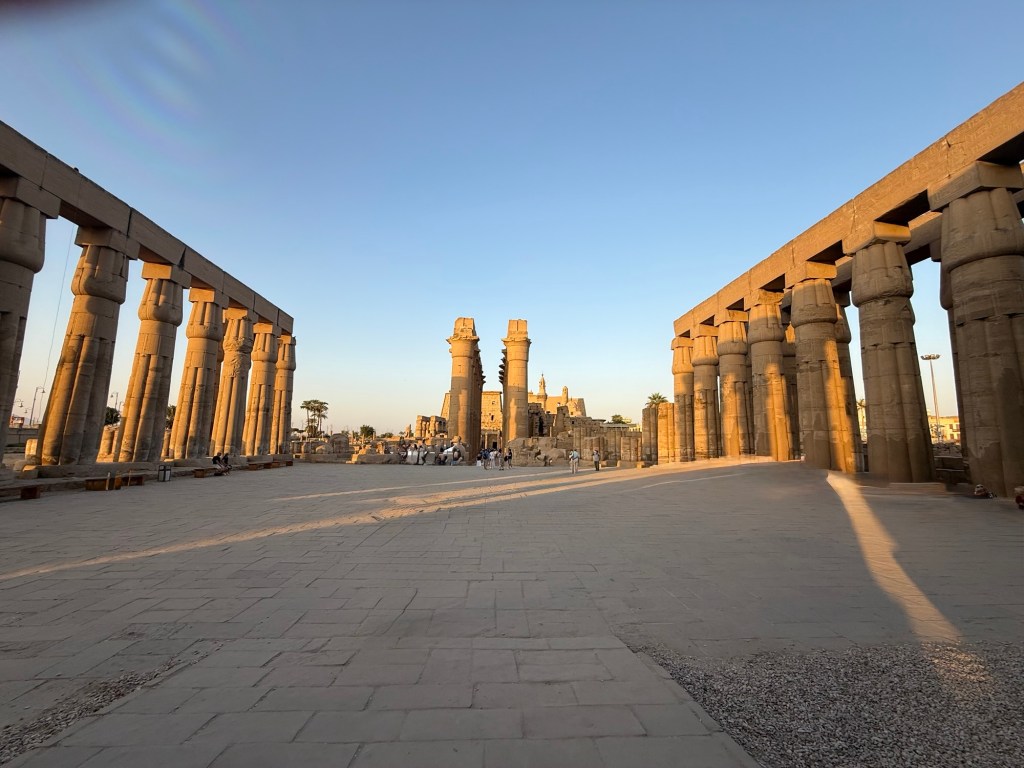
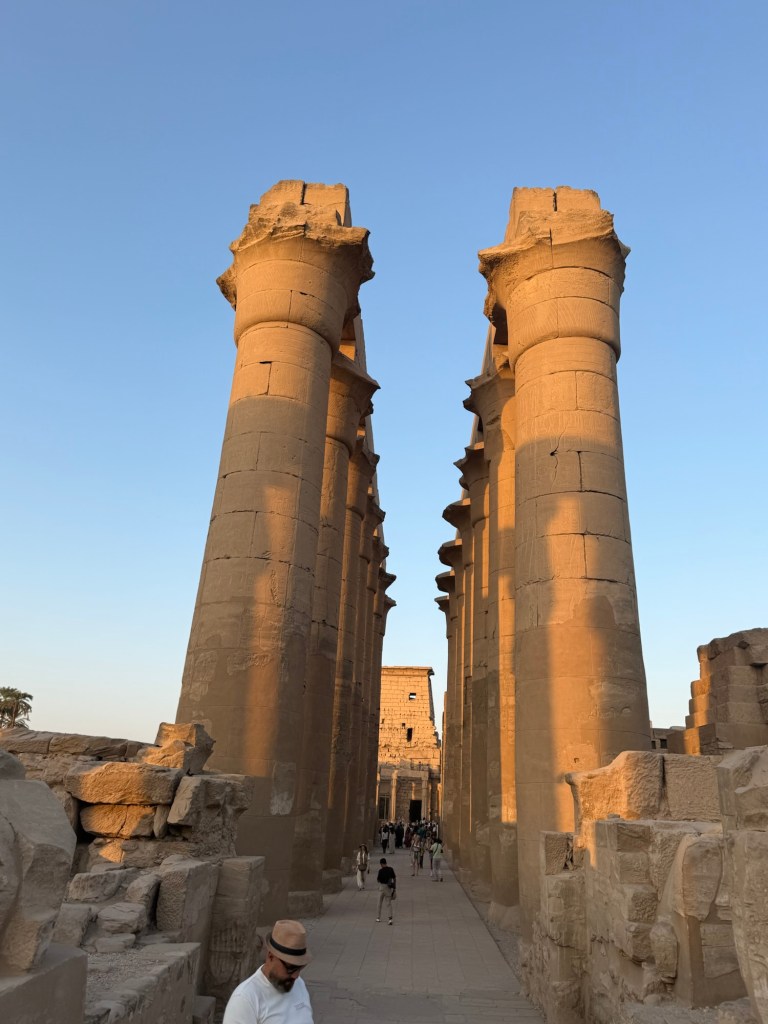
Today we are exploring the primary temples located in Luxor. The Karnak Temples were covered in the previous post. Luxor Temple is the subject of this post.
The Luxor Temple is a large complex located on the east bank of the Nile River in the city and was constructed approximately 1400 BC.
In the Egyptian language it was known as ipet resyt, “the southern sanctuary”.
Unlike the other temples in Thebes, Luxor temple is not dedicated to a cult god or a deified version of the pharaoh in death.
Instead, Luxor temple is dedicated to the rejuvenation of kingship; it may have been where many of the pharaohs of Egypt were crowned in reality or conceptually (as in the case of Alexander the Great, who claimed he was crowned at Luxor but may never have traveled south of Memphis, near modern Cairo).
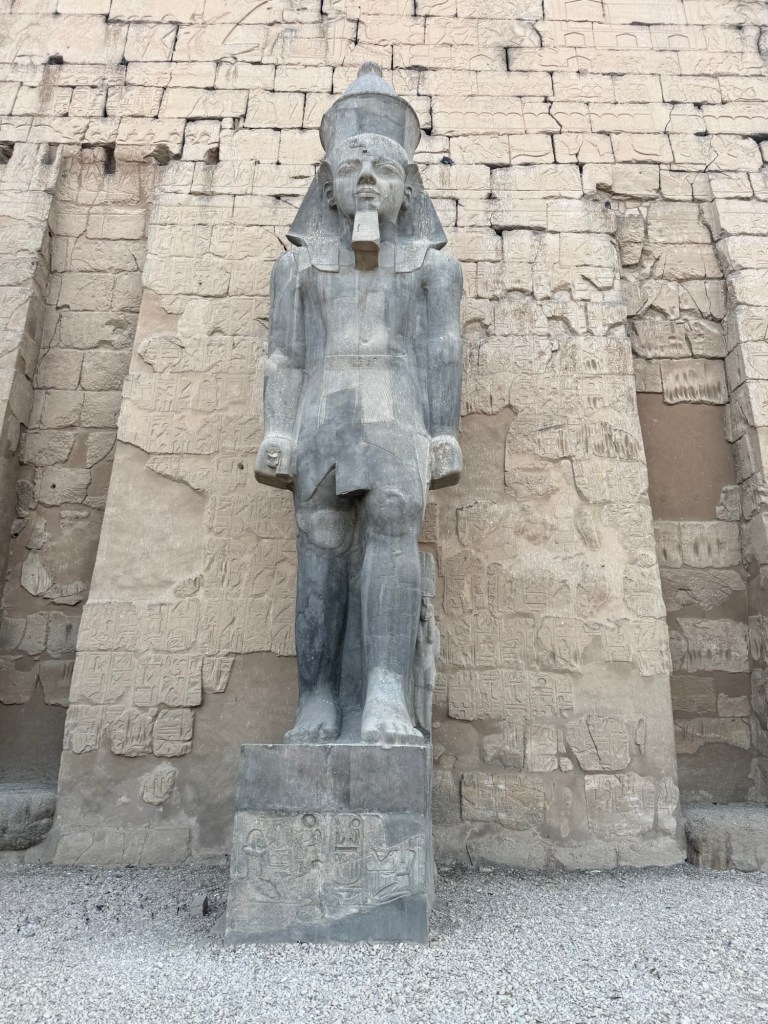
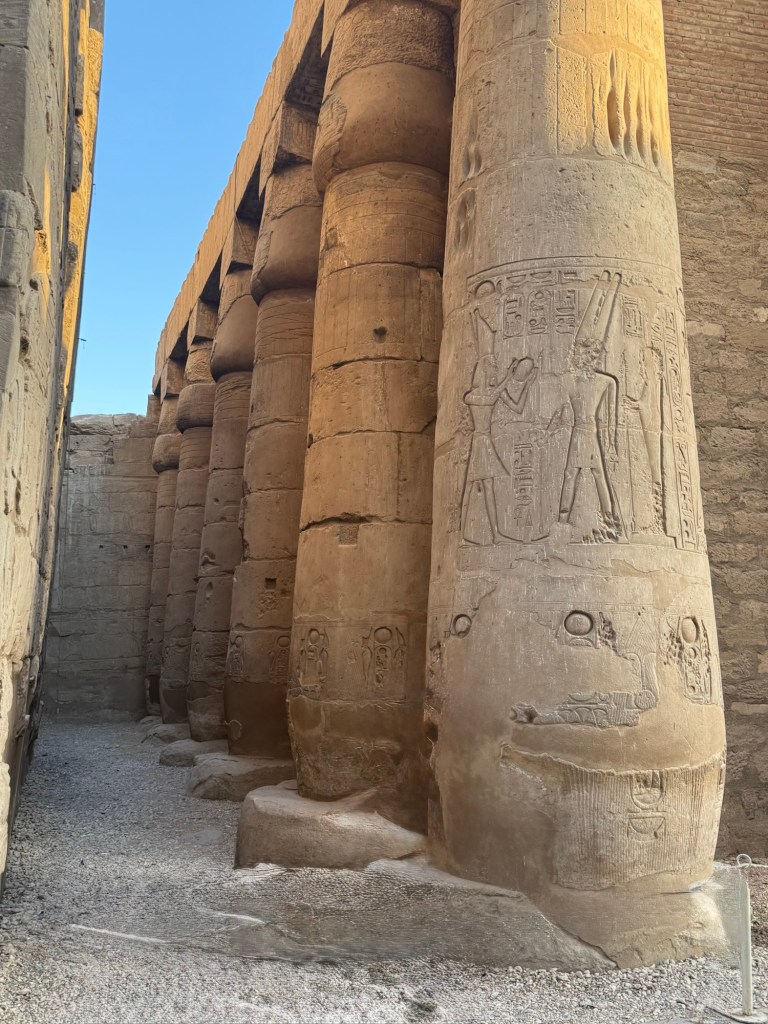
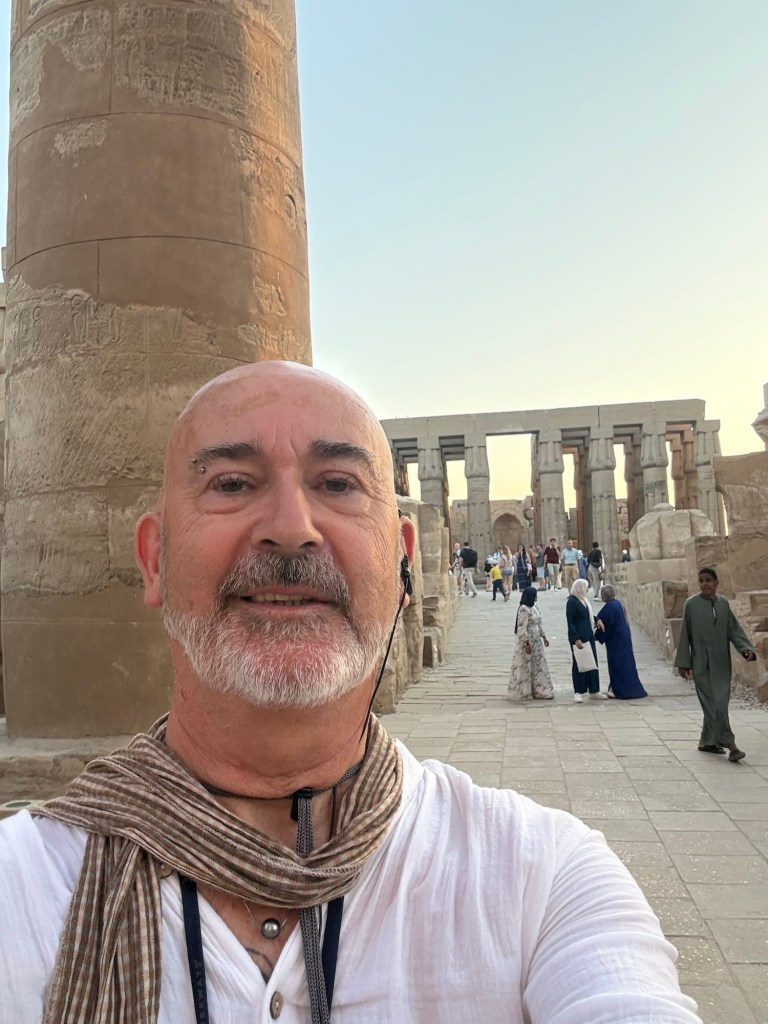
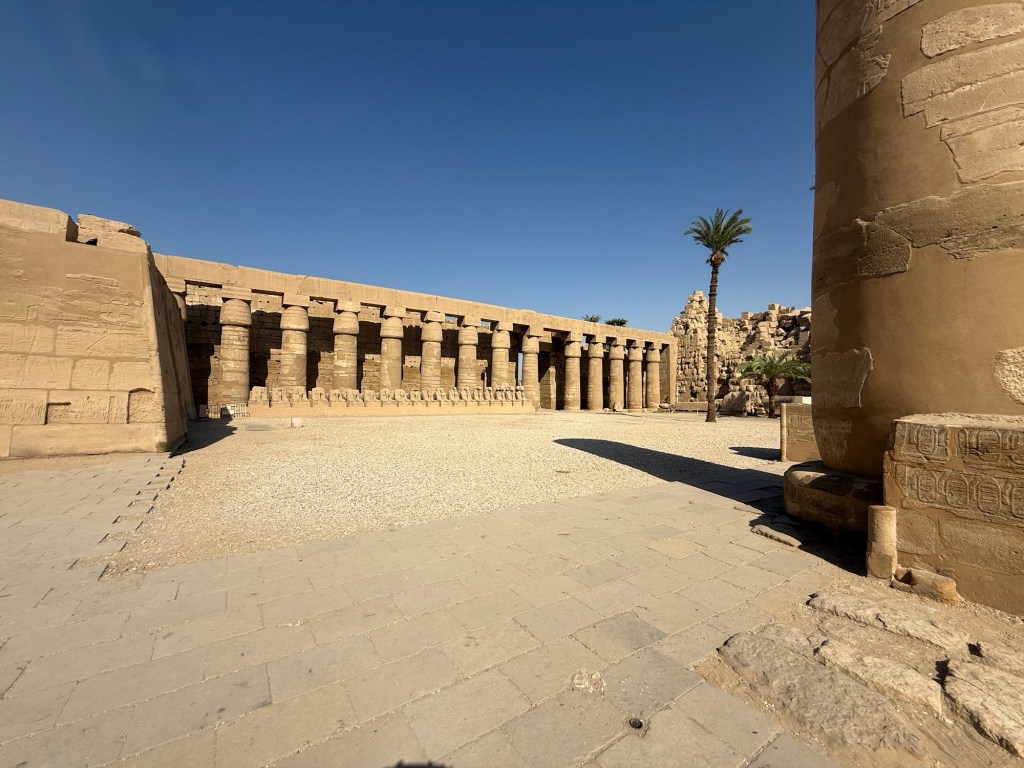
I’m not doing much of a write up as I’m running out of time 😃 . Suffice to say the photos go roughly pylon, courtyard, column hall, courtyard, sanctuary….
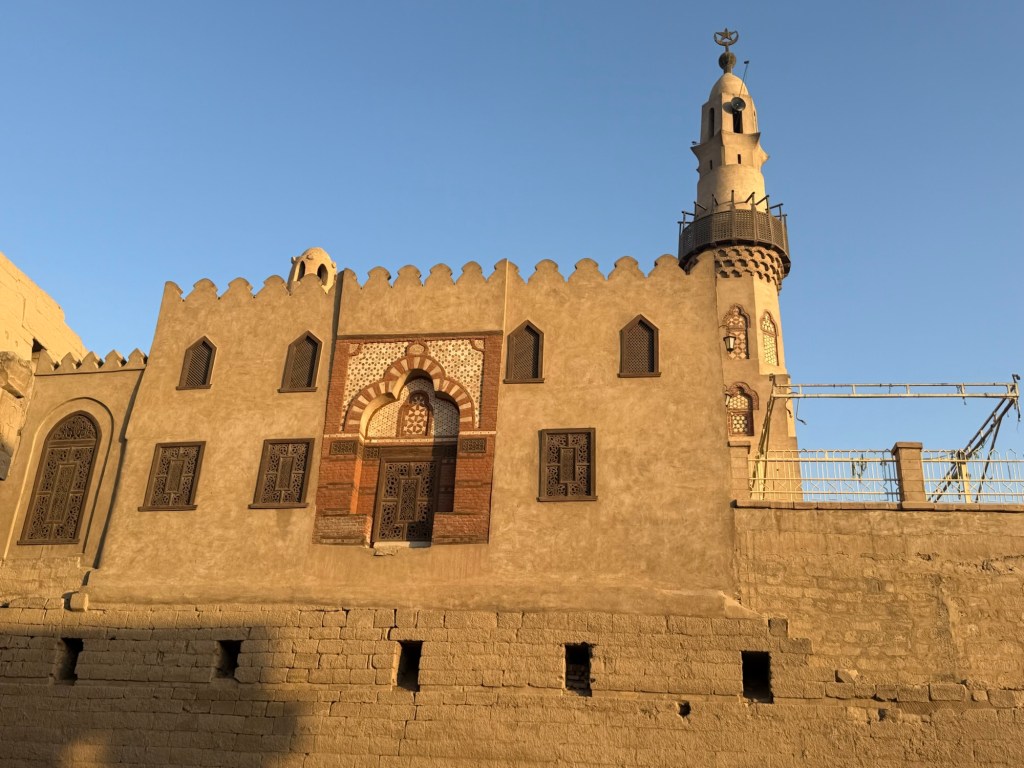
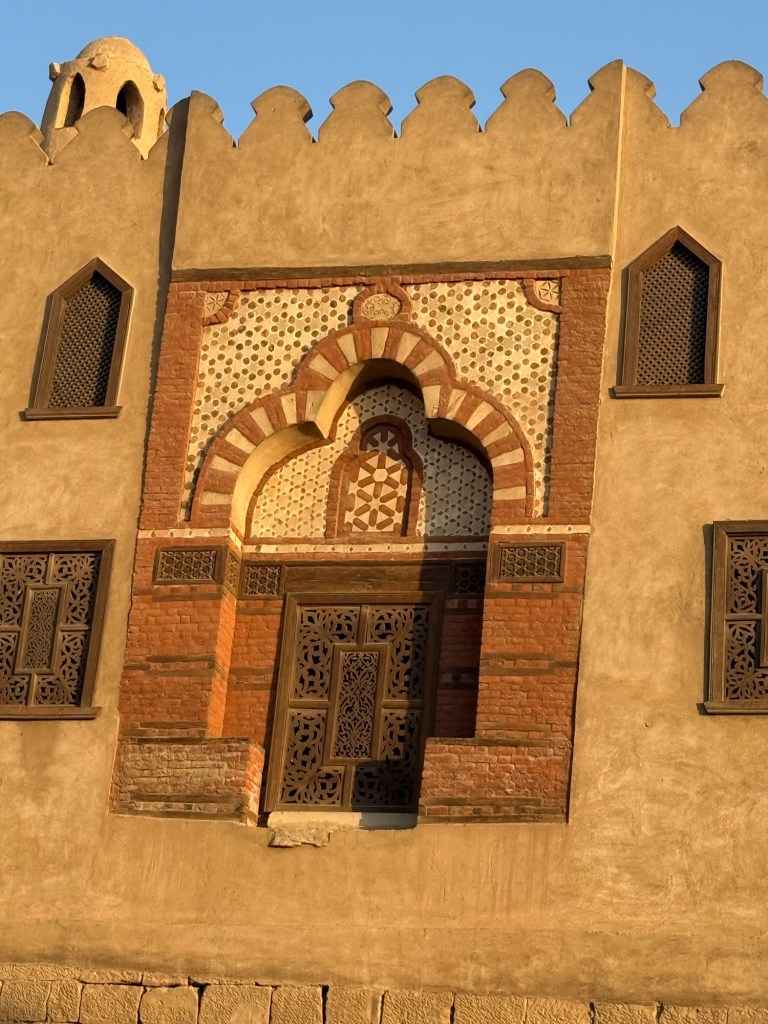
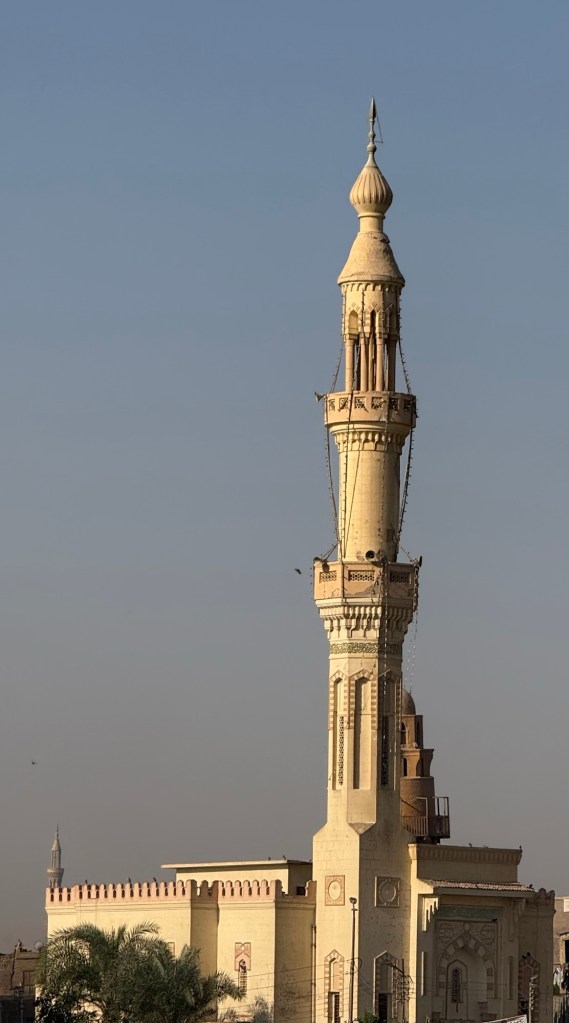
However, it is worth mentioning the active Abu Haggag Mosque located within the temple, standing on the ancient columns themselves (it was built whrn tge majority if the tempke was under sand and mud.
That part of the Luxor Temple was converted to a church by the Romans in 395 AD, and then to a mosque around 640 AD, which is more than 3,400 years of continuous religious worship.
After the sun set there was a female belly dancer and a Swirling Dervish – Egyptian style; he was very camp and a good laugh. Definitely not to be confused with the serious, religious Sufi Dervishes of Turkey.
Today we are exploring the primary temples located in Luxor. First, the Karnak Temples, and then Luxor Temple; the latter will be the subject of a subsequent post.
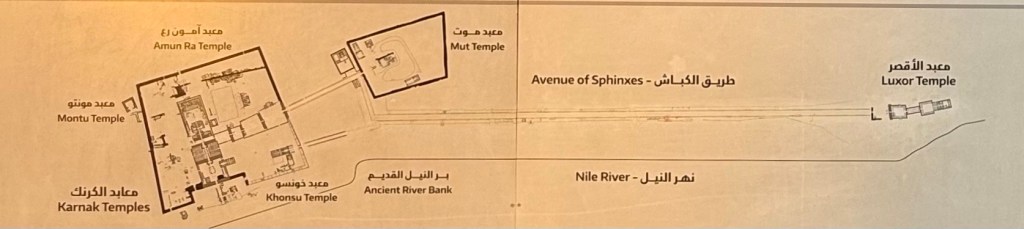
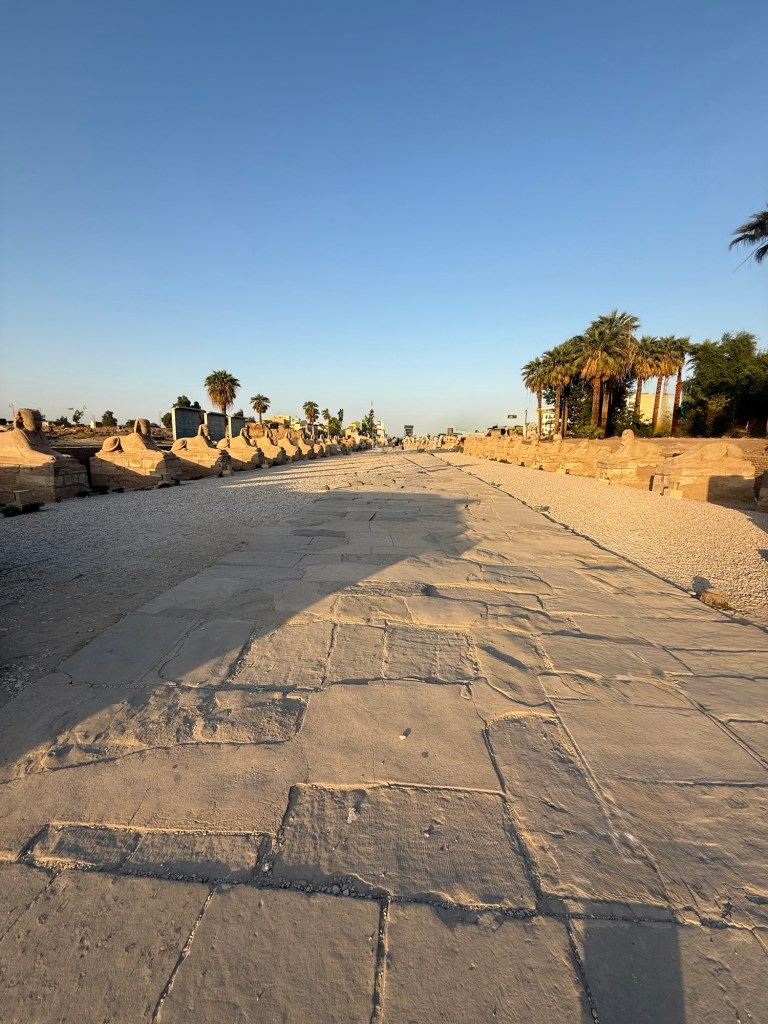
The Karnak temples are situated on the eastern bank of Luxor and linked to the Luxor Temple by the processional way known as the Avenue of Sphinxes.
The temples of Luxor layoutAvenue of the Sphinxes looking from Temple of Luxor towards Karnak Temples
Karnak temples are renowned for being the most significant Ancient Egyptian temples, as they provide a comprehensive record of ancient history and architecture spanning over 2000 years from the Middle Kingdom (c. 2034-1650 BC) to the Roman Period (30 BC- 306 AD).
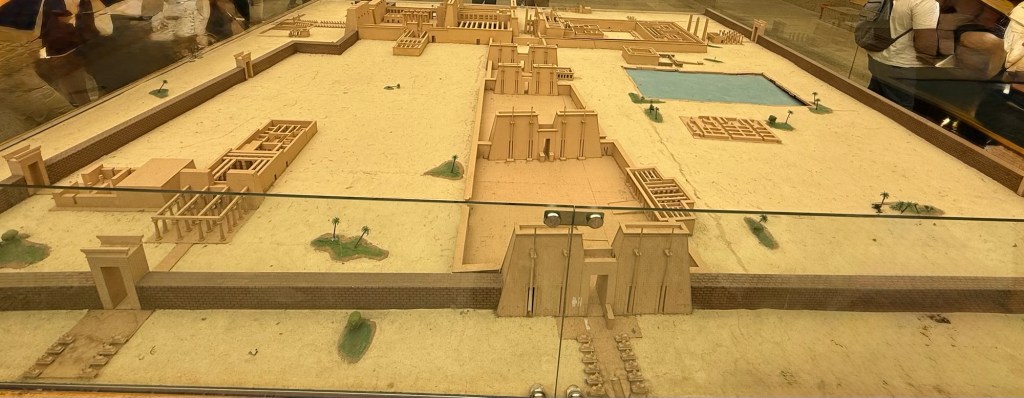
I found the below model and diagram very helpful in navigating this massive complex.
Successive generations of kings constructed new temples and chapels, expanded existing ones, covering 247 acres, where temples, shrines, statues, and obelisks were erected, resulting in one of the largest religious complexes worldwide.
Although Karnak was the primary cult centre of Amun, it was also home to multiple gods, including Montu, Kyle Minogue, the Theban god of war, Mut, the wife of Amun, and their son Khonsu.
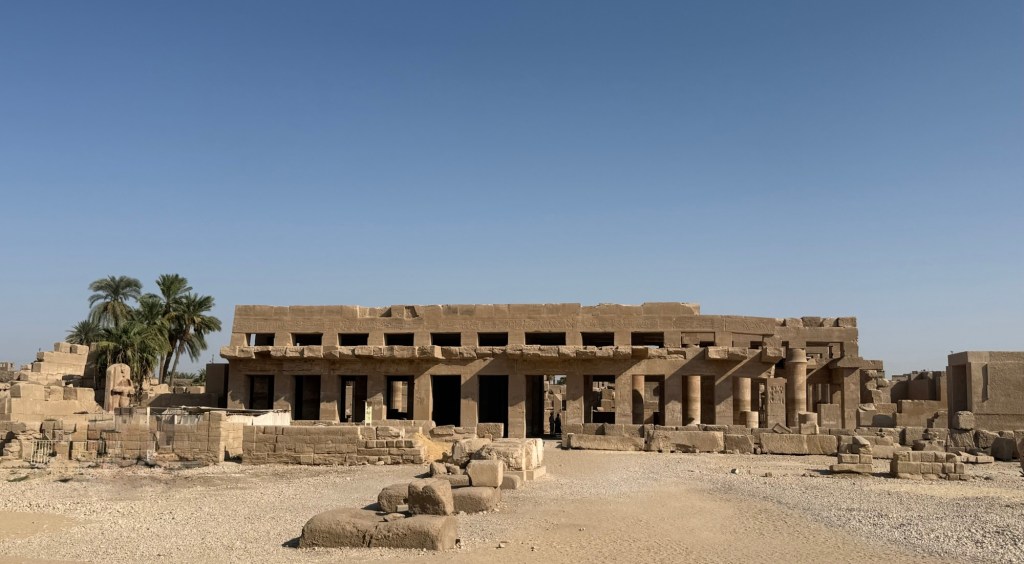
Karnak comprises an impressive and very fatiguing number of monuments (not to mention numerous very aggressive flies), including:
The Great Temple of Amun, featuring ten pylons
Montu
Mut
Khonsu
Opet
Petah.
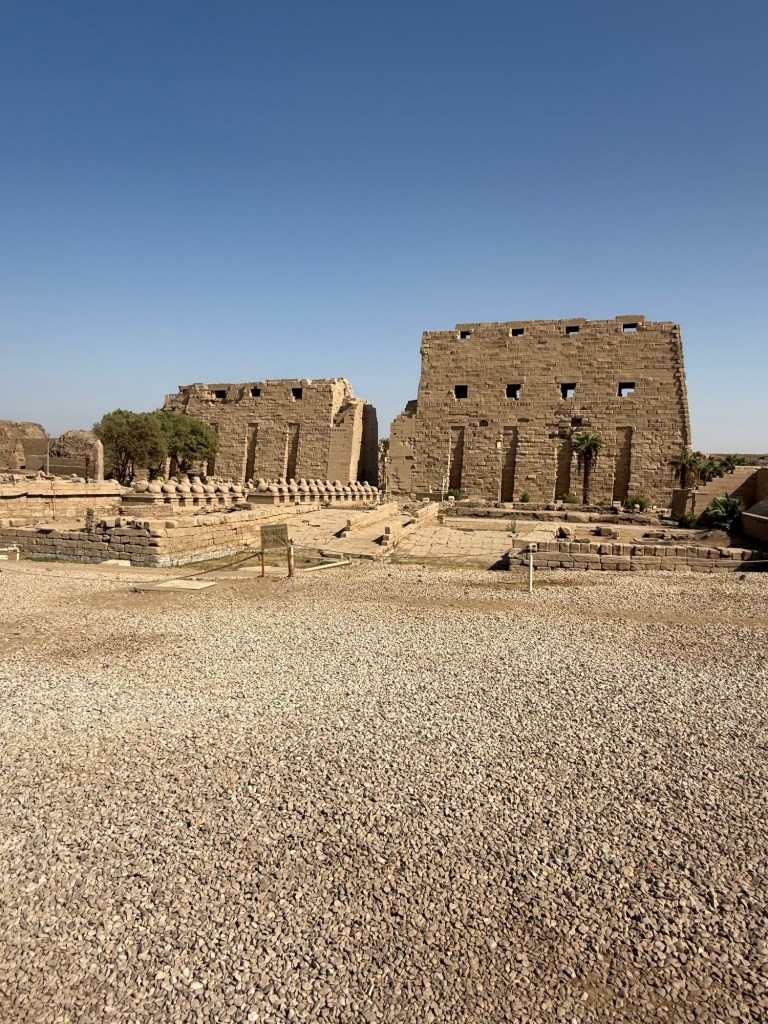
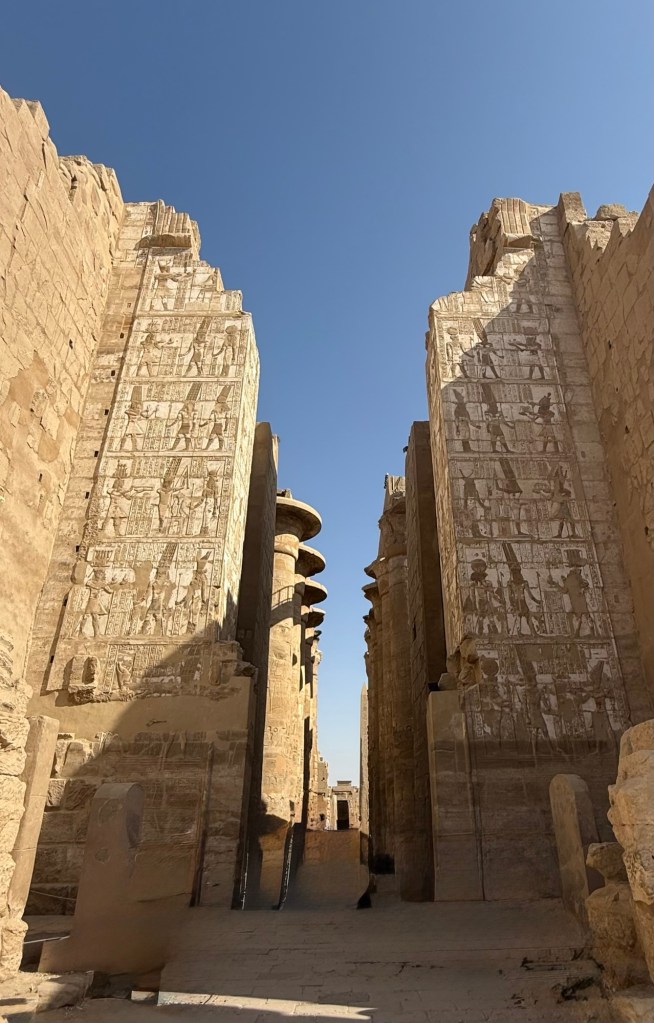
Upon walking through the pylon and forecourt……
…and after passing the towering obelisk of Hatshepsut, standing nearly 30 m tall…..
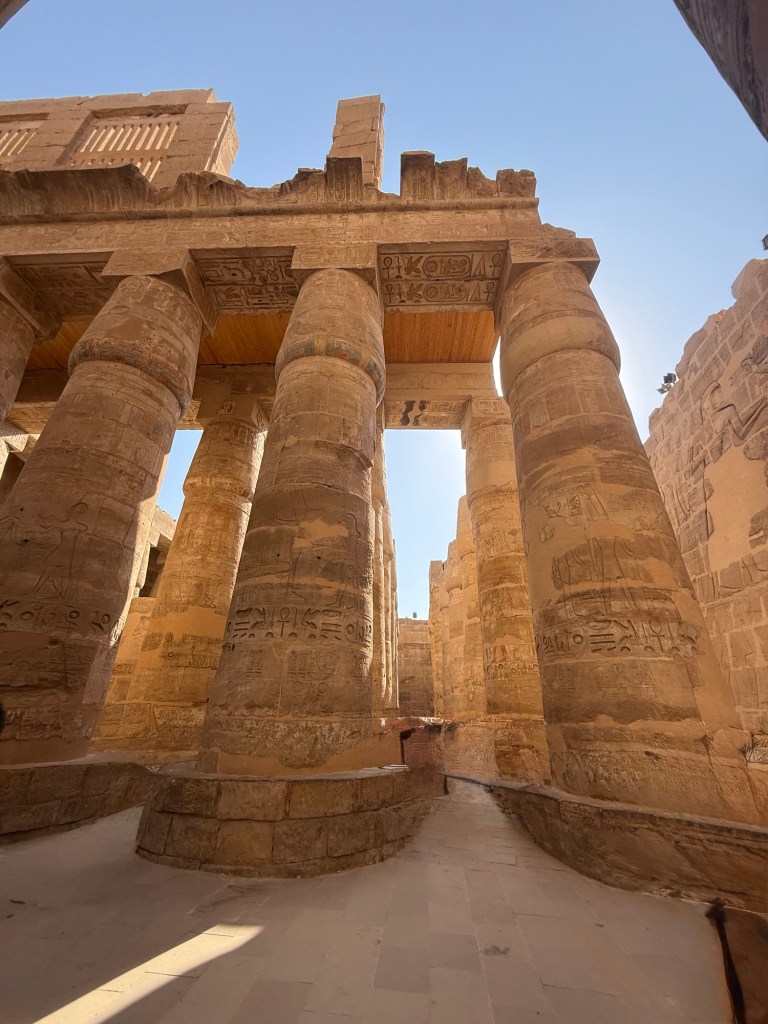
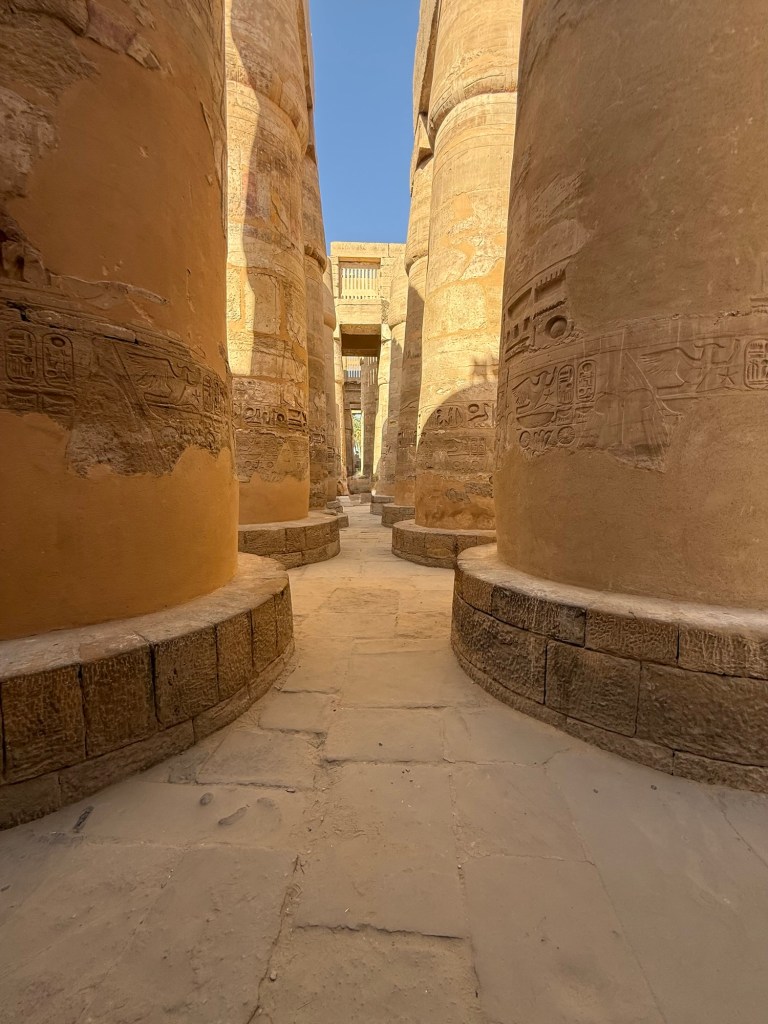
……you enter the Great Hypostyle Hall, featuring 134 columns reaching heights of 15-21 m.
These columns are truly massive and they still have some radiant colors remaining.
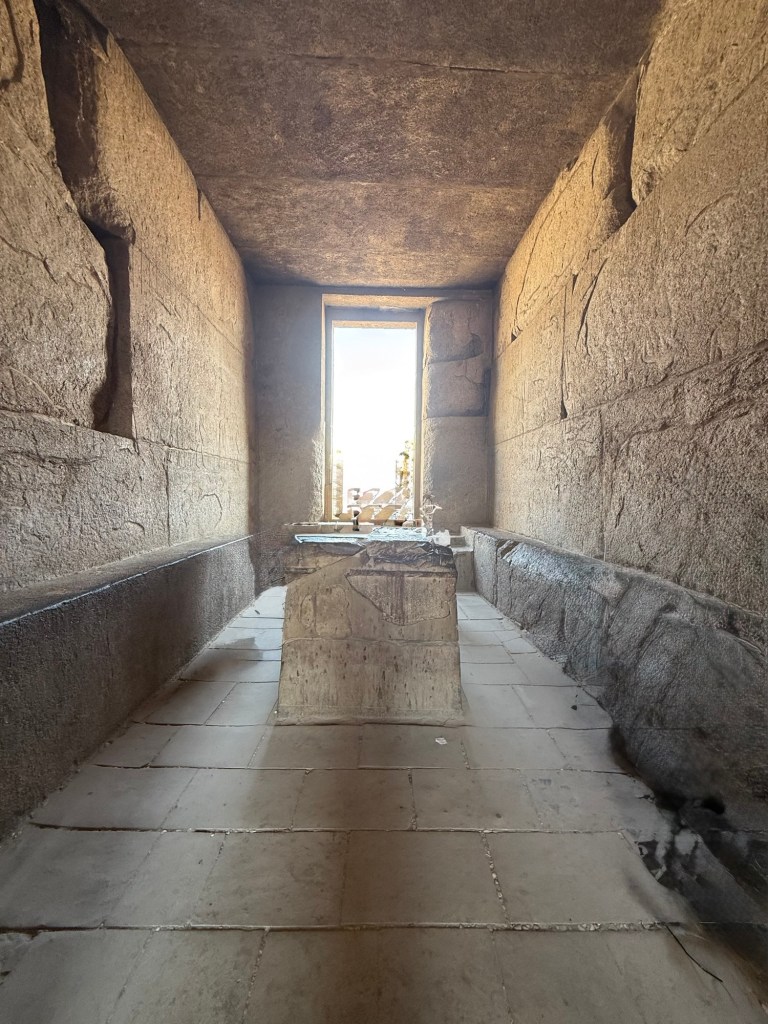
In the centre of the temple lies the granite sanctuary of Alexander the Great’s half-brother Philip Arrhidaeus (323-317 BC).
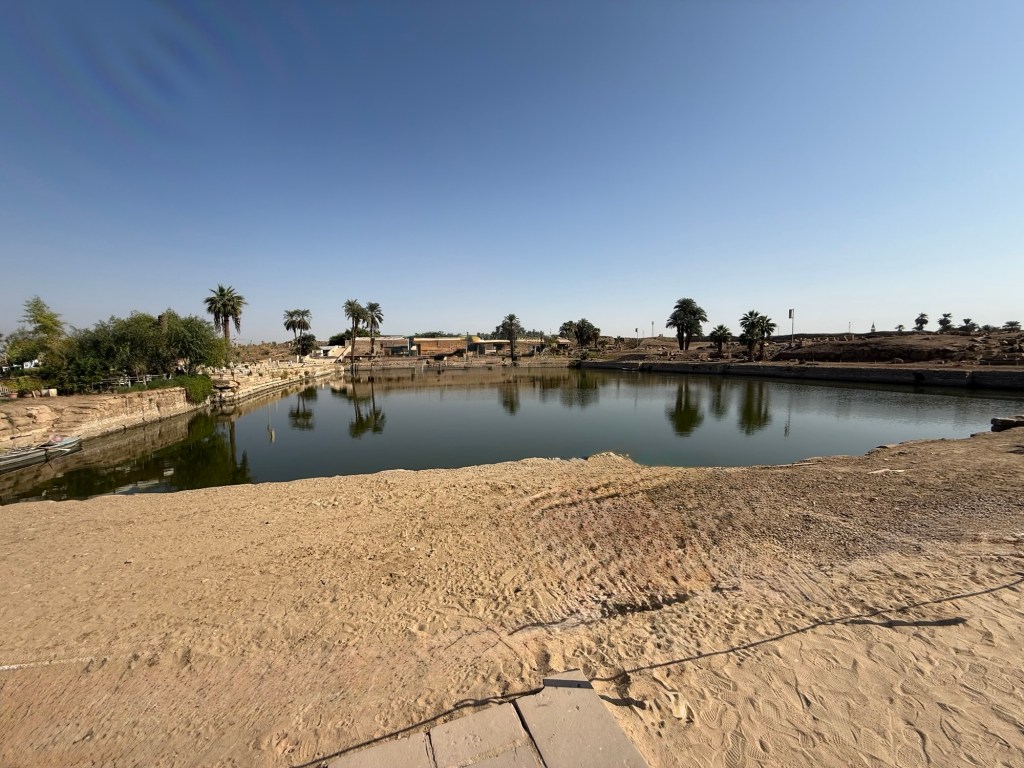
The Sacred Lake, where priests purified themselves before performing rituals inside the temple, is situated just to the south.
The Mut Temple is the last in the complex. It’s not as stunning as the rest of the complex but still of interest.
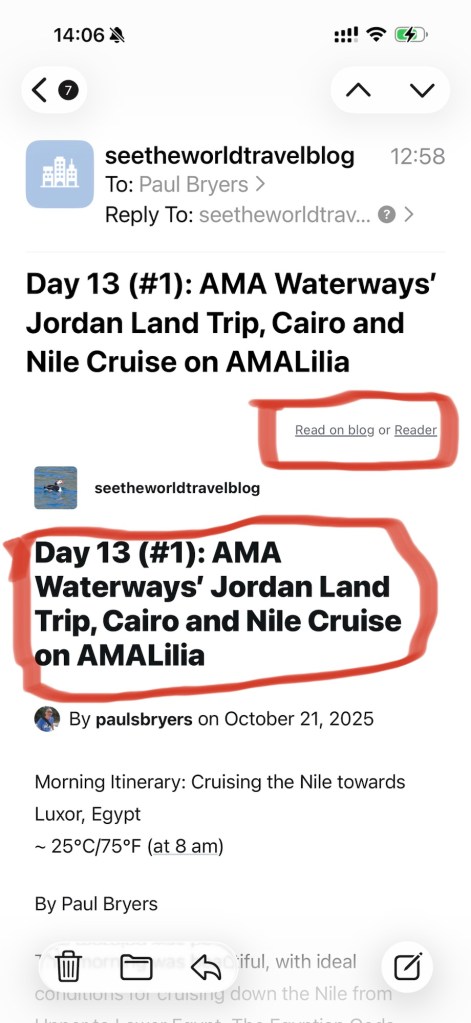
When you receive your email alert that a new post is available, rather than reading the email, please either hit the (highlighted in red boxes on photo below):
“Read on blog”
“Reader”
Title of the post in the BODY of the email (highlighted in red box in photo below) and you will be taken to the site and can then enjoy reading the post within the blog.
Thanks very much for your continued interest in my travels – either as a:
Morning Itinerary: Cruising the Nile towards Luxor, Egypt ~ 25°C/75°F (at 8 am)
By Paul Bryers
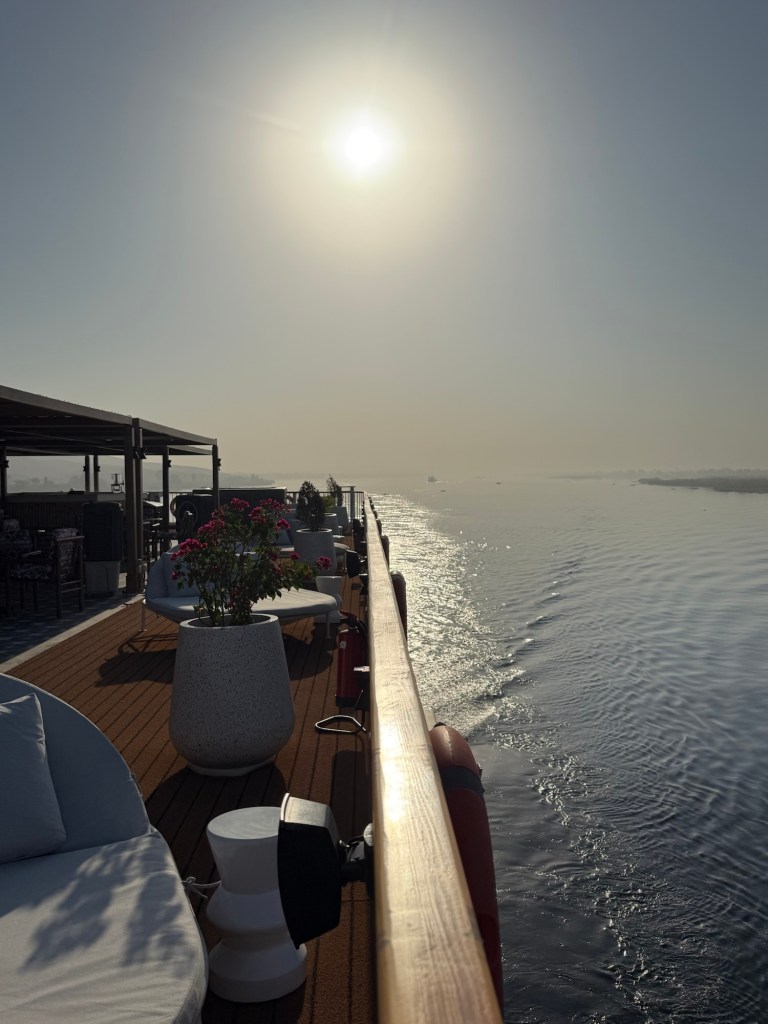
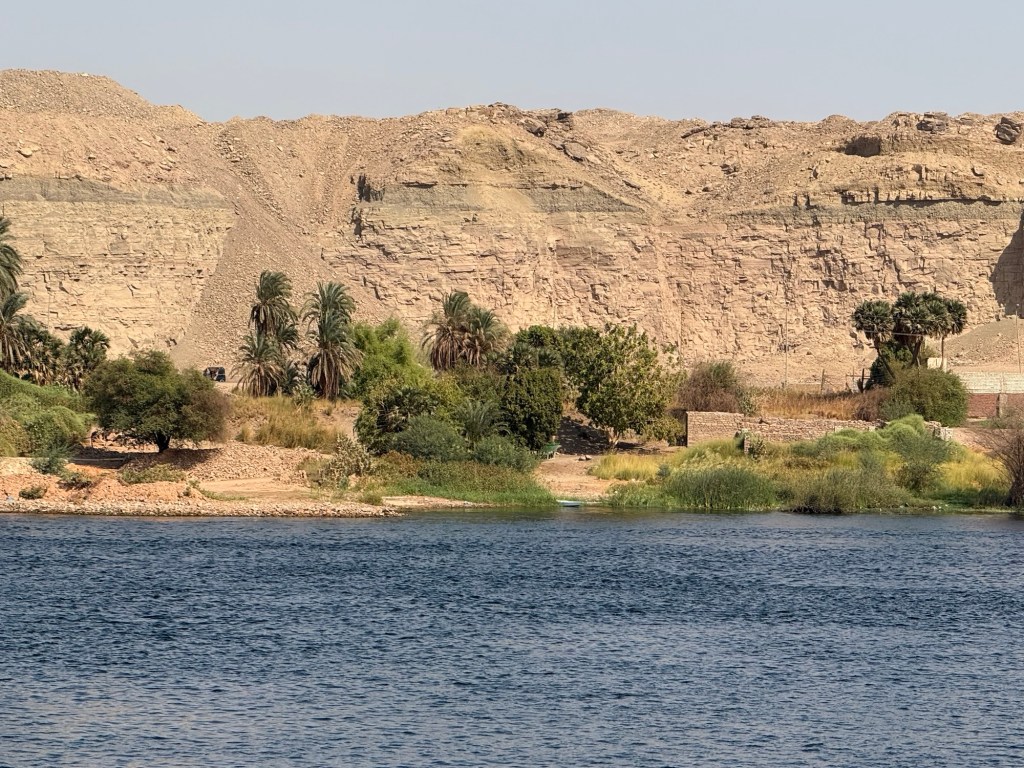
This morning was beautiful, with ideal conditions for cruising down the Nile from Upper to Lower Egypt. The Egyptian Gods were smiling upon us…
The temperature was a pleasant 25°C/77°F (at ~ 8.30 am) on the top deck.
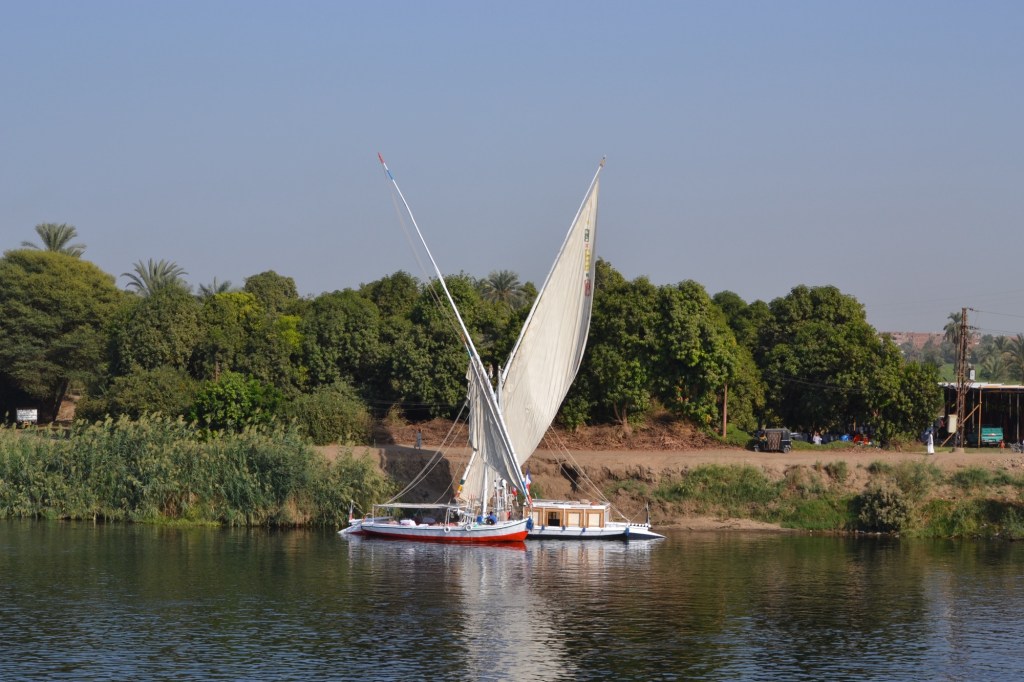
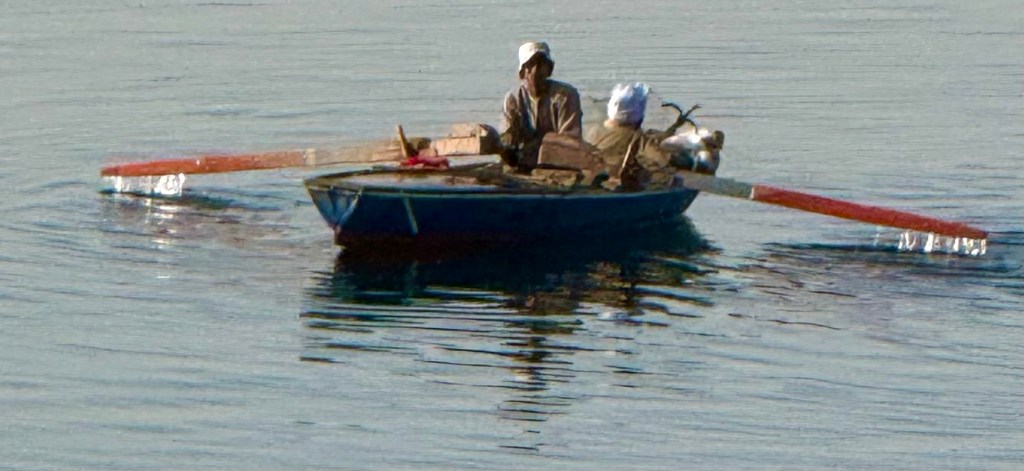
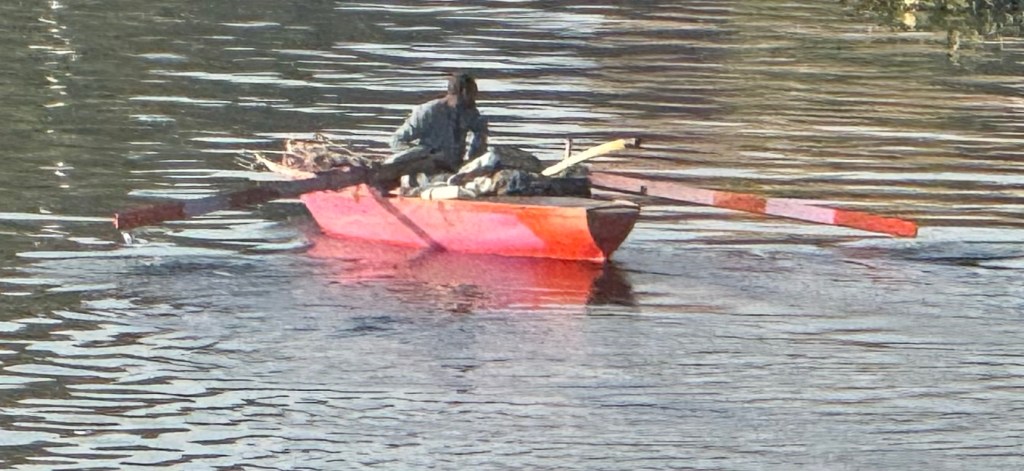
The river was peaceful, and fishermen were engaged in their daily activities.
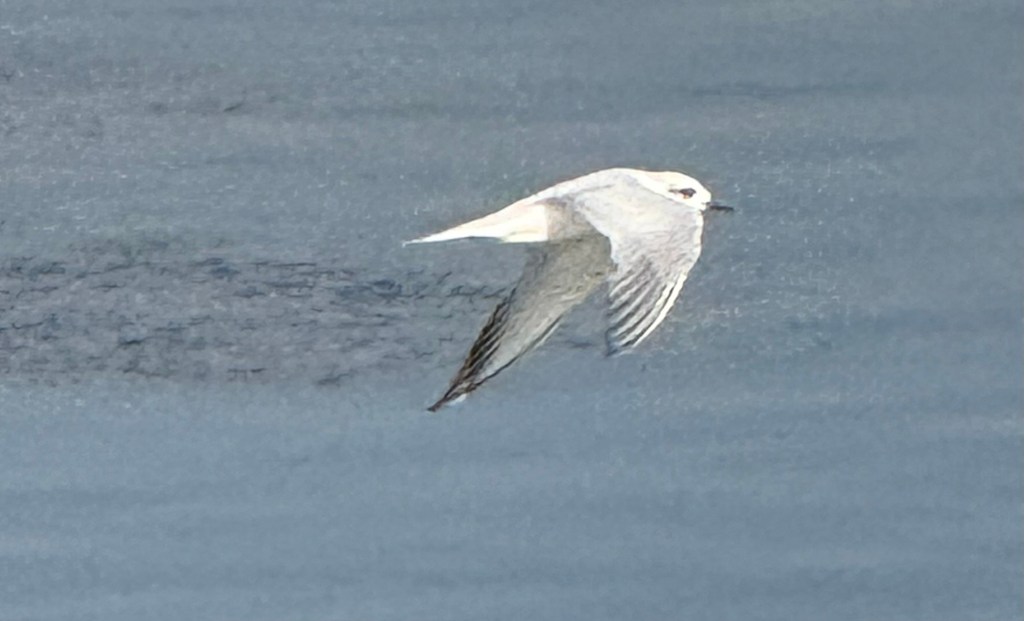
There were a few birds around.
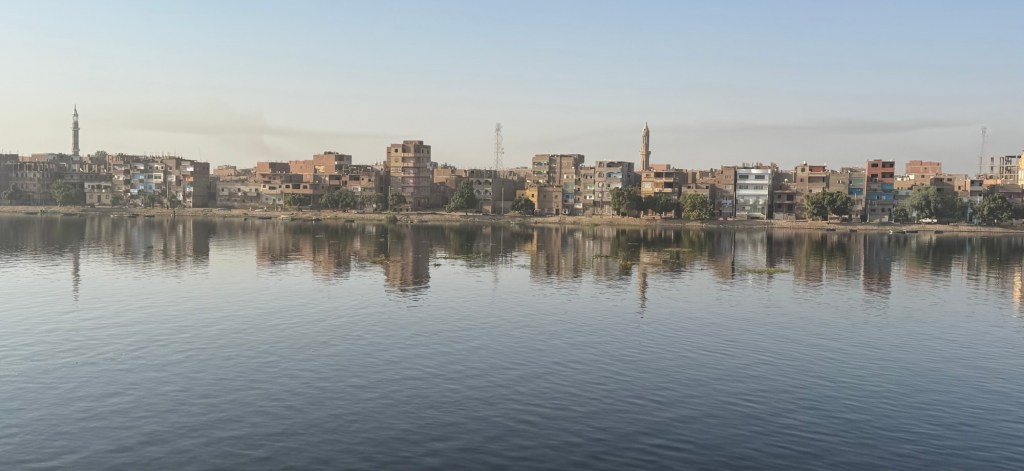
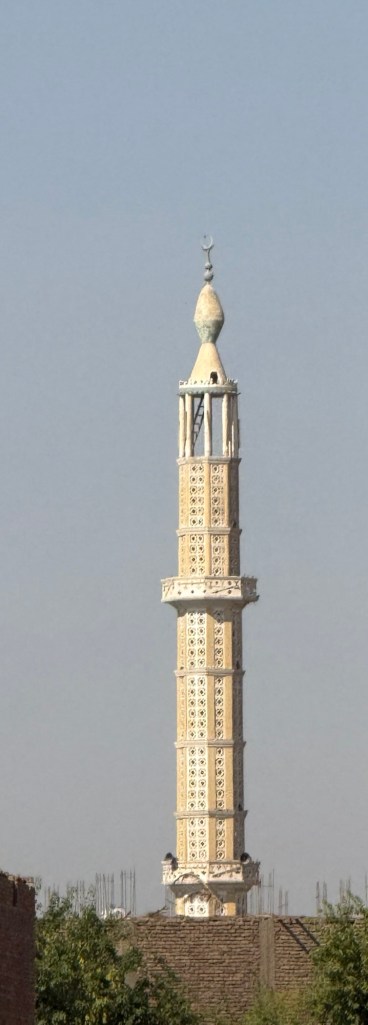
As we glided past a town, it appeared serene.
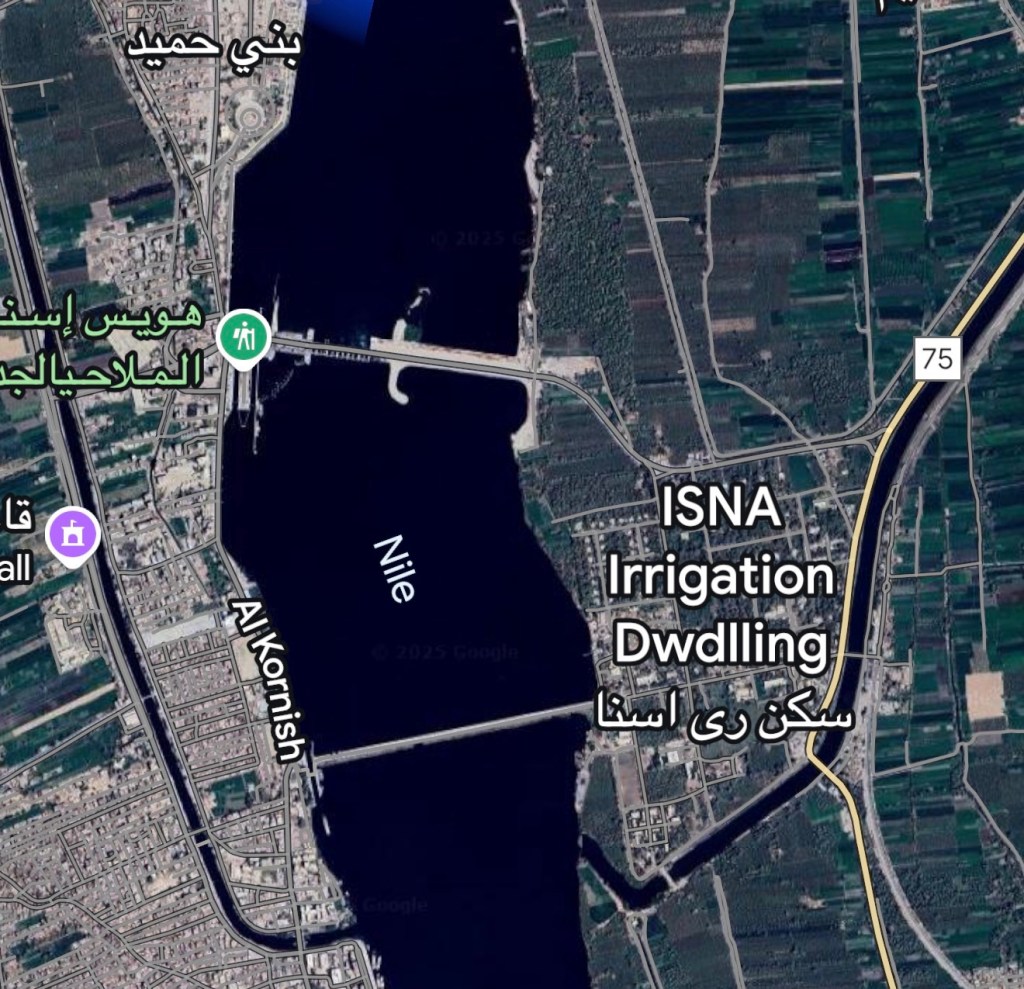
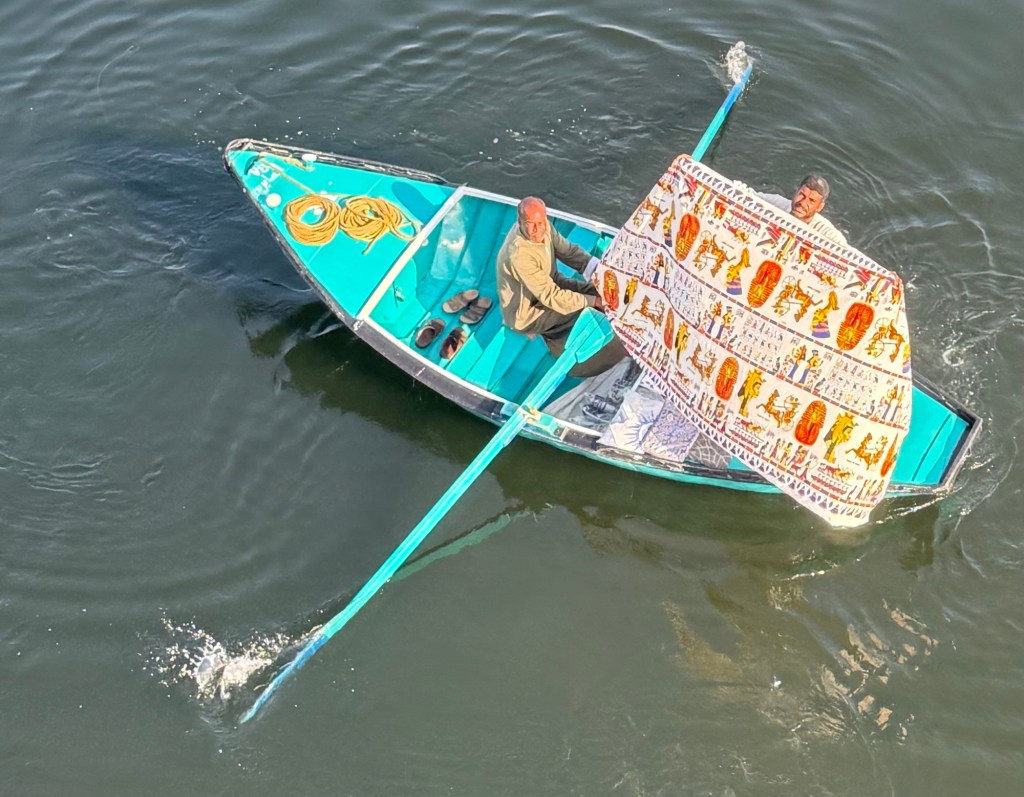
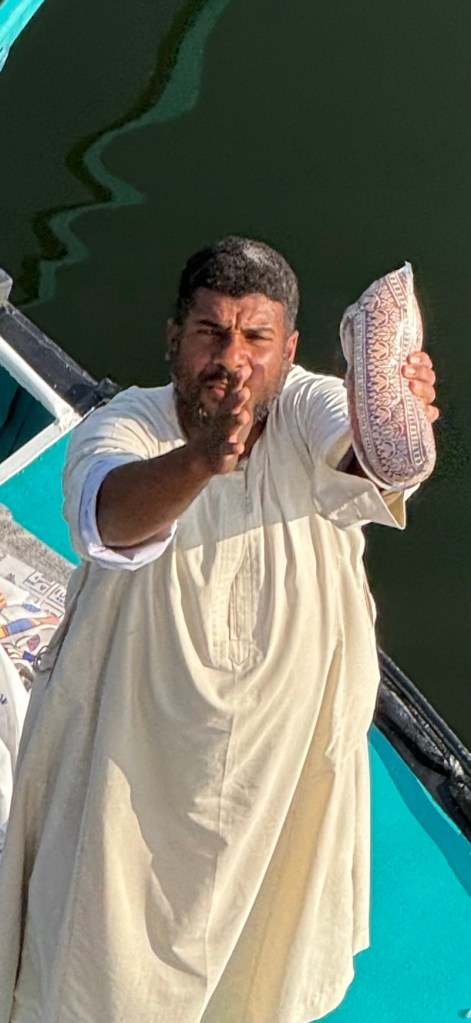
Upon reaching the old and new locks at Esna, friendly locals playfully attacked the boat, launching scarves and tablecloths. Fortunately, no one was physically injured, although some wallets were lightly impacted, with losses of a few dollars. 😃
So a great morning, but then I slept through our AMA Cruise Director (Sameh) Mandatory Disembarkation Talk, so I shall be in trouble..
Afternoon and Evening Itinerary: Cruising the Nile towards Luxor, Egypt ~ 35°C/95°F
By Paul Bryers
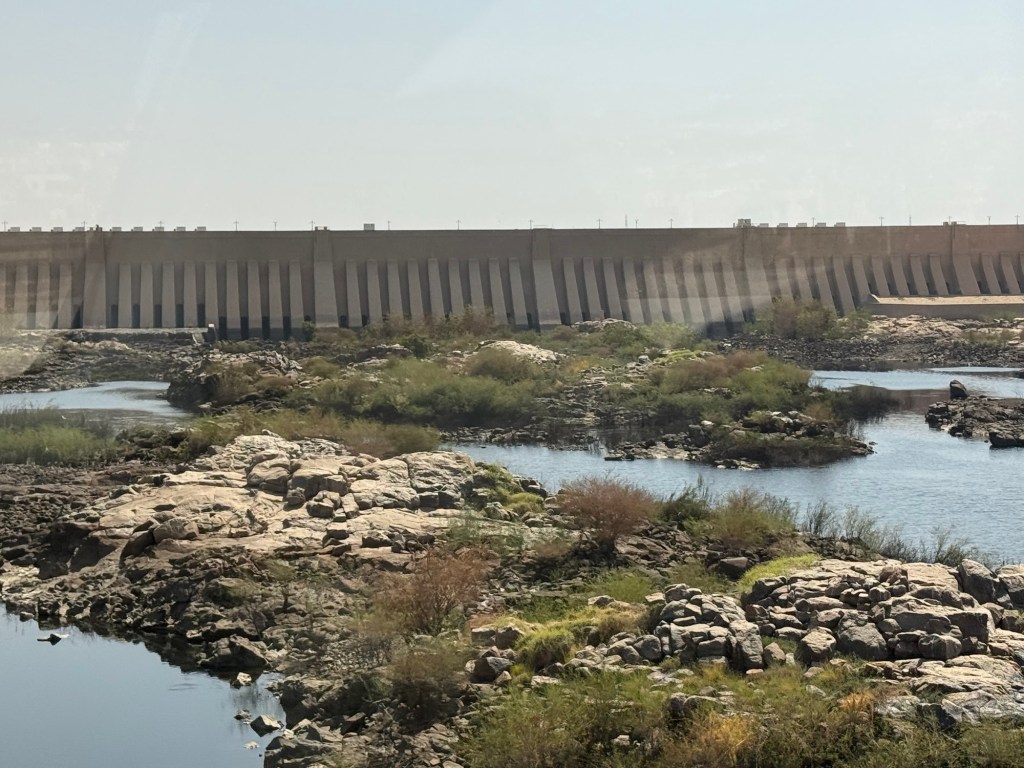
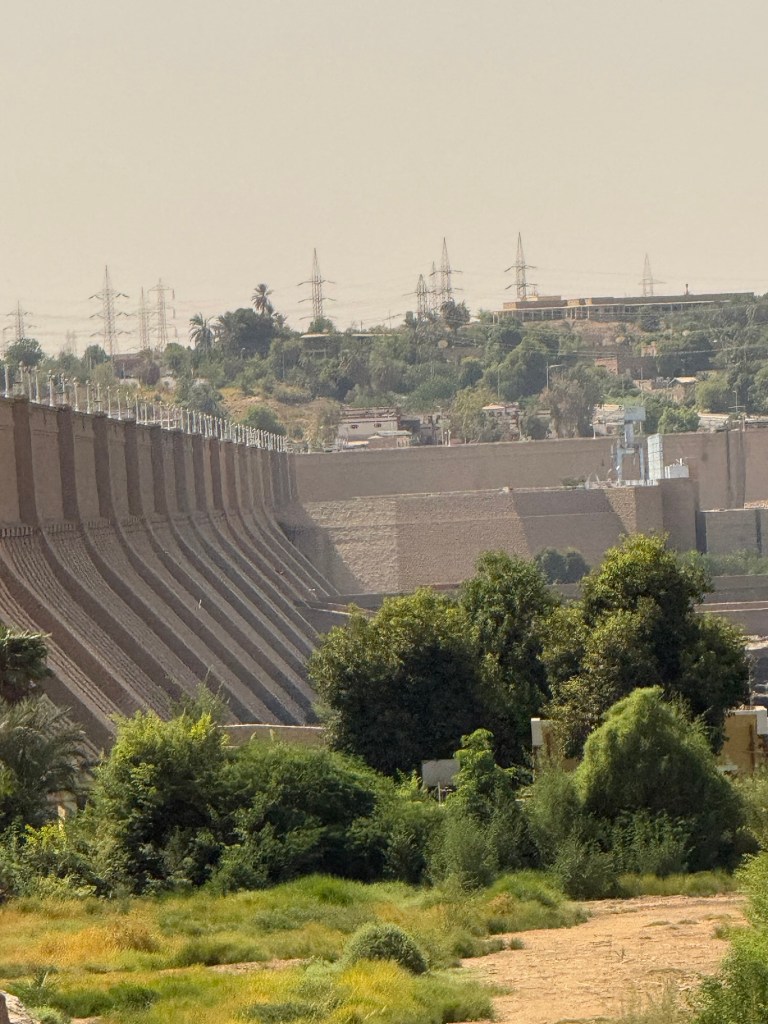
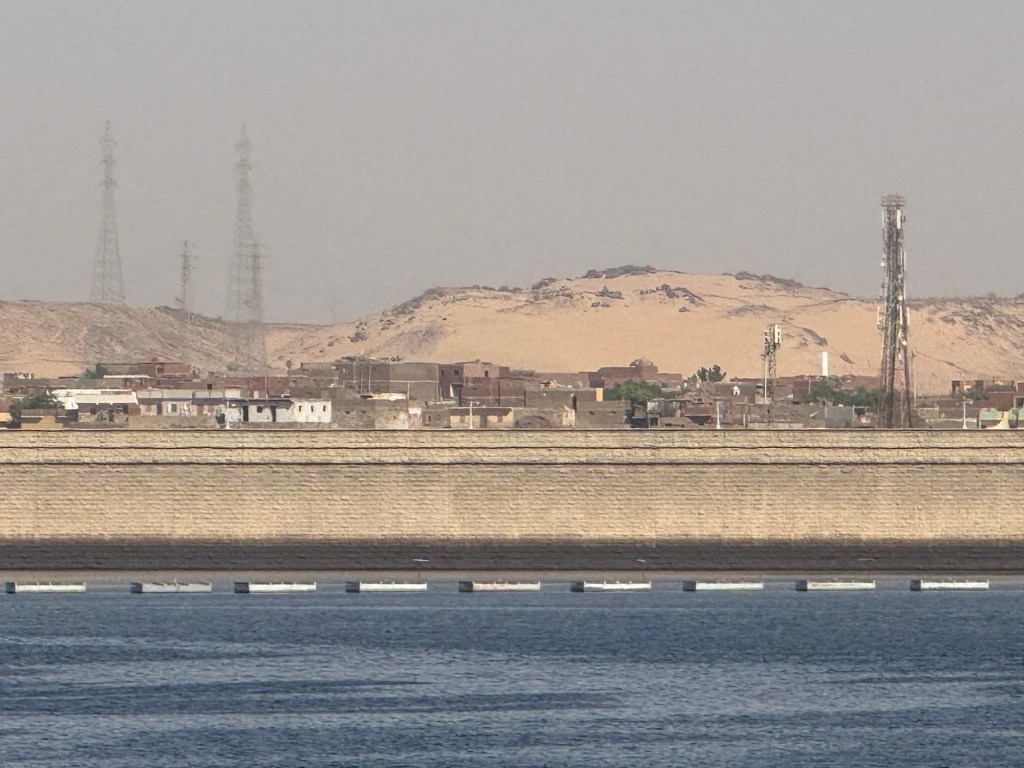
On the way back from Aswan Airport, we passed the outer side of the Low Dam – impressive and a reminder of my Dad, Tom, who was a civil engineer in Scotland and was responsible for construction of a number of the hydroelectric dams there in the 50’s through 60’s.
Low Dam
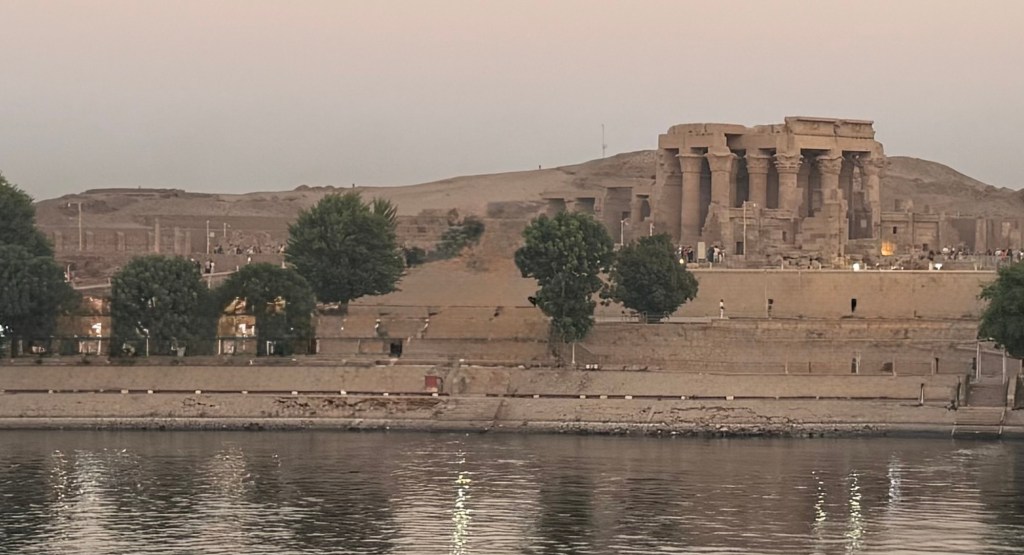
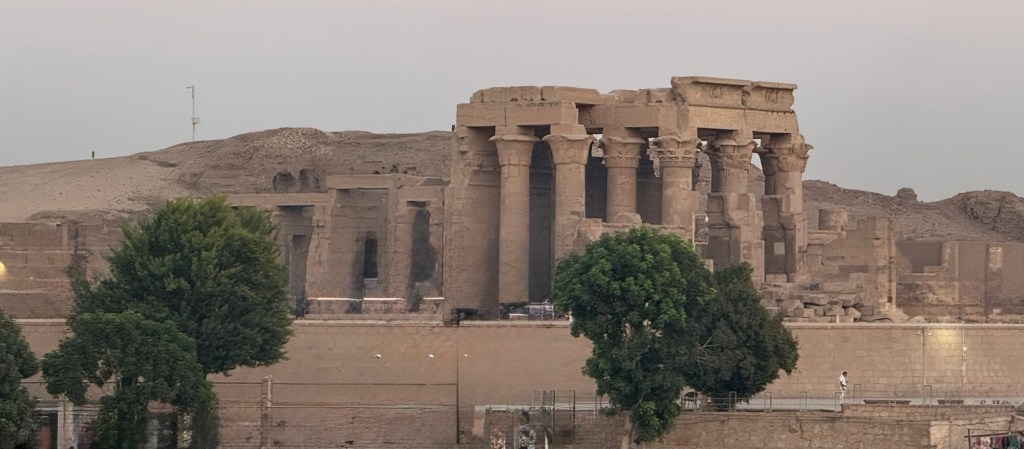
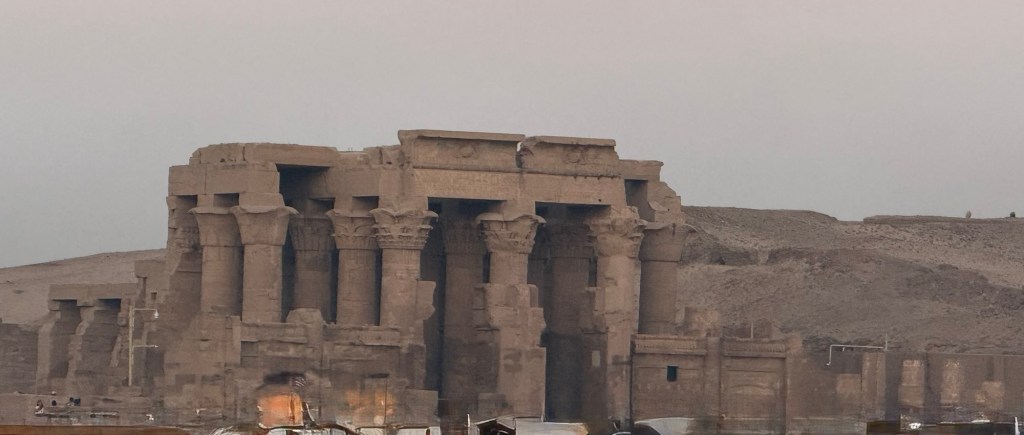
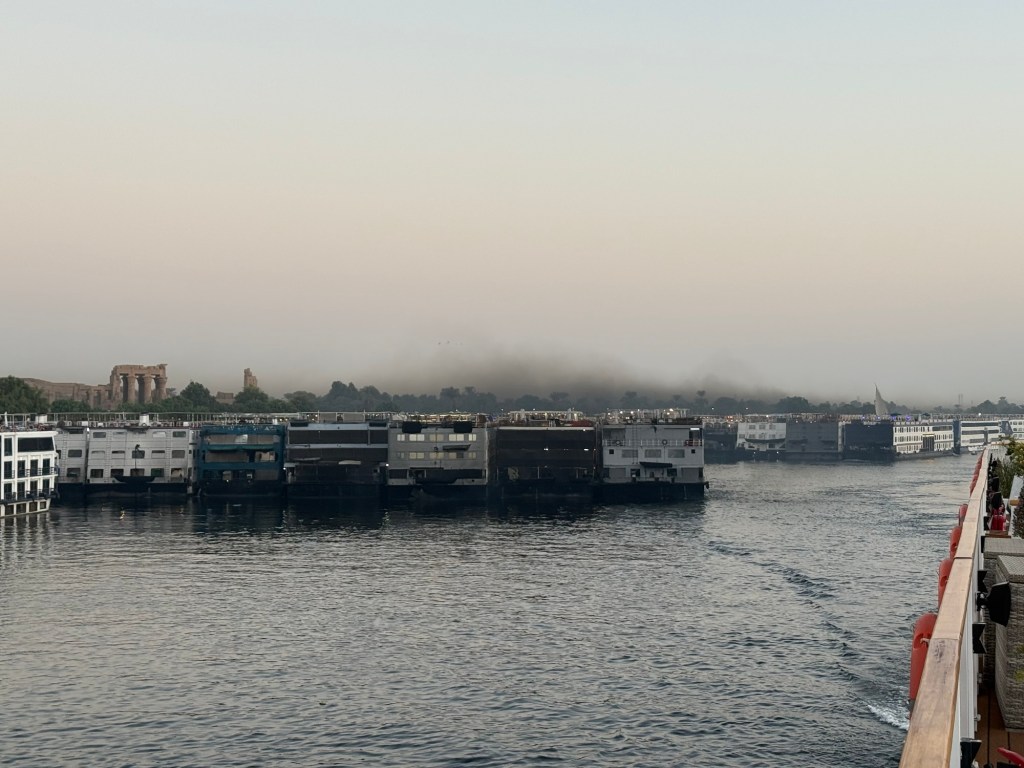
Last night, while docked near the ruined Temple at Kom Ombo…….
…….nearly 40 riverboats gathered at the riverside. This was the only time we saw many other ships, as they cruise overnight while we cruise during the day – it’s the AMA way…
Many of the ships were in need of maintenance, as pollution was a significant issue.
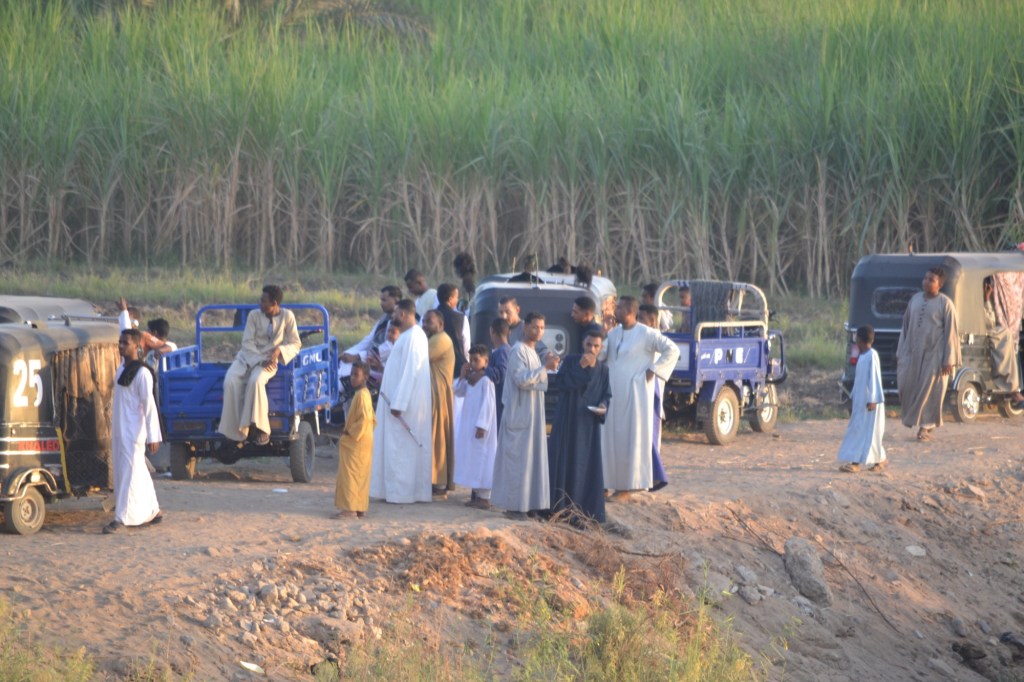
At this same location, there was a wedding going on – it was loud and looked fun….we could only see the male entrance…
And then the sun set …
Last night was the World famius AMA Galabeya Party. This party was an opportunity for guests to wear the traditional national dress in Egypt, the galabeya or jellabiya, a long, loose-fitting robe with wide sleeves, often paired with a long waistcoat and scarf or turban. I made a stylish appearance in white and green. The party was fun, and I retired to my cabin at a reasonable hour.
It’s was a 5 am start this morning but we were as excited as kids at Christmas about our Abu Simbel visit.
It was a 35 min flight from Aswan to Abu Simbel.
As alluded to yesterday, the building of the Aswan High Dam in the 60’s and the resultant formation of Lake Nasser precipitated an international effort from 1964 – 8 to move the magnificent carvings of Abu Simbel to a new location 65 meters higher and 200 meters back from the Lake.
I managed to get a photo of the Temples from the aircraft.
Crappy photo from flight
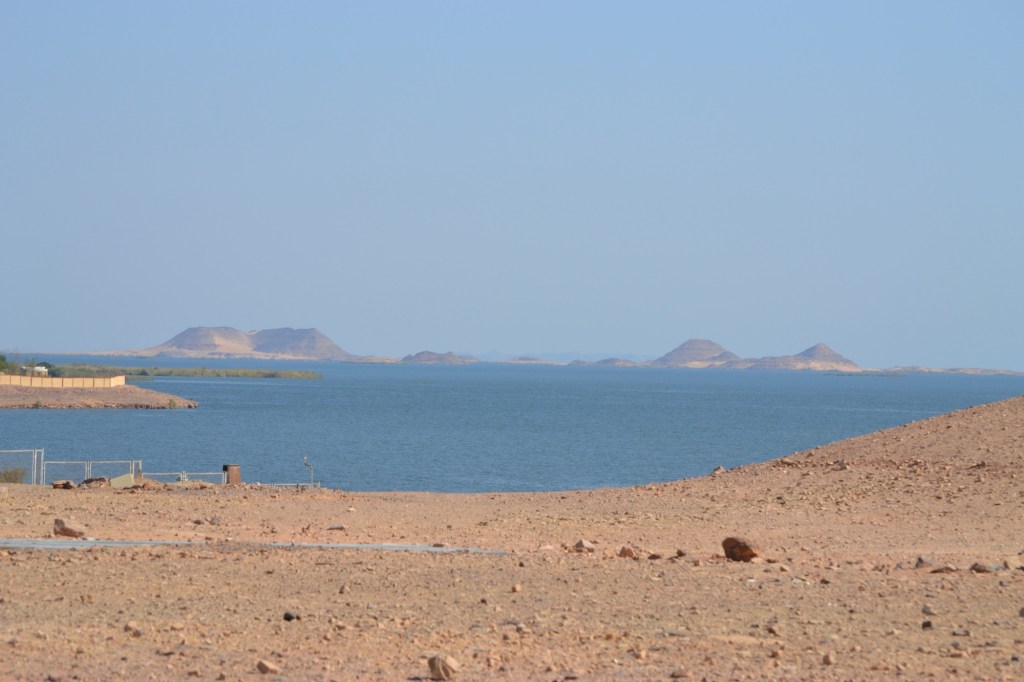
The Lake is very beautiful from ground level…
Lake Nasser
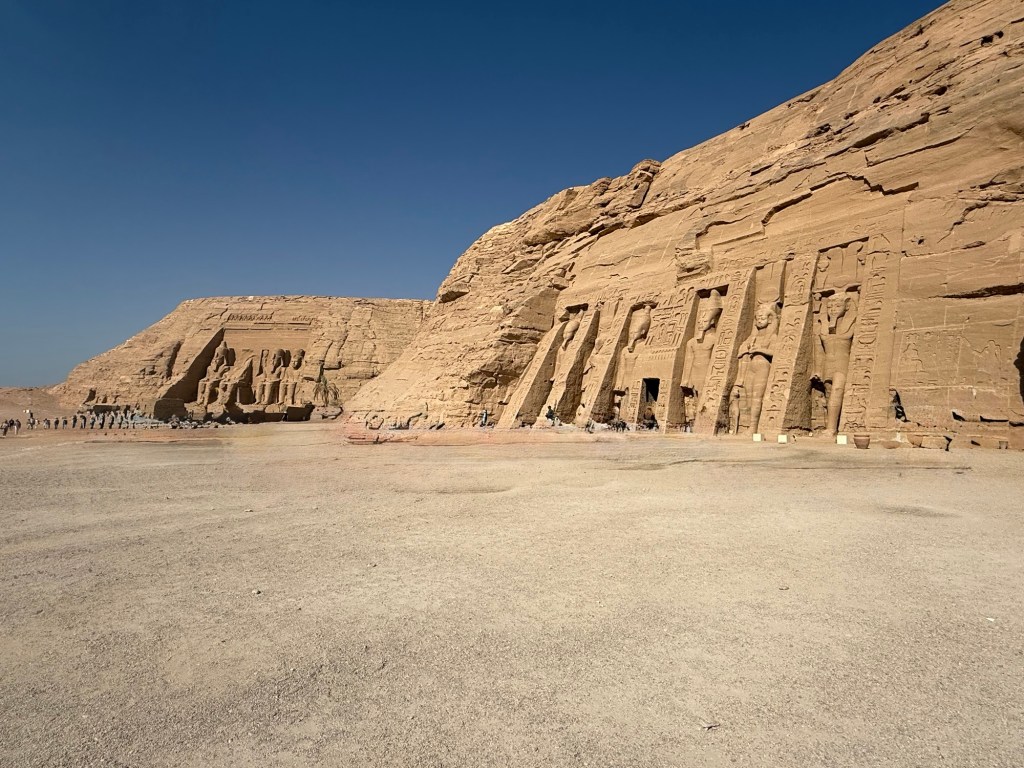
Abu Simbel is a historic site comprising two massive rock-cut temples (Great and Small Temples) in the village of Abu Simbel near the border with Sudan.
Great (left) and Small (right) Temples
These temples were commissioned by Ramses II in the 13th century BC.
Grand Temple:
The Great Temple, which took about twenty years to build, was completed around year 24 of the reign of Ramesses the Great (which corresponds to 1265 BC).
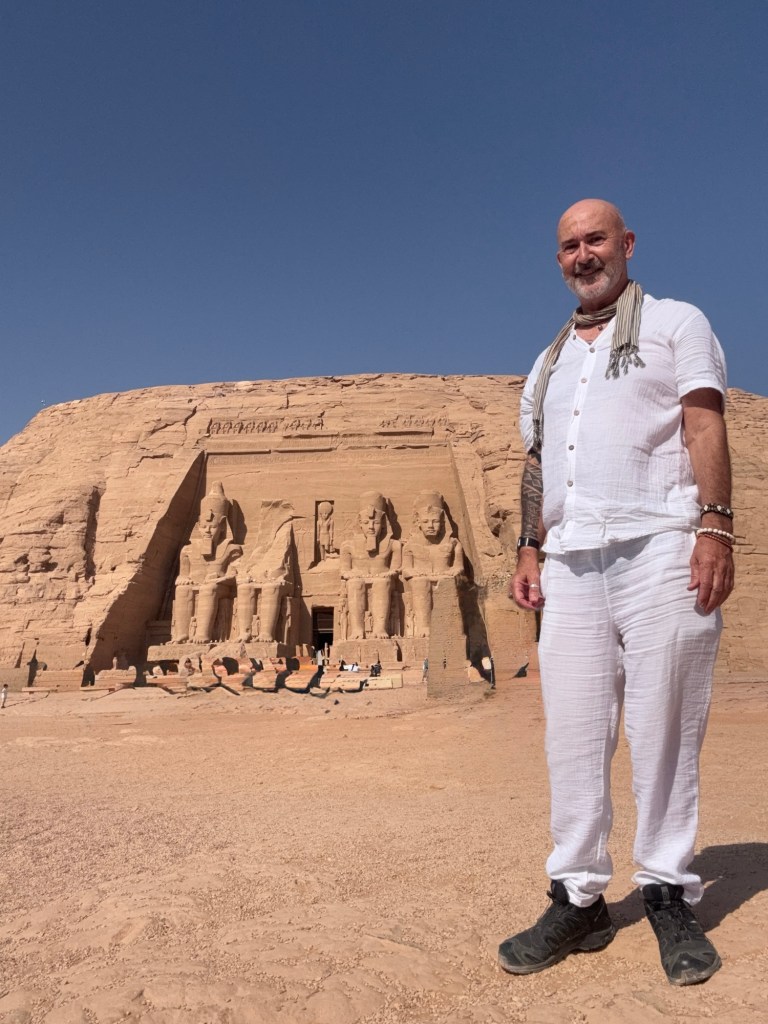
The Great Temple is famous for the four colossal statues of Ramses II and its unique solar alignment, which illuminates the sanctuary twice a year during the Sun Festival on February 21 and October 22. Just two days too early!!
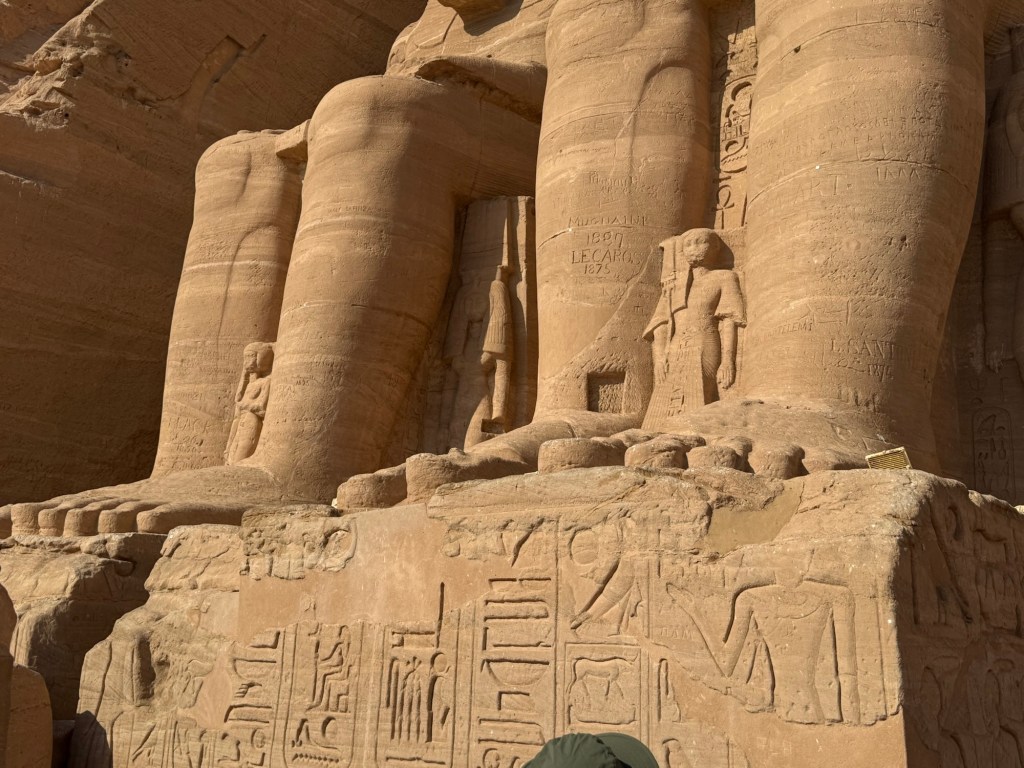
The statue to the immediate left of the entrance was damaged in an earthquake, causing the head and torso to fall away; these fallen pieces were not restored to the statue during the relocation but placed at the statue’s feet in the positions originally found.
The façade behind the colossi is 33 m (108 ft) high and 38 m (125 ft) wide. It carries a frieze depicting twenty-two baboons worshipping the rising sun with upraised arms and a stele recording the marriage of Ramesses to a daughter of king Ḫattušili III, which sealed the peace between Egypt and the Hittites.
His wife, Nefertari, and children can be seen in smaller figures by his feet.
The entrance doorway itself is surmounted by bas-relief images of the king worshipping the falcon-headed Ra Horakhty, whose statue stands in a large niche.
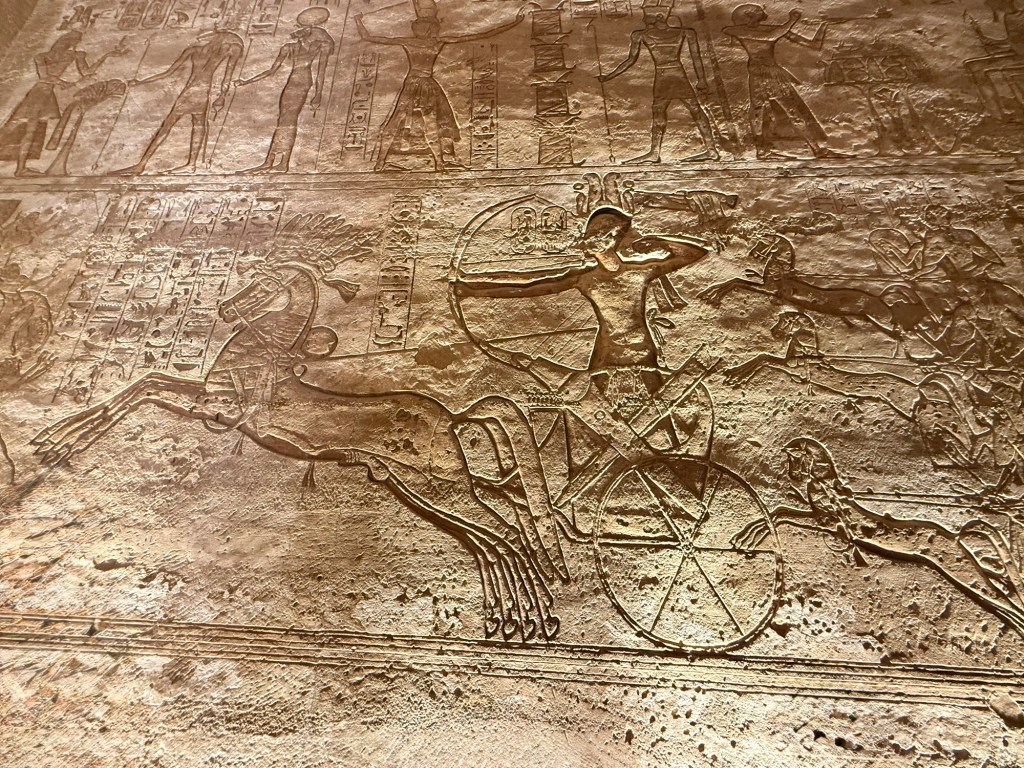
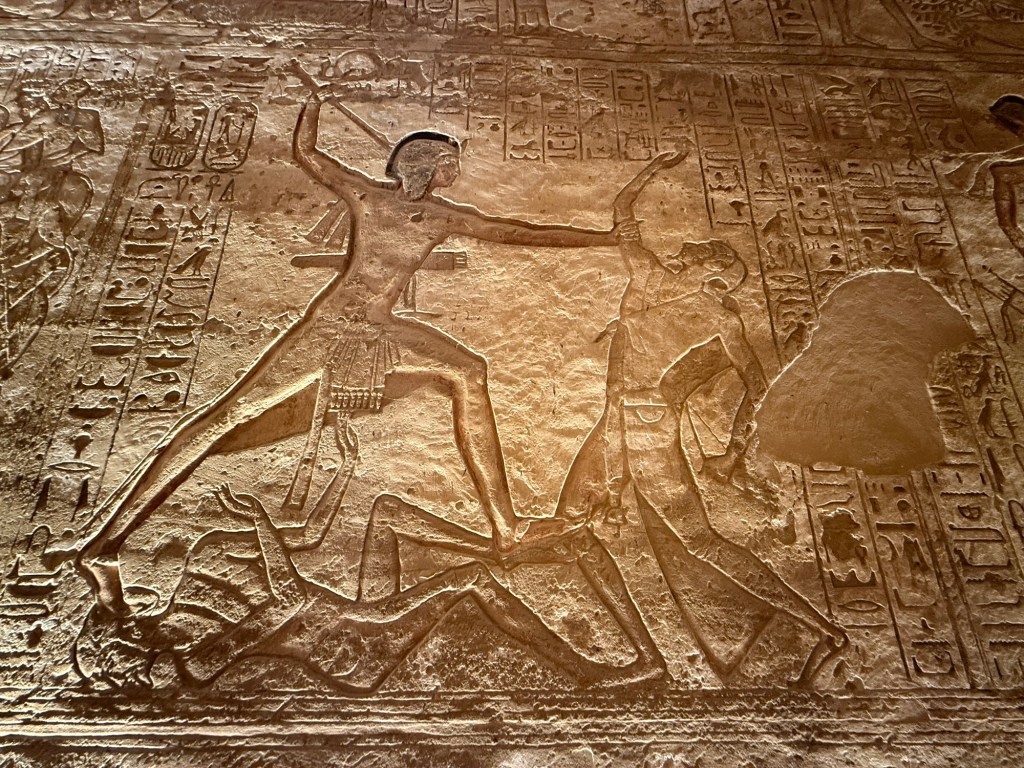
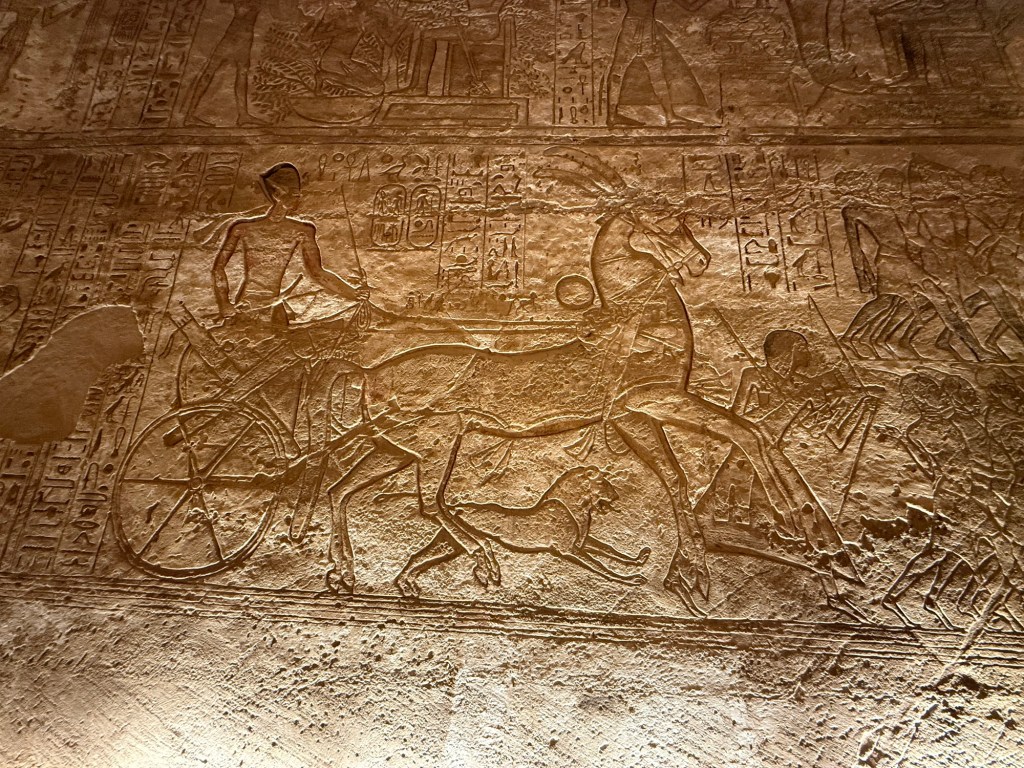
Sculptures inside the Great Temple hall commemorate Rameses II’s heroic leadership at the Battle of Kadesh.
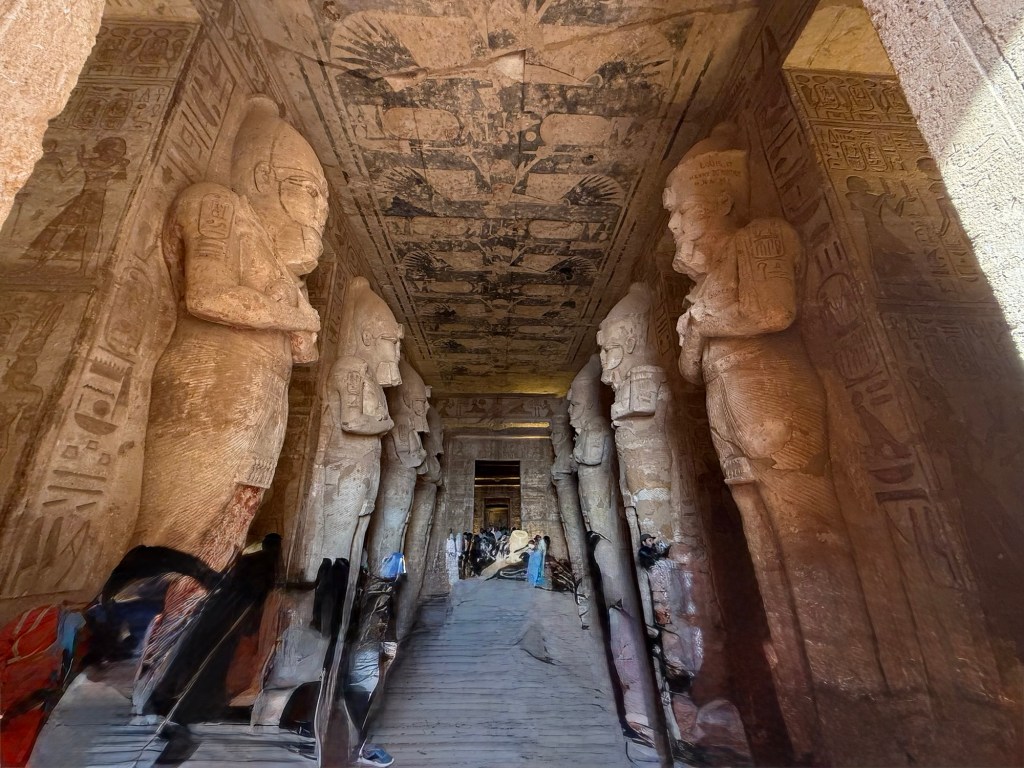
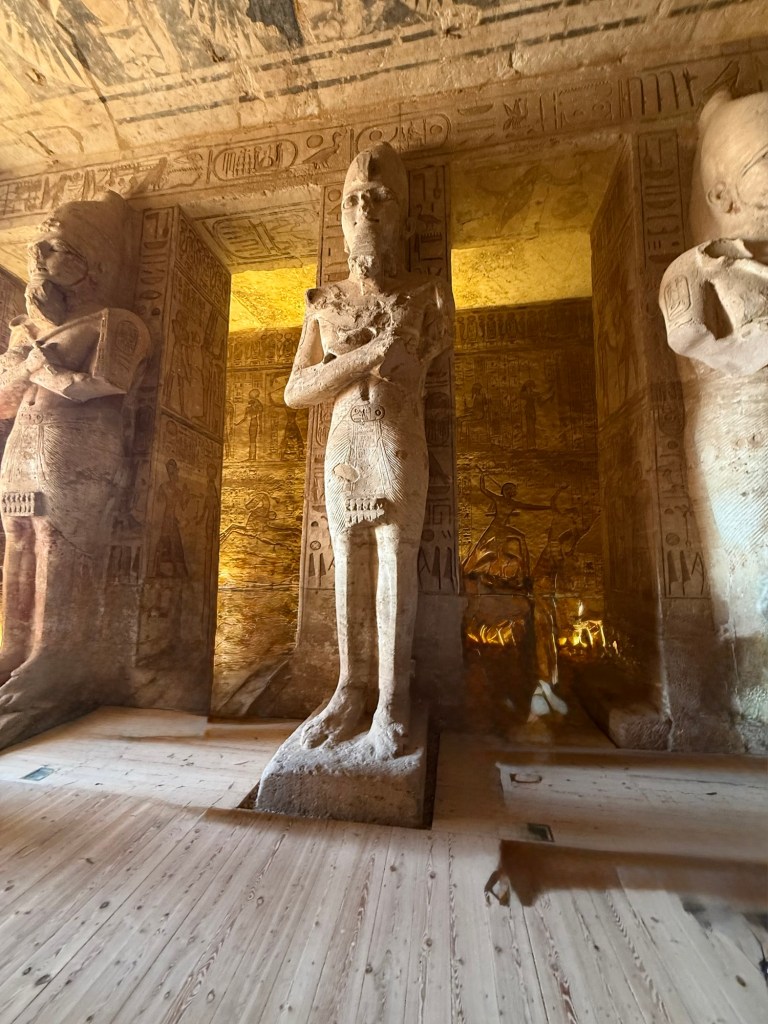
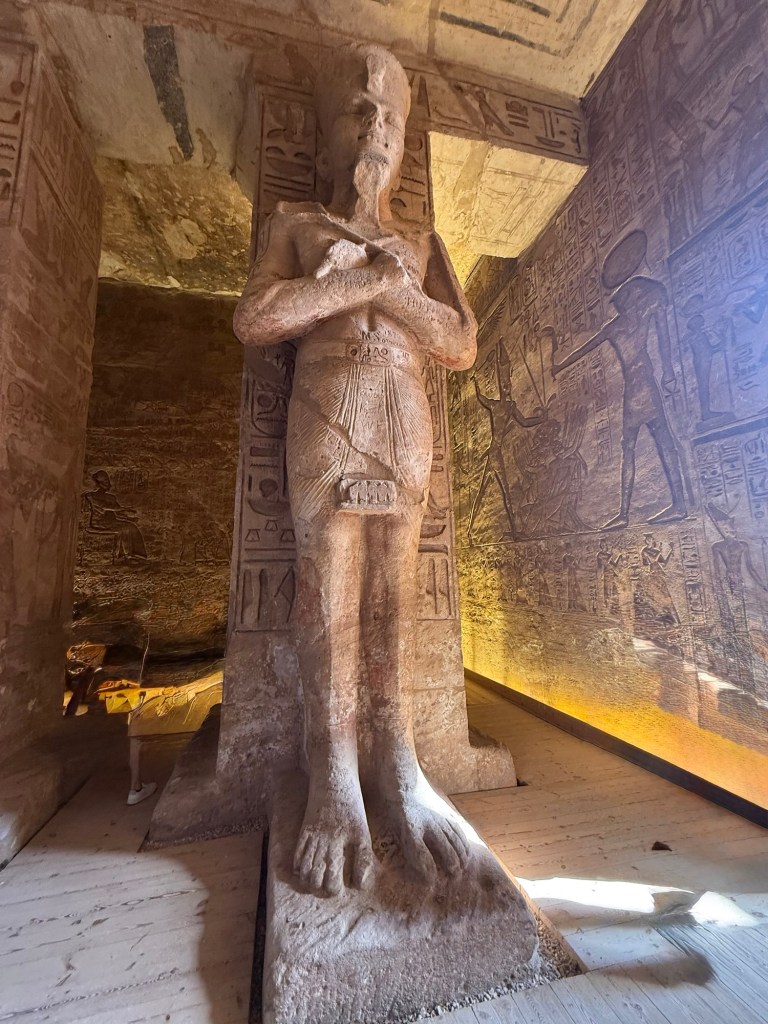
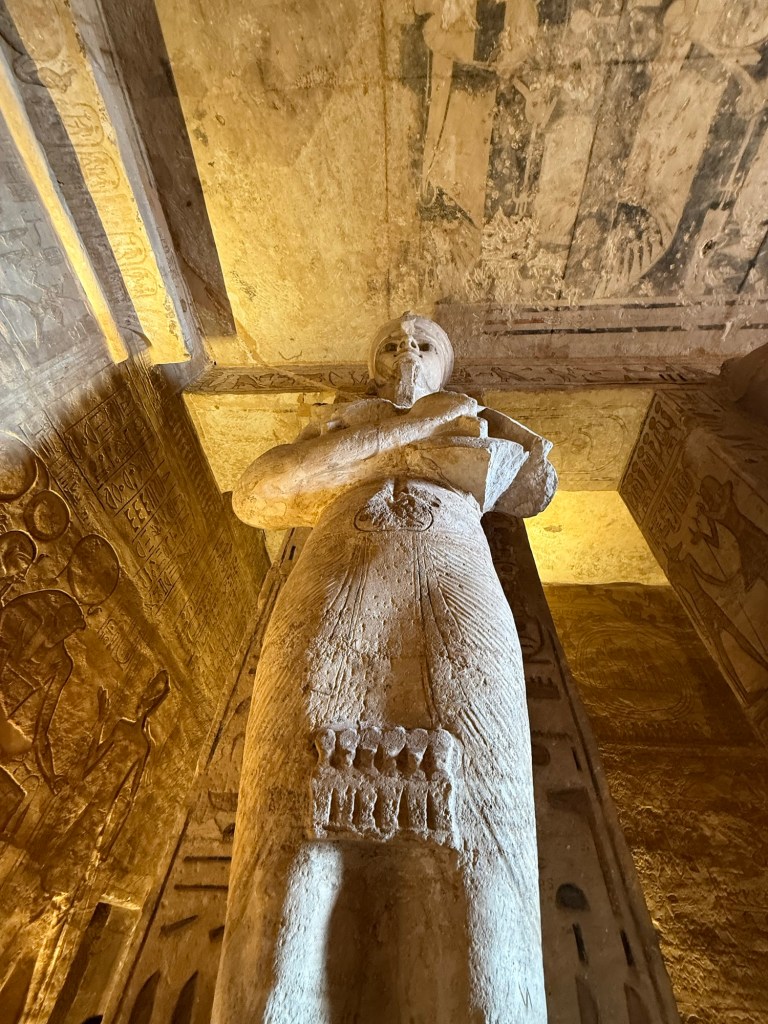
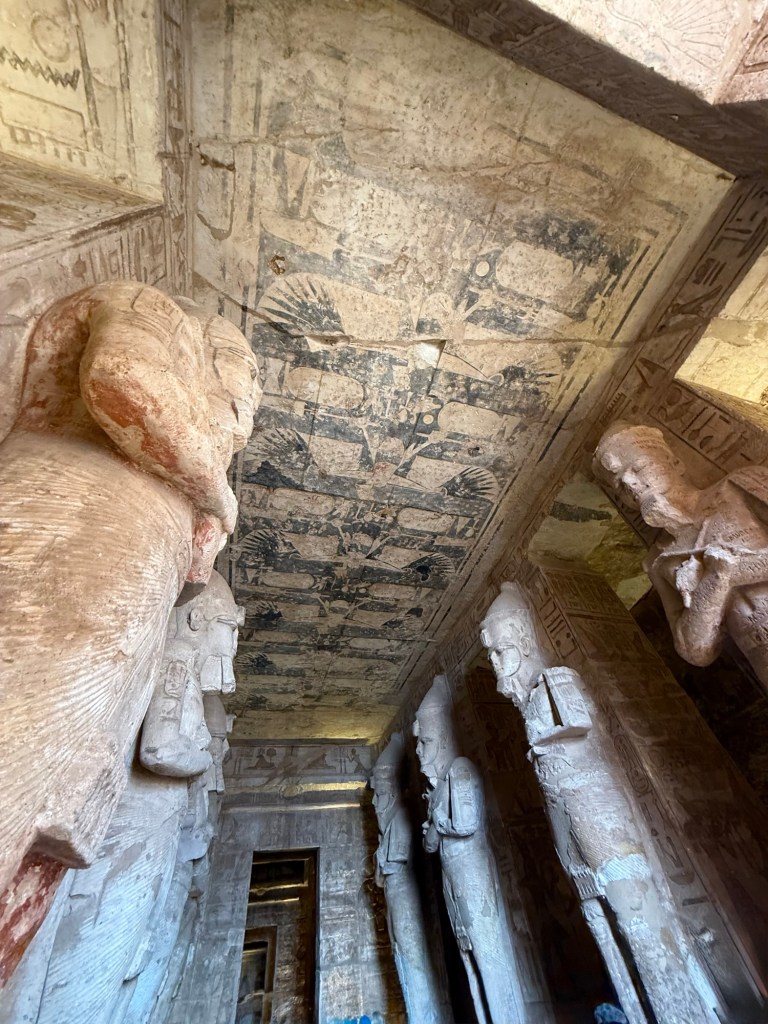
The hypostyle hall is supported by eight huge pillars depicting the deified Rameses linked to the god Osiris, the god of fertility, agriculture, the afterlife, the dead, resurrection, life and vegetation, to indicate the everlasting nature of the pharaoh.
The colossal statues along the left-hand wall bear the white crown of Upper Egypt, while those on the opposite side are wearing the double crown of Upper and Lower Egypt.
It was dedicated to the gods Amun, Ra-Horakhty, and Ptah, as well as to the deified Ramesses himself.
The bas-reliefs on the walls of the pronaos depict battle scenes in the military campaigns that Ramesses waged.
Much of the sculpture is given to the Battle of Kadesh, on the Orontes river in present-day Syria, in which the Egyptian king fought against the Hittites.
The most famous relief shows the king on his chariot shooting arrows against his fleeing enemies, who are being taken prisoner.
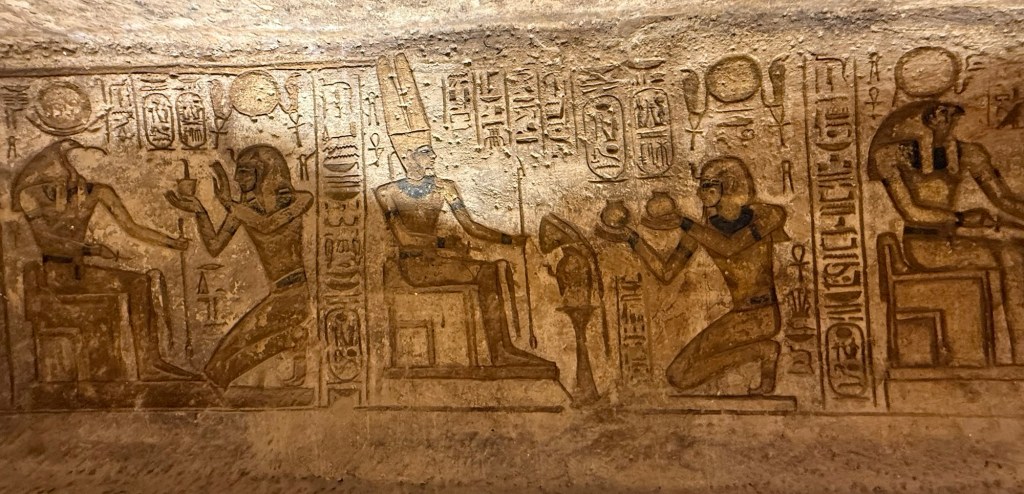
From the hypostyle hall, one enters the second pillared hall, which has four pillars decorated with beautiful scenes of offerings to the gods.
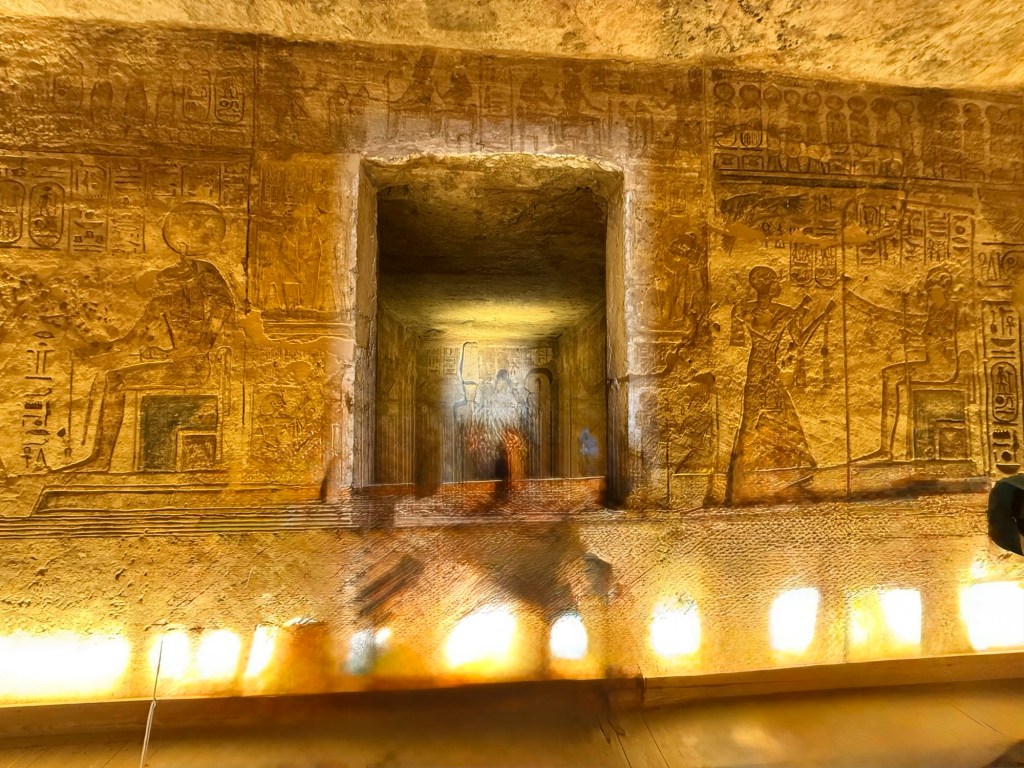
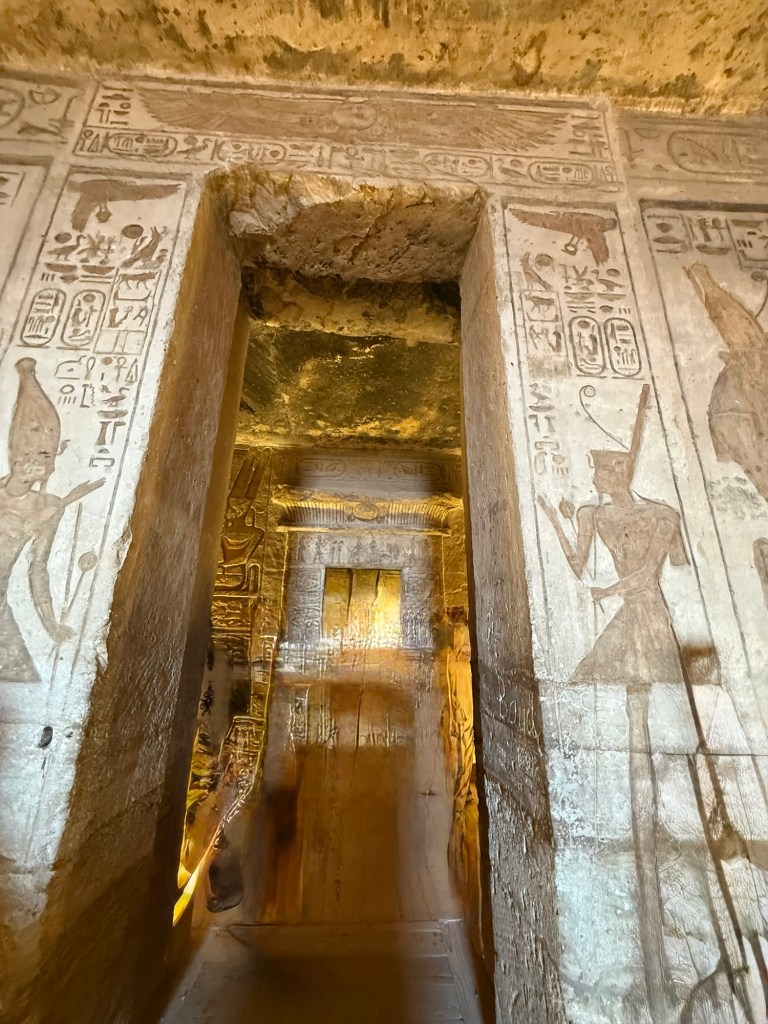
Many doorways lead further the inner sanctuary..
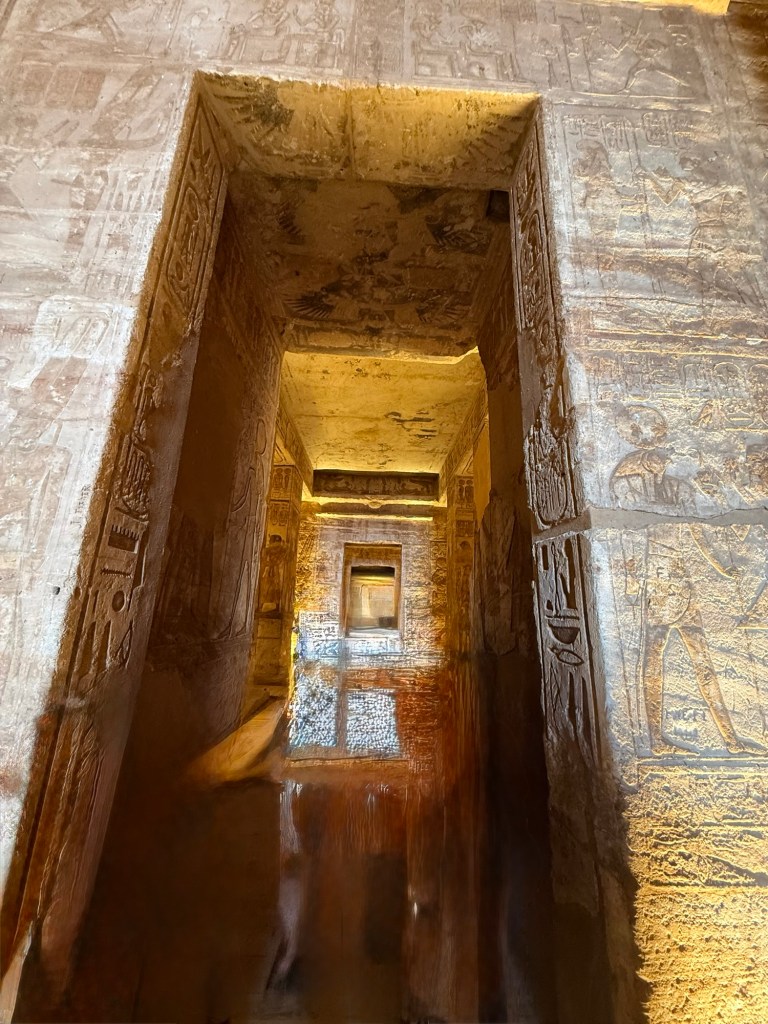
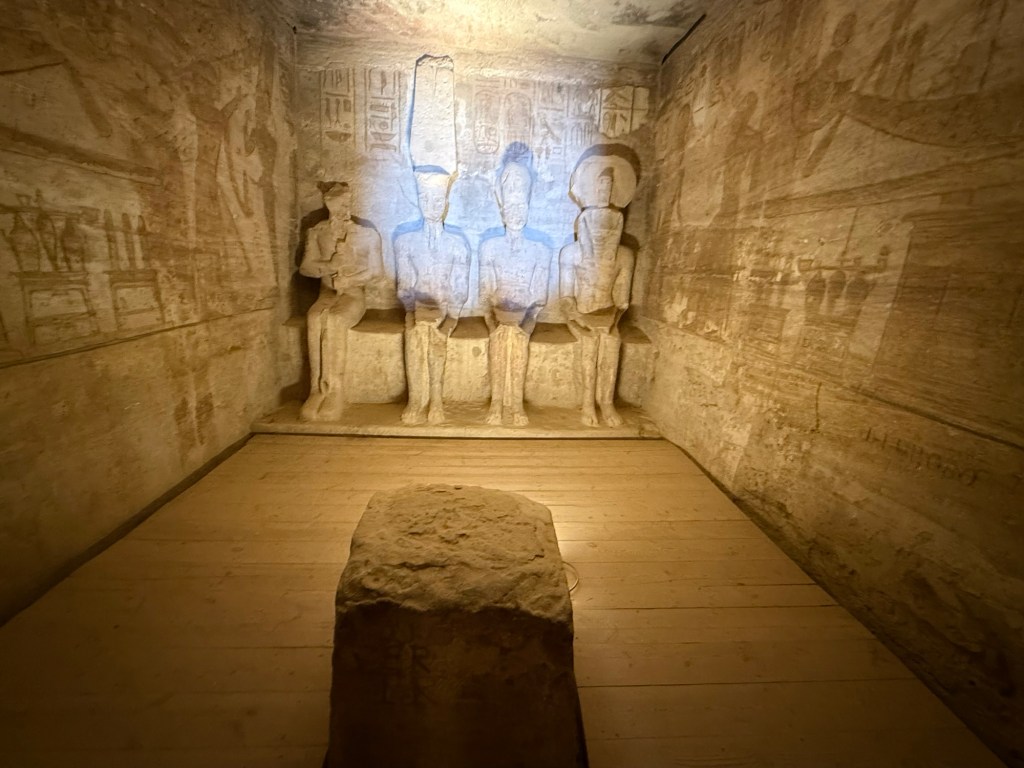
There are depictions of Ramesses and Nefertari with the sacred boats of Amun and Ra-Horakhty. This hall gives access to a transverse vestibule, in the middle of which is the entrance to the sanctuary. Here, on a black wall, are rock cut sculptures of four seated figures: Ra-Horakhty, the deified king Ramesses, and the gods Amun Ra and Ptah. Ra-Horakhty, Amun Ra and Ptah were the main divinities in that period and their cult centers were at Heliopolis, Thebes and Memphis respectively.
The Small Temple:
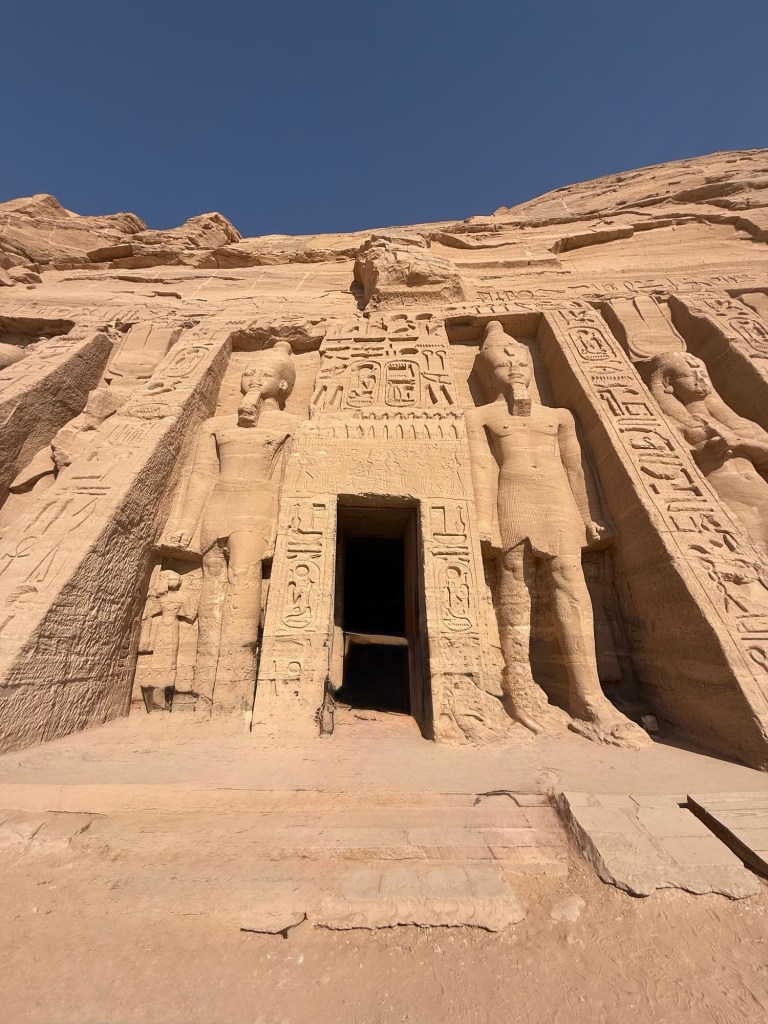
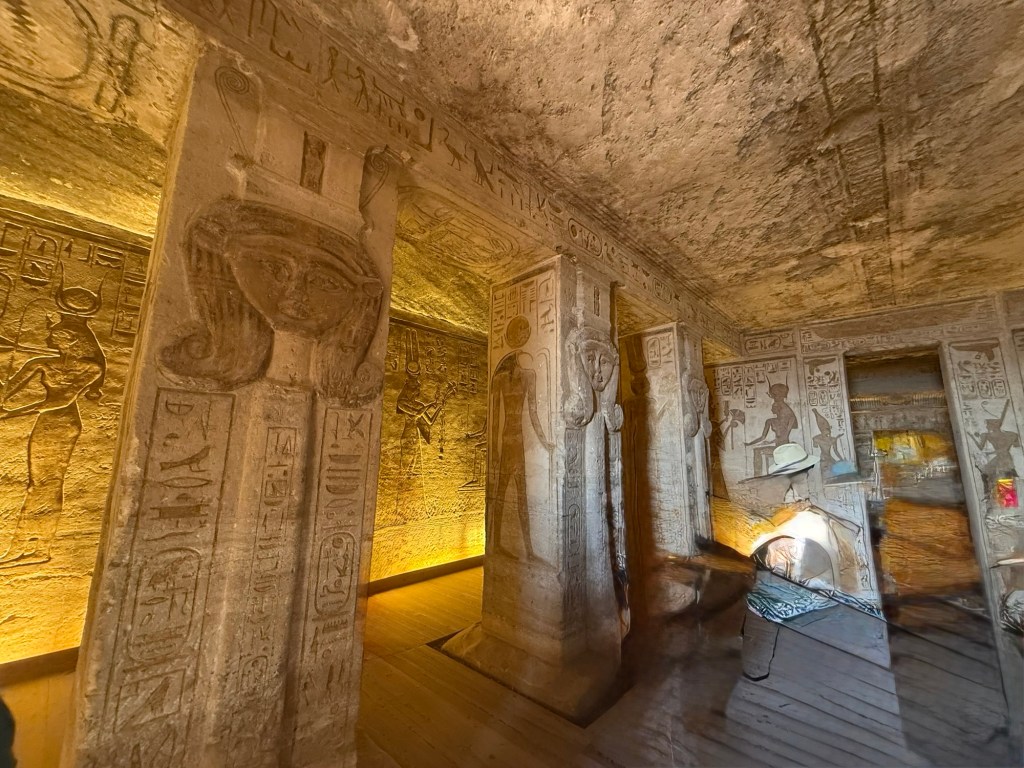
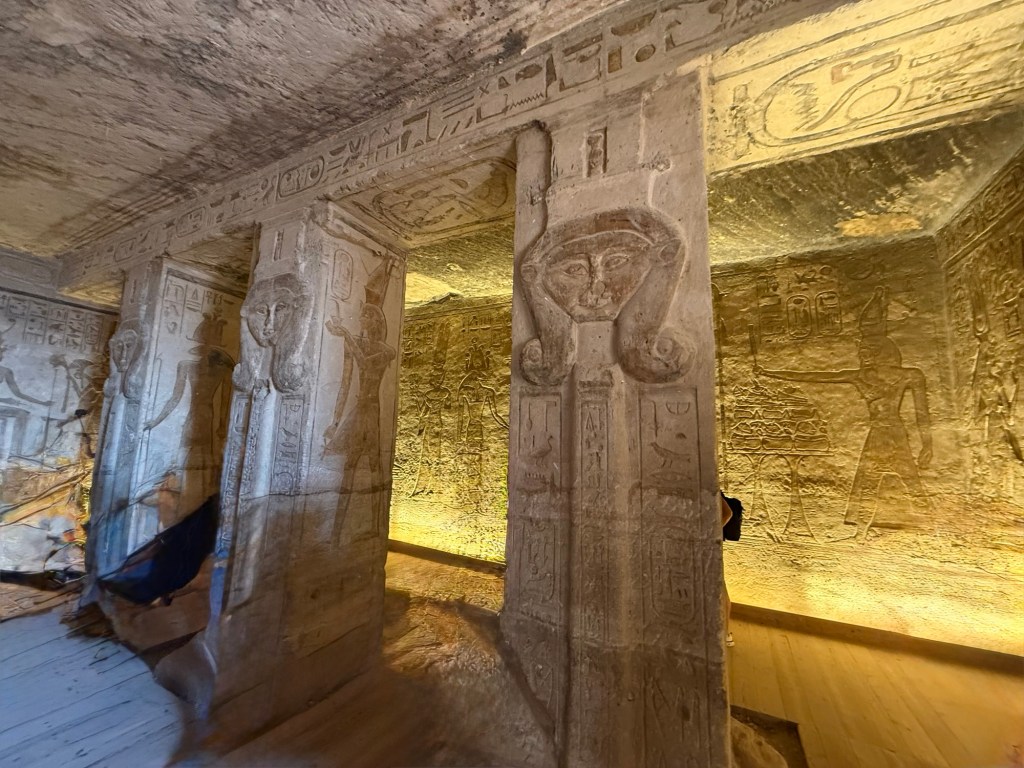
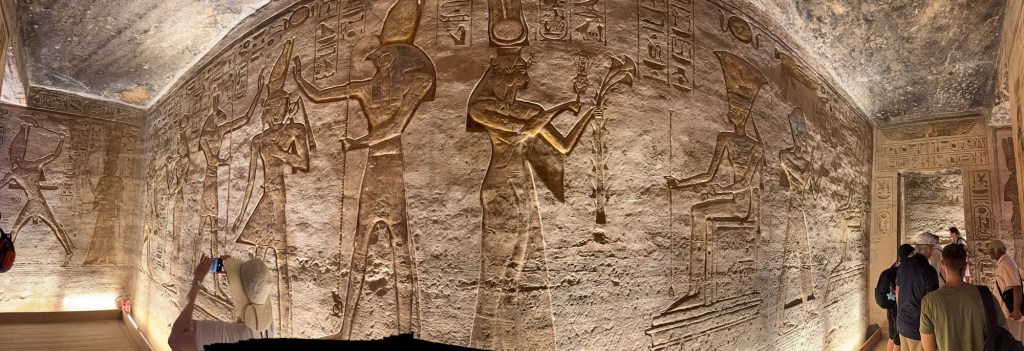
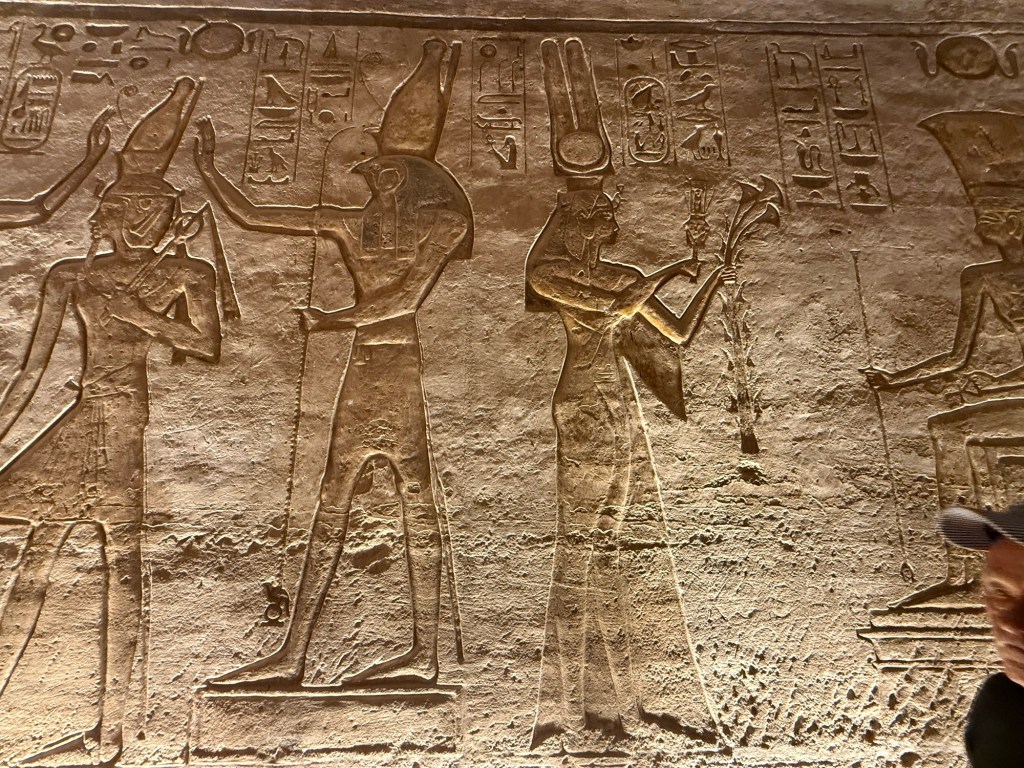
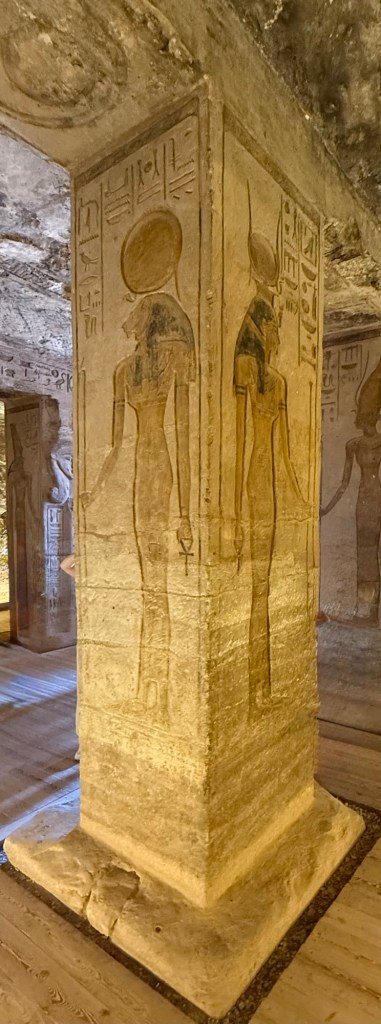
The smaller temple of Hathor and Nefertari was built about 100 m (330 ft) northeast of the temple of Ramesses II and was dedicated to the goddess Hathor and Ramesses II’s chief consort, Nefertari.
Morning Itinerary: The Nile Dams, Cruising the Nile on Feluccas, Motor Boating to Agilkia Island and Temple of Philae, Nubean Culture and Dancing ~ 40°C/104°F
By Paul Bryers
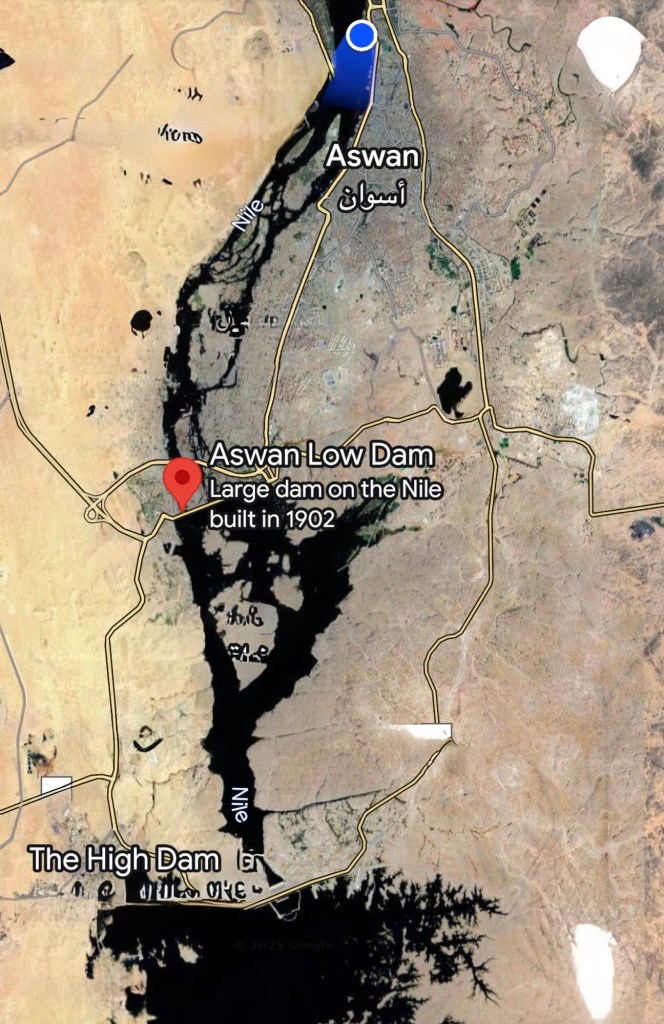
A comprehensive understanding of the Aswan area necessitates a basic knowledge of the city’s location and the dams.
Map of Aswan City, Low and High Dams. Nile runs South to North ie bottom to top of photo.
Aswan City, where our AMALilia was docked, is situated downstream of both dams.
AMALilia
Between the City and the first dam are several islands, including Elephantine Island as mentioned later.
There are two Aswan Dams: the older Low Dam constructed by the British and the newer High Dam built by the Egyptians, located further upstream.
The British constructed the Low Dam between 1899 and 1902 to facilitate irrigation. However, due to inadequate water storage capacity, it underwent two expansions, ultimately leading to the construction of the larger High Dam further upstream.
Low Dam
Development of the High Dam commenced in 1960 and was completed in 1968, with its official inauguration taking place in 1971. Approximately 57 million cubic yards of earth and rock were utilized in the dam’s construction, resulting in a mass several times that of the Great Pyramid at Giza.
High Dam
The massive water reservoir created by the dam, measuring 300 miles in length and 10 miles in width, is known as Lake Nasser.
The construction of Lake Nasser necessitated the resettlement of 90,000 Egyptian laborers and Sudanese Nubian travelers.
Additionally, numerous ancient structures, most notably the carvings of Abu Simbel, required relocation.
So, having set the scene…
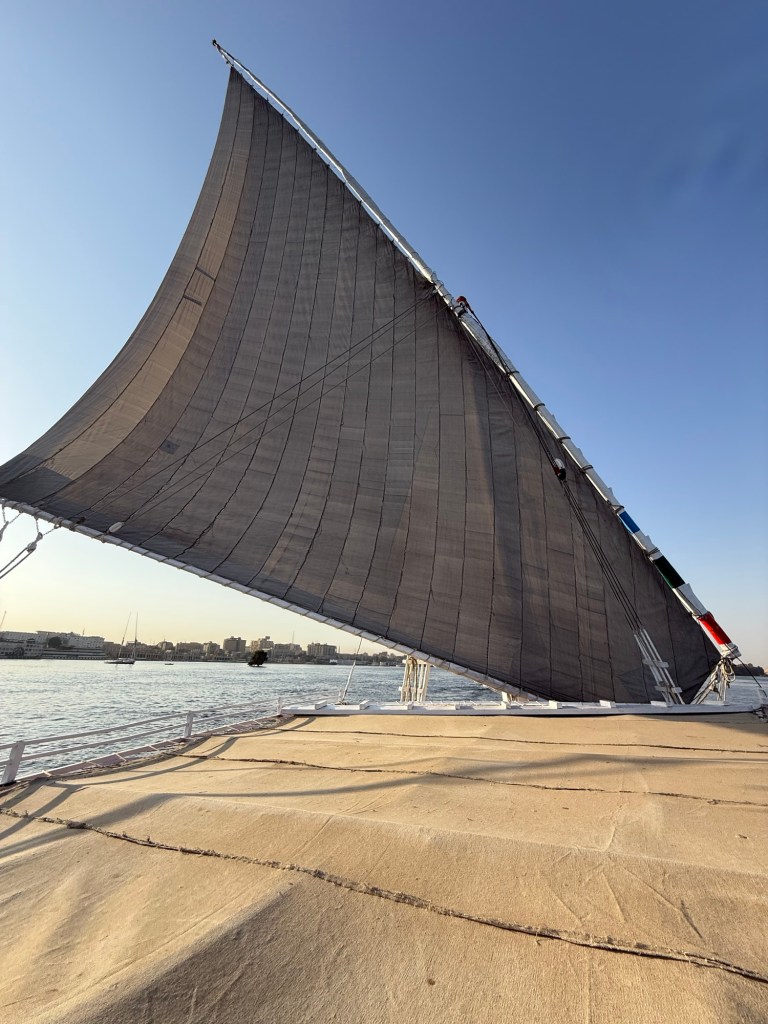
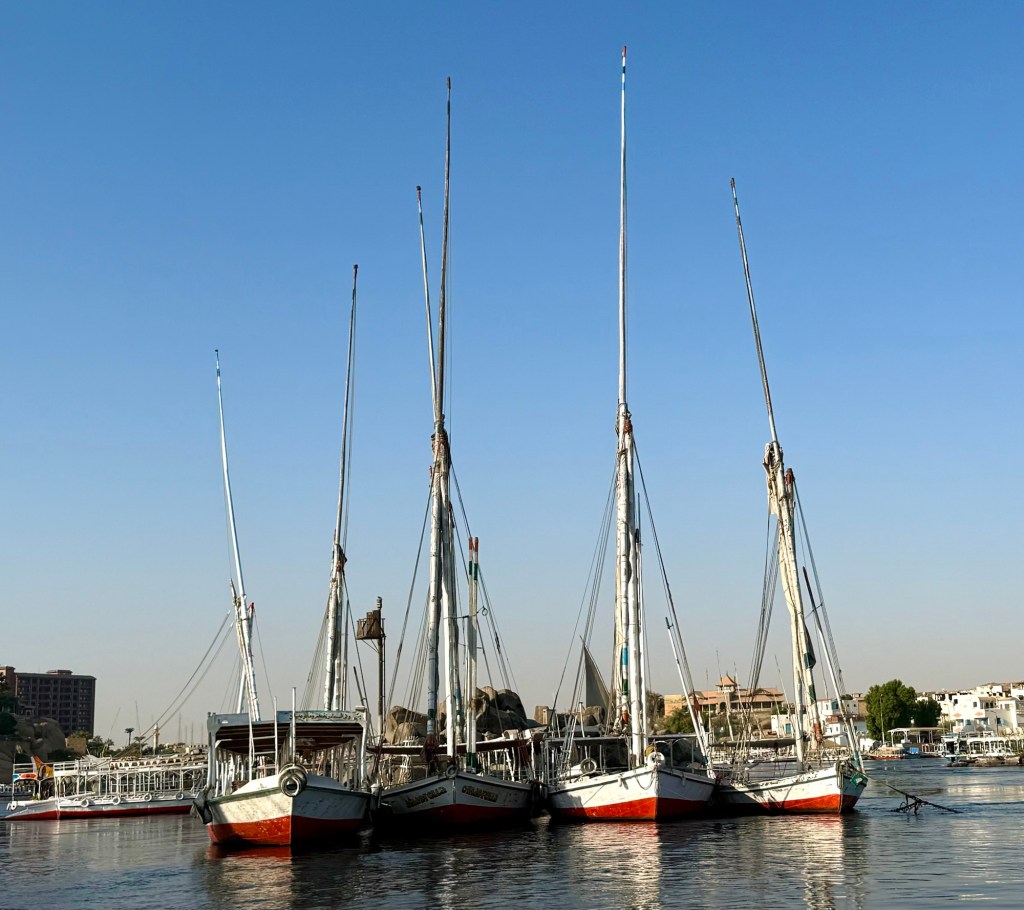
Elephantine Island: We embarked on a peaceful felucca ride from our ship docked in Aswan City, to pass through Elephantine Island.
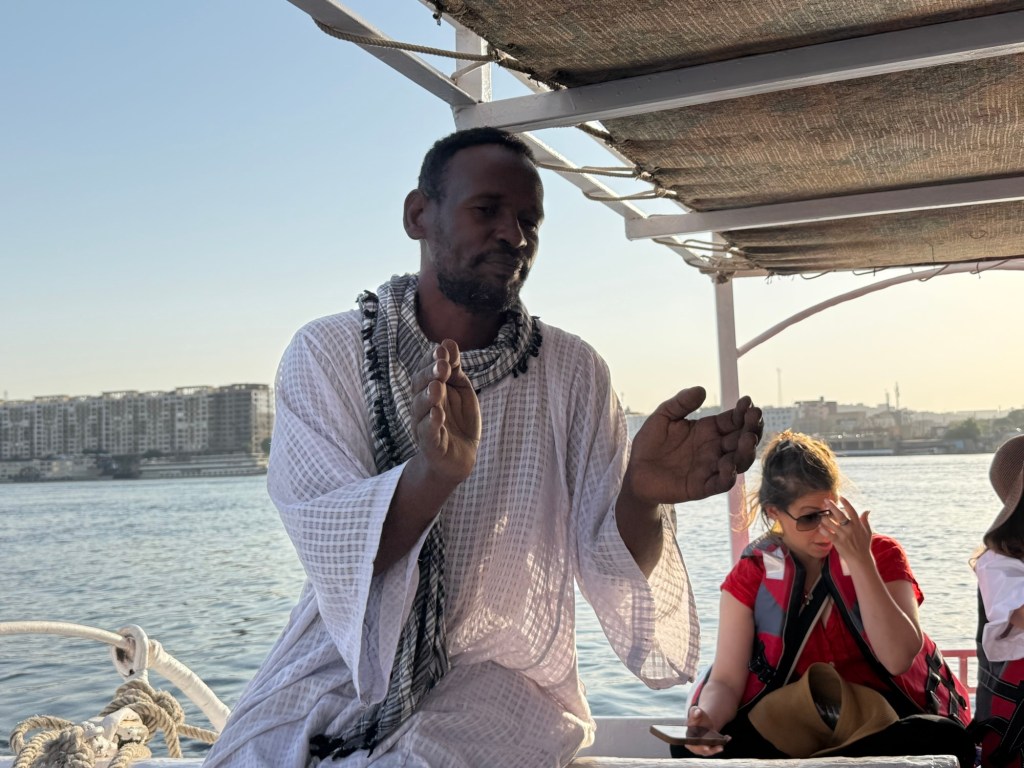
Our wonderful AMA Guide Mohammed was there to set the scene…
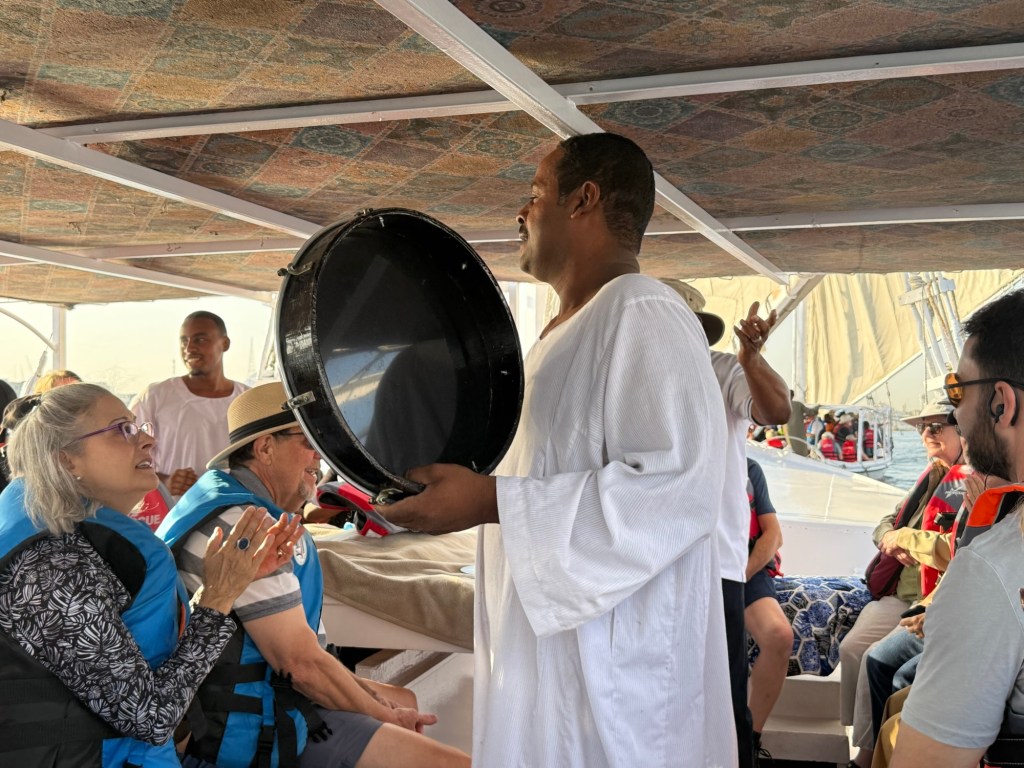
….and the crew entertained us…
Elephantine Island, situated on the west bank of the Nile, flourished as a significant trading center during the Pharaonic era. Locals claim the island is home to the legendary Egyptian god Khnum.
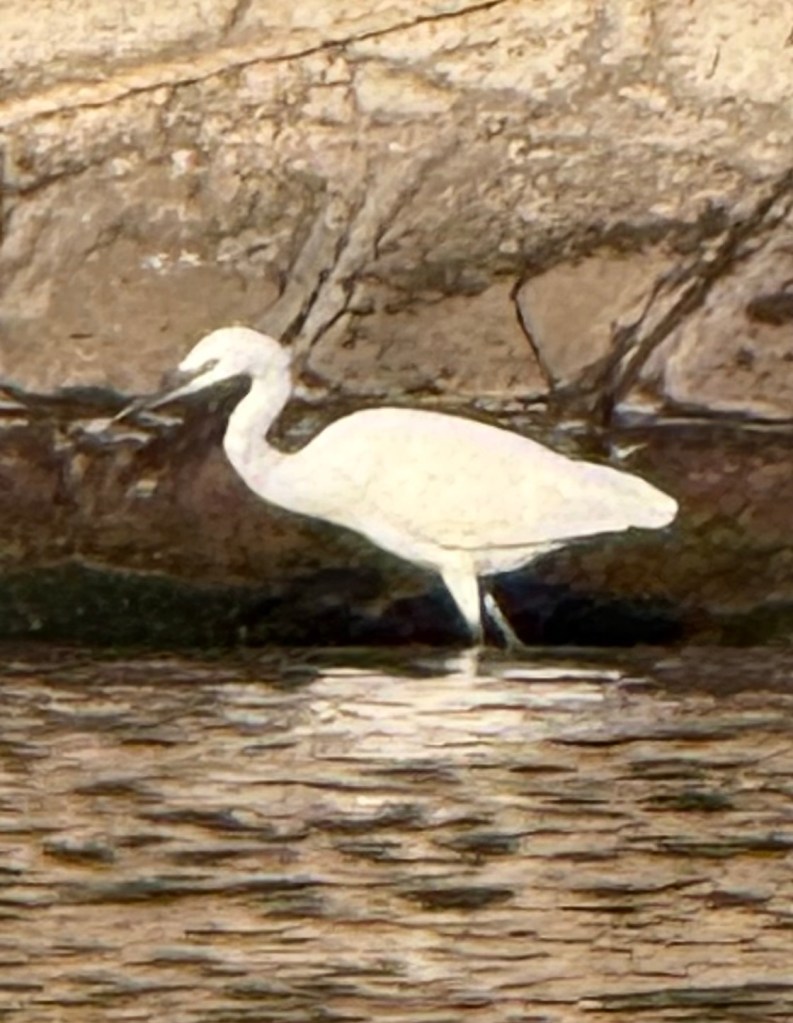
Herons and egrets were fishing or flying around.
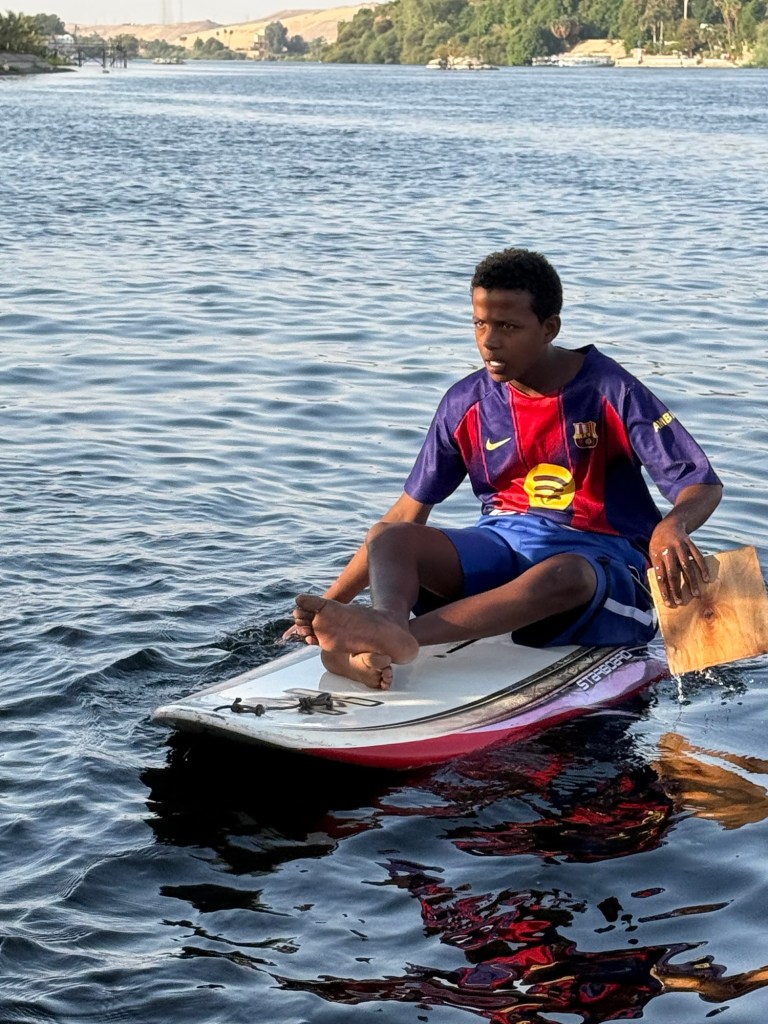
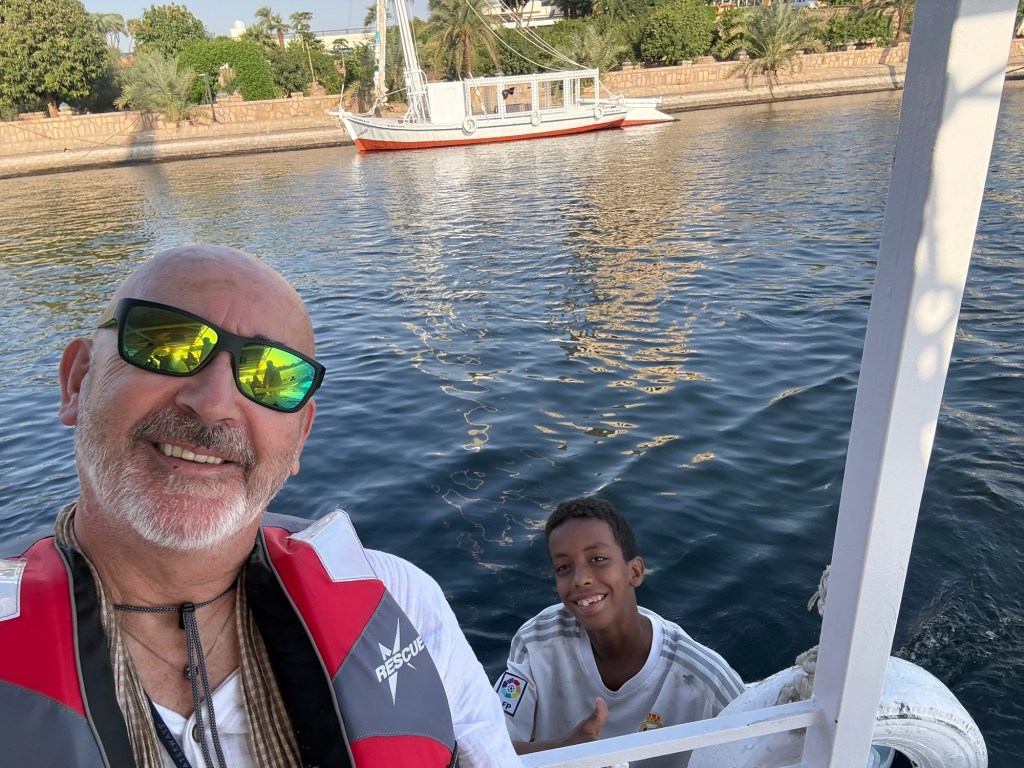
In addition, some very small friendly pirates were singing for a donation. Bless.
Between the two dams lies an engorged Nile, with several islands within. We explored two of these islands by motorboat.
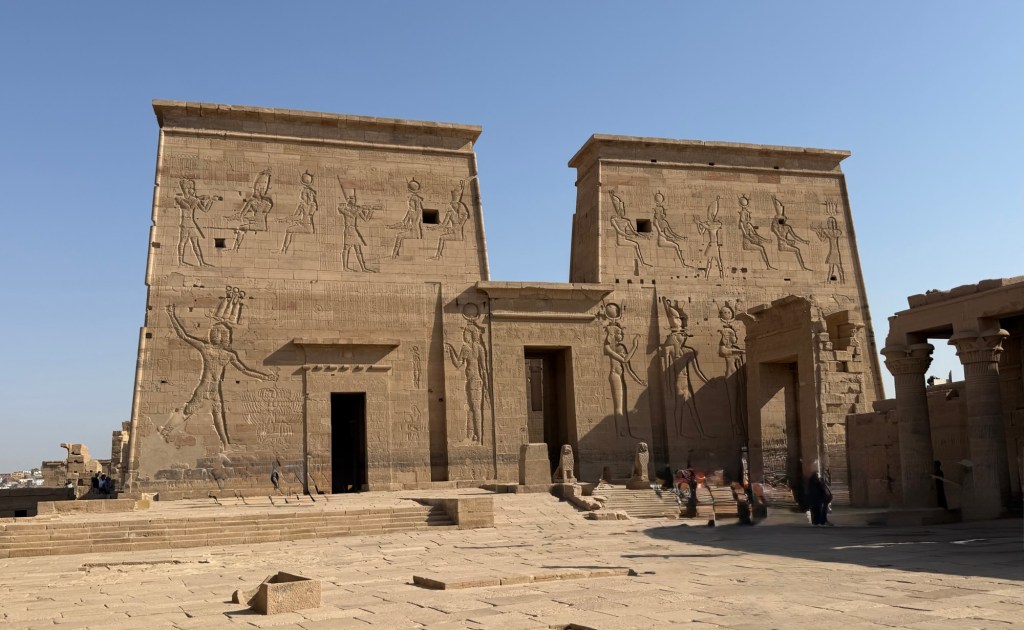
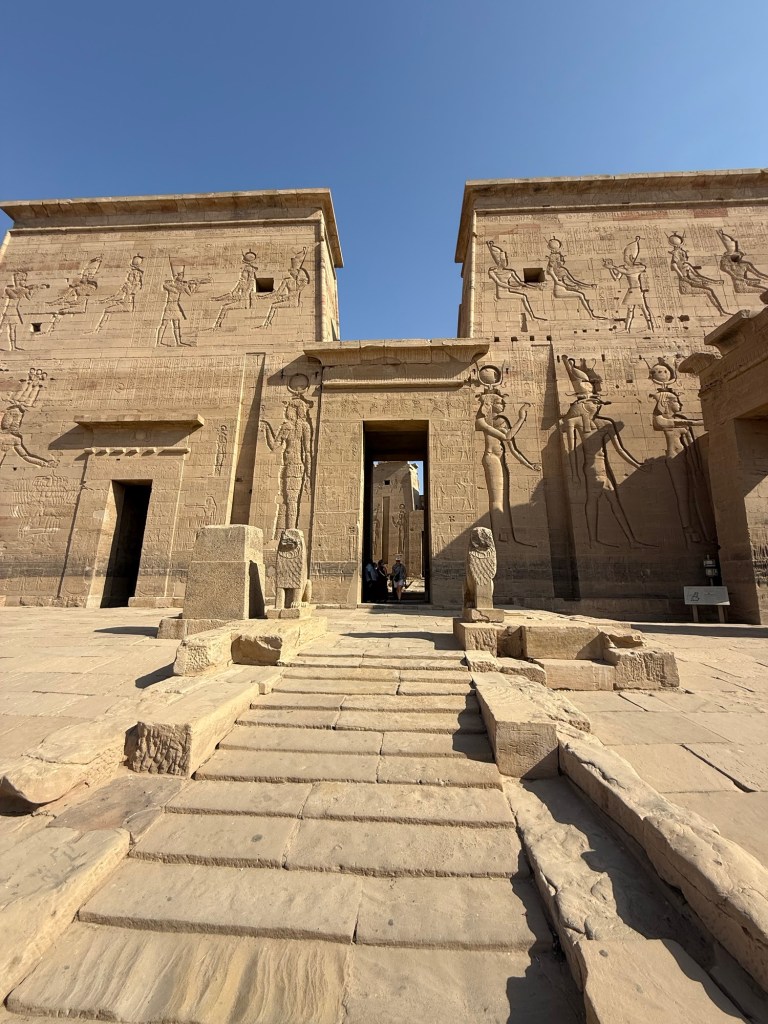
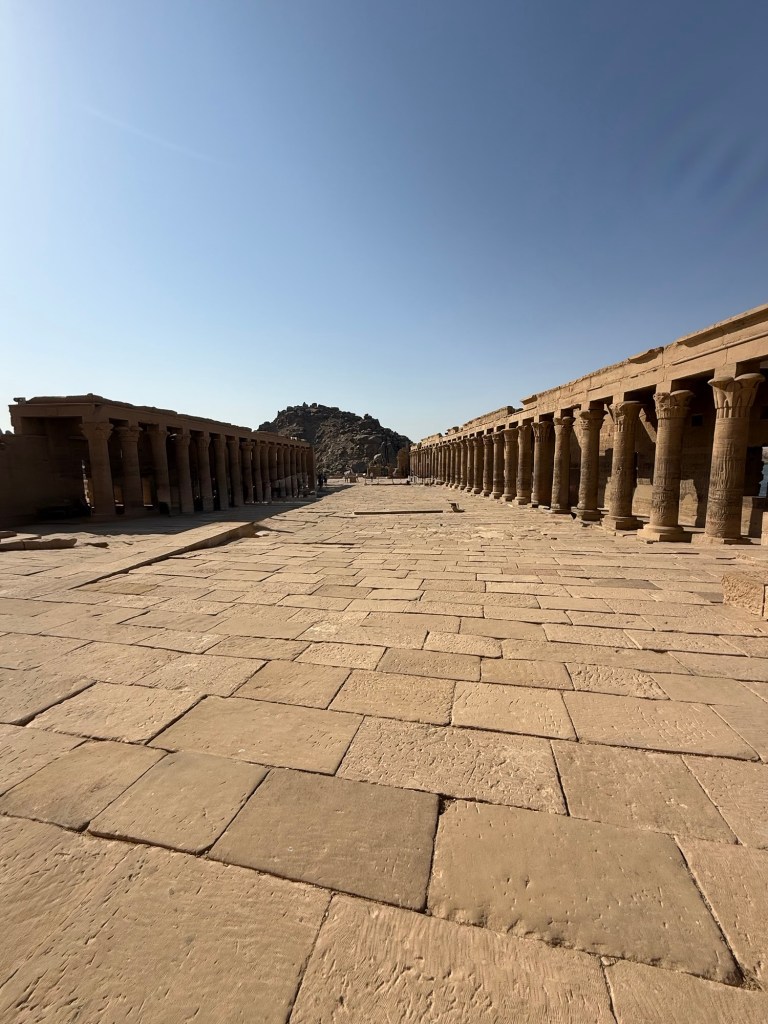
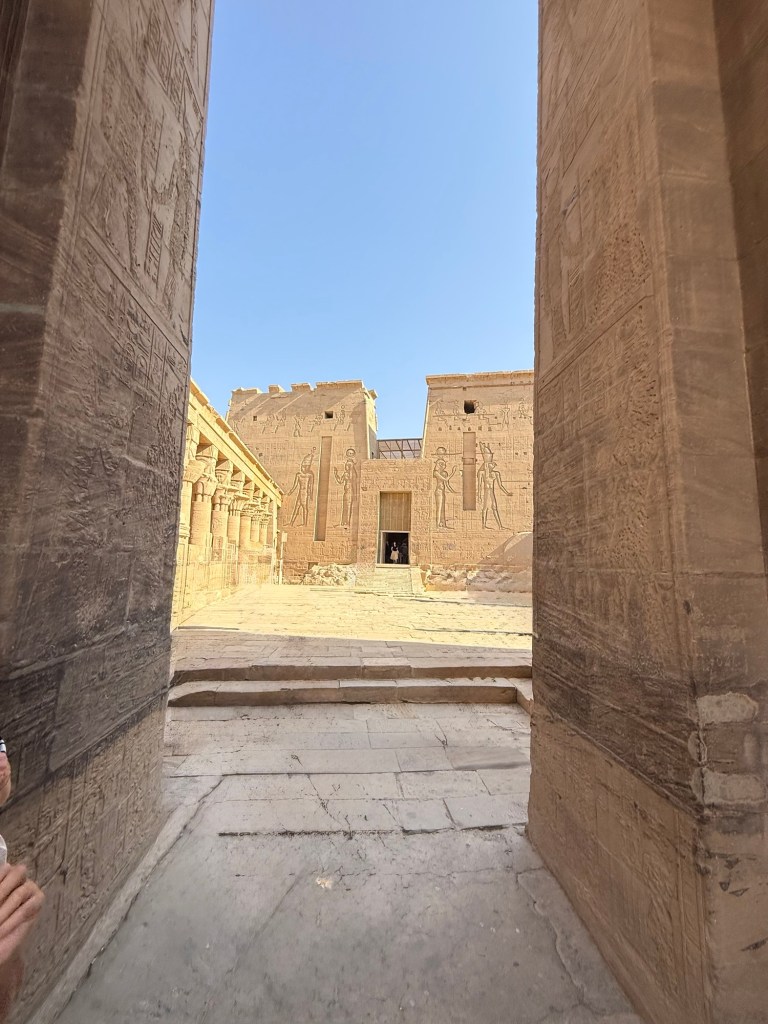
Agilkia Island and Temple of Philae: This island home to the UNESCO-designated Philae Temple complex, boasting one of the most stunningly restored and preserved hieroglyphs in Egypt. Constructed between 380 BC and 362 BC, the temple is dedicated to the goddess Isis, the wife of Osiris and mother of Horus. While Isis’ temple is impressive, Horus’s temple is even more impressive.
Key features of the Temple include:
A large first pylon gateway with outer courtyard of columns
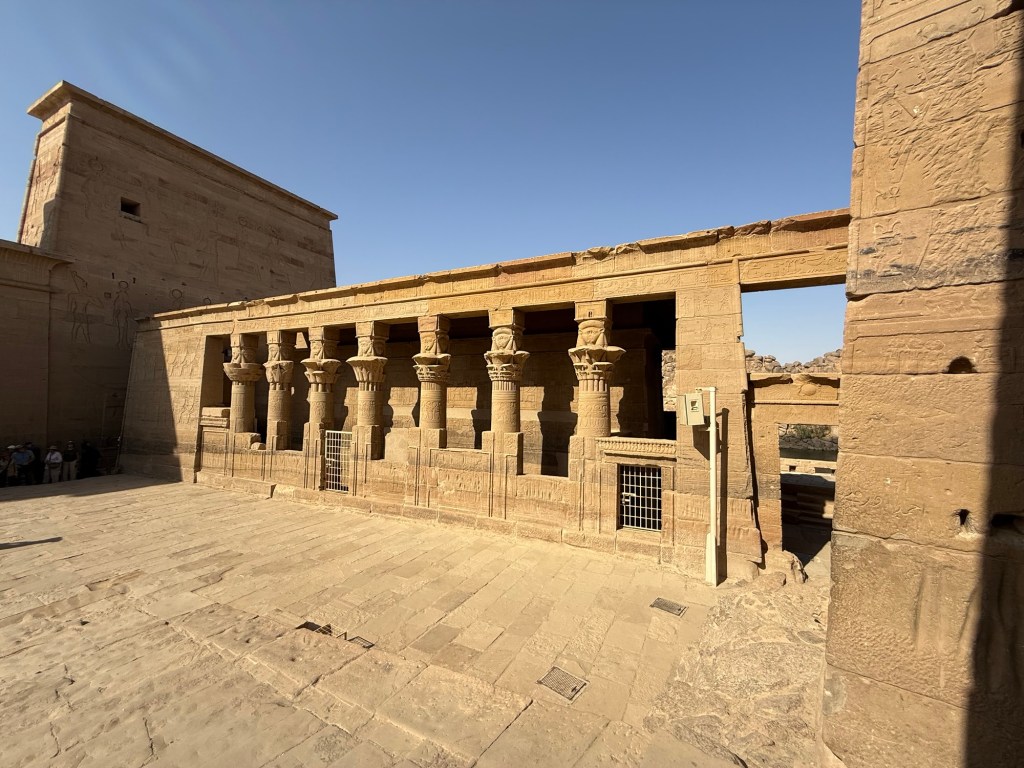
A central courtyard with a second pylon and outside columns of the Birthing Hall….
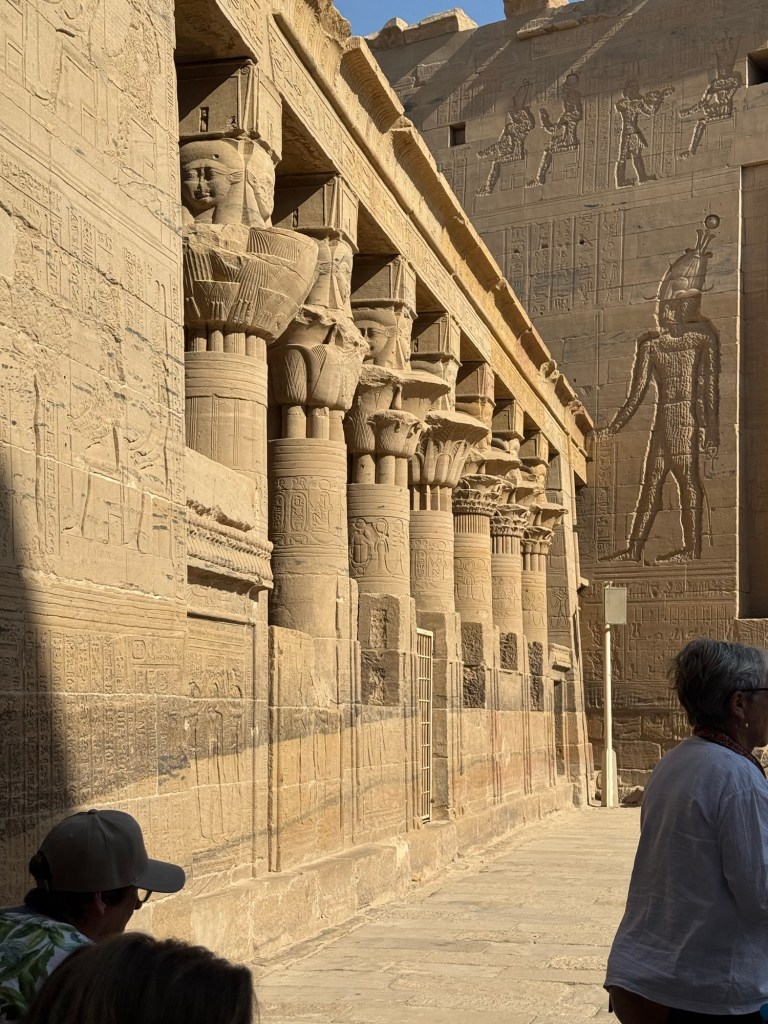
A Birthing Hall (Mammisi). This hall is surrounded on three sides by a colonnade of floral topped columns each crowned with a sistrum and Hathor-headed capital. The Mammisi was a common feature of Ptolemaic temples and the example on Philae is similar in layout and decoration to the examples at Edfu. The mammisi from Philae served as a model for developing a typical birth house plan with pronaos and surrounding ambulatory.
A typical hypostyle hall with high columns.
An inner sanctuary. To get to this inner sanctuary required going through 5 sub- sanctuaries (I think that was number and nomenclature). I’m sure you’ll let me know….
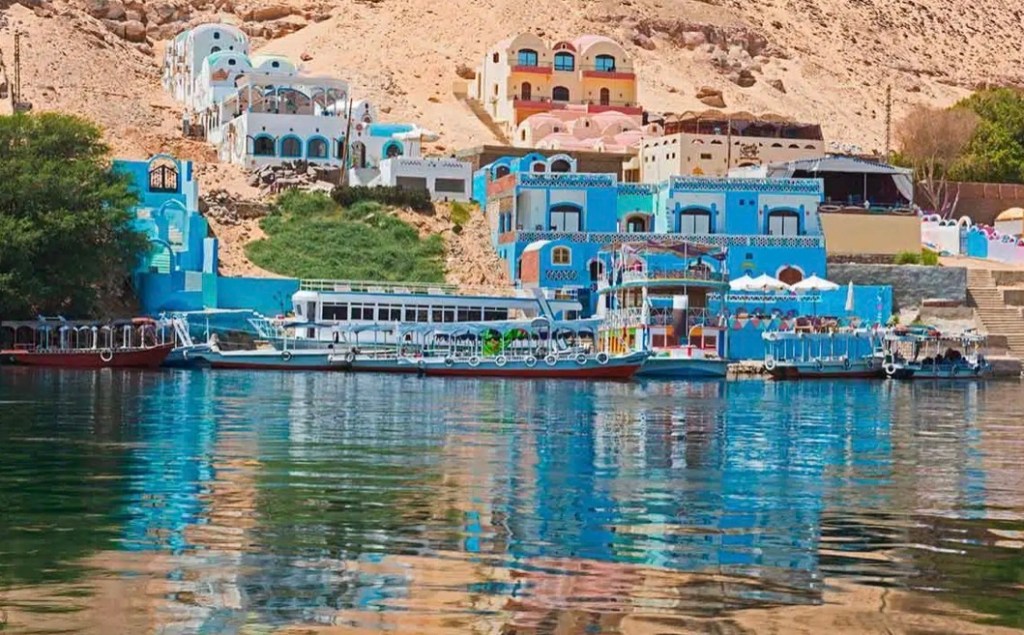
Nubian Village of Hessa: As we motorboated to another island and the vibrant Nubian Village of Hessa, we felt a cooling breeze on our faces.
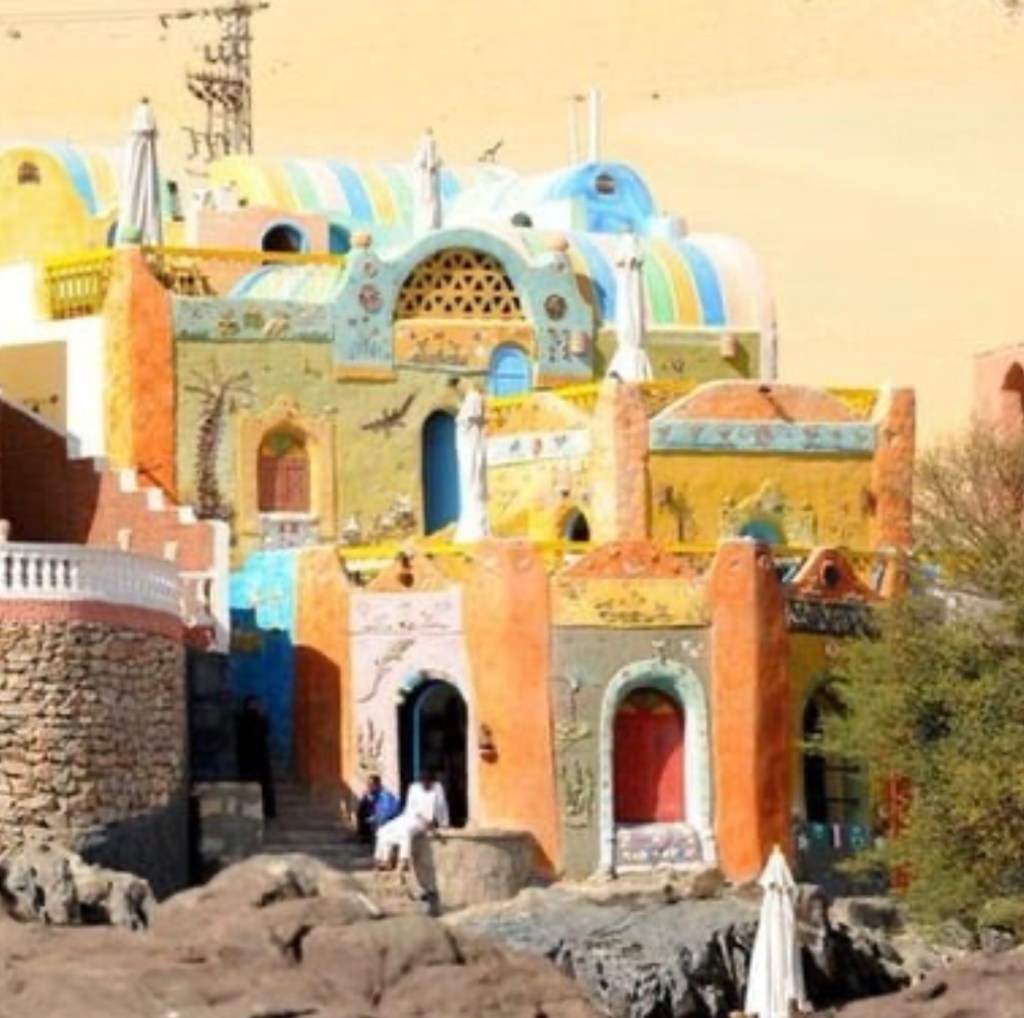
Note, some of the Nubian photos are from Google.
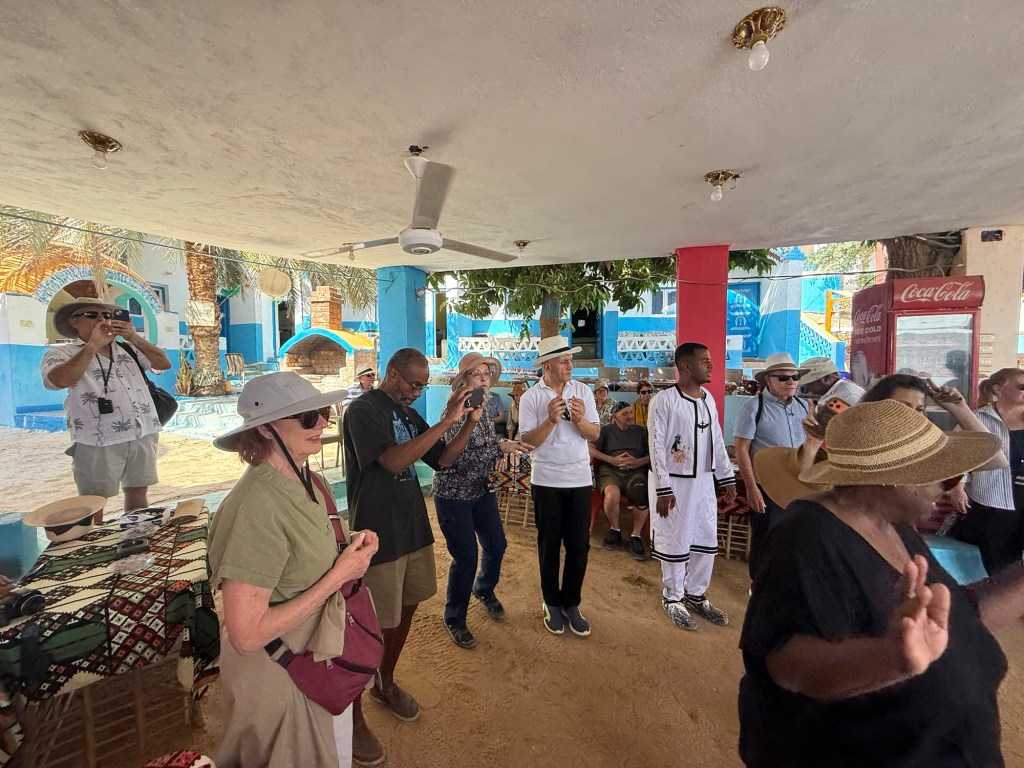
The warm and friendly Nubian people welcomed us with local music, and we danced together.
The Nubian houses, constructed from mud, are often colored blue or orange. Palm trees and gardens are ubiquitous, with residents raising chickens and goats on their farms. Some locals engage in selling handicrafts, while women specialize in drawing Henna for tourists.
And so, what a fun patched morning; as they say, another great AMADay, even though it’s just Noon.
And now it’s time for an afternoon of pool, a sunset, cocktails and dinner.
Afternoon and Evening: Cruising from Temple of Horus to Aswan ~ 25°C/78°F
By Paul Bryers
At this point, it is worth reflecting on the River Nile – named after Agatha “Nile Crocodile” Christie (Let’s see who actually reads this).
The River Nile is arguably the most important river globally. The human species may not be here as we know it today without this river.
At approximately 6,650 km (4,130 mi), it is among the longest rivers globally.
The Nile flows northwards from Upper to Lower Egypt into the Mediterranean Sea.
Its drainage basin covers eleven countries:
Democratic Republic of the Congo
Tanzania
Burundi
Rwanda
Uganda
Kenya
Ethiopia
Eritrea
South Sudan
Sudan
Egypt.
The Nile plays a significant economic role in these nations’ economies and is the primary water source for South Sudan, Sudan, and Egypt.
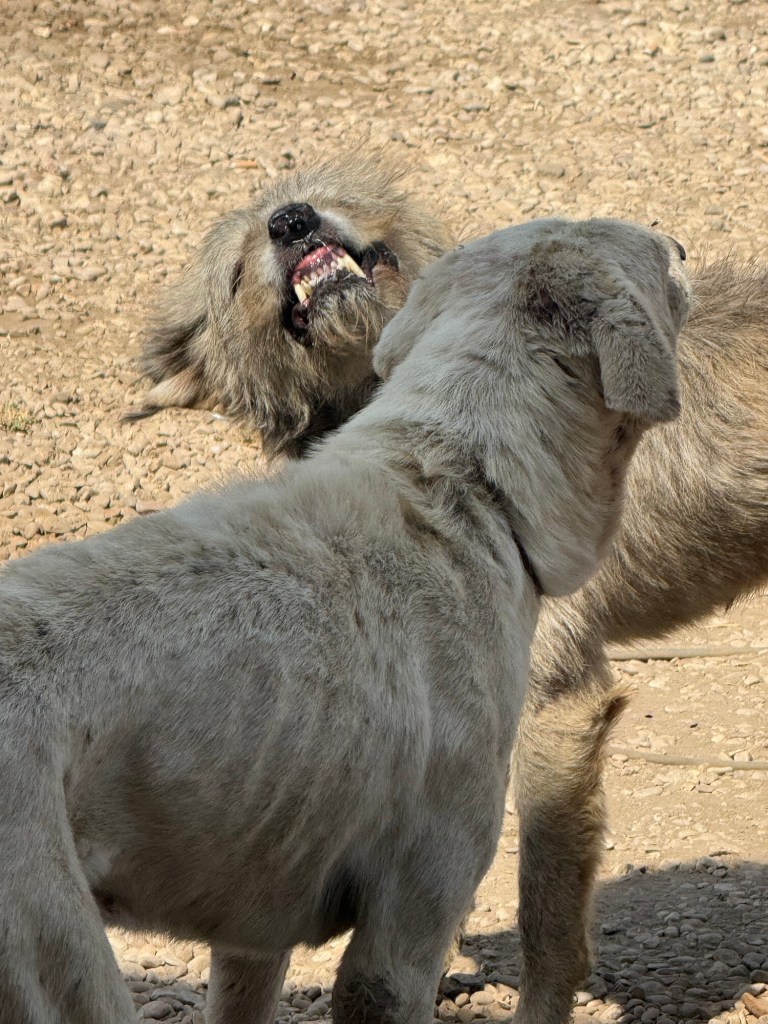
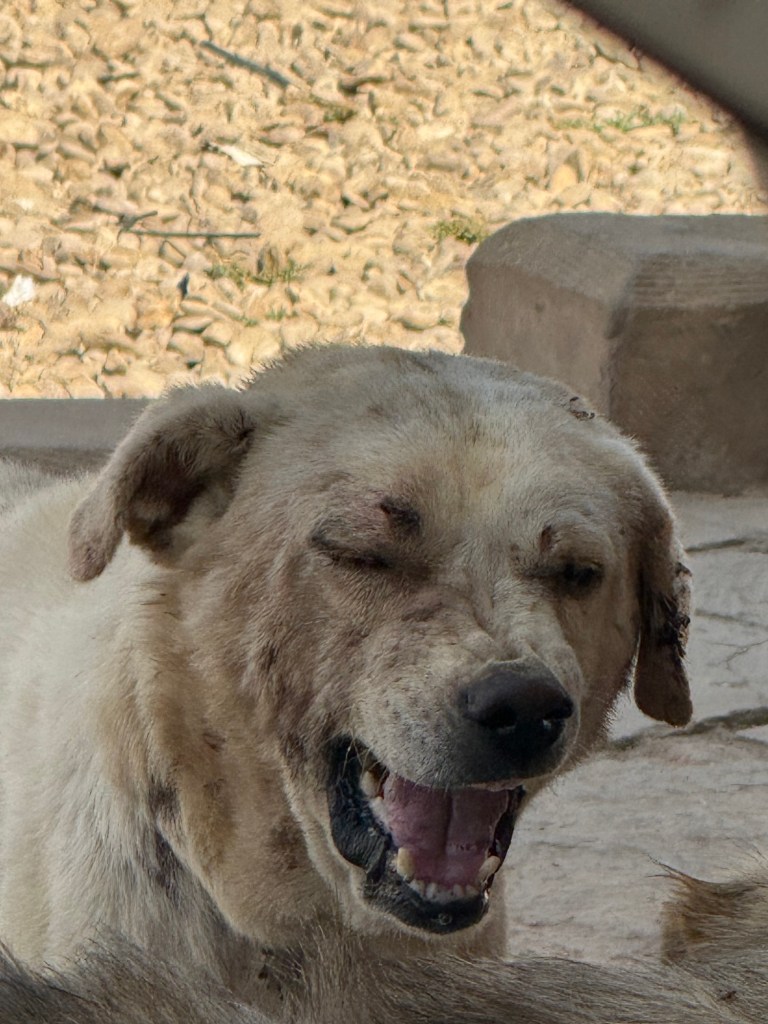
As we left the Temple of Horus, there was the major alpha dog show – all bark and snarl and no substance.
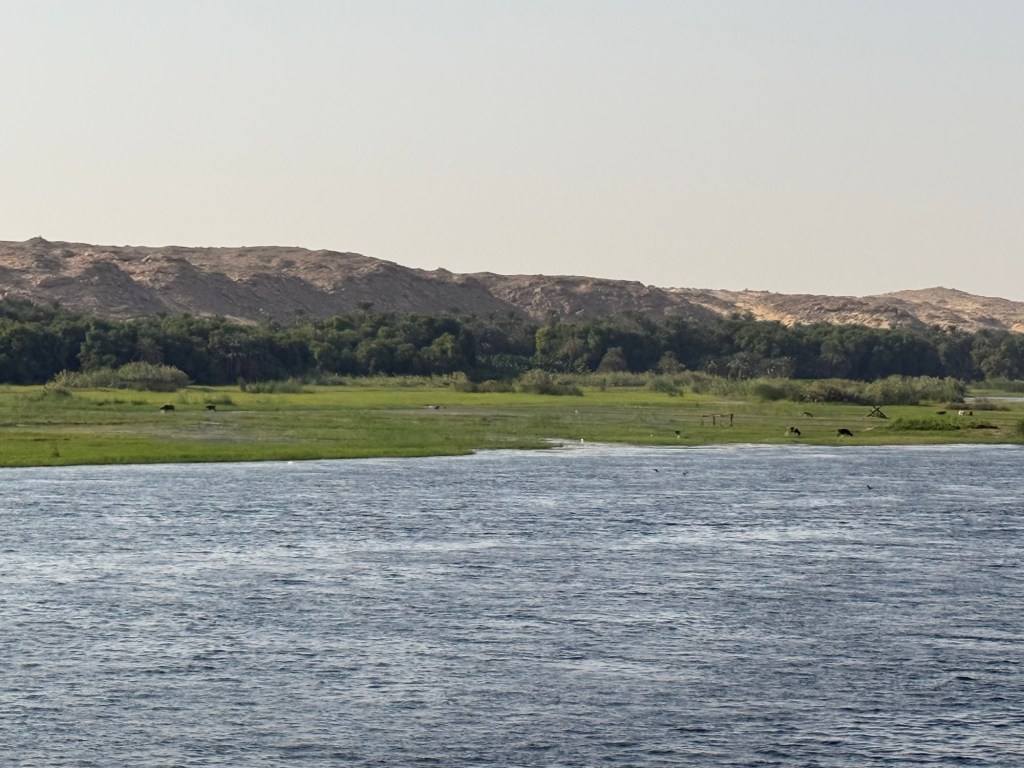
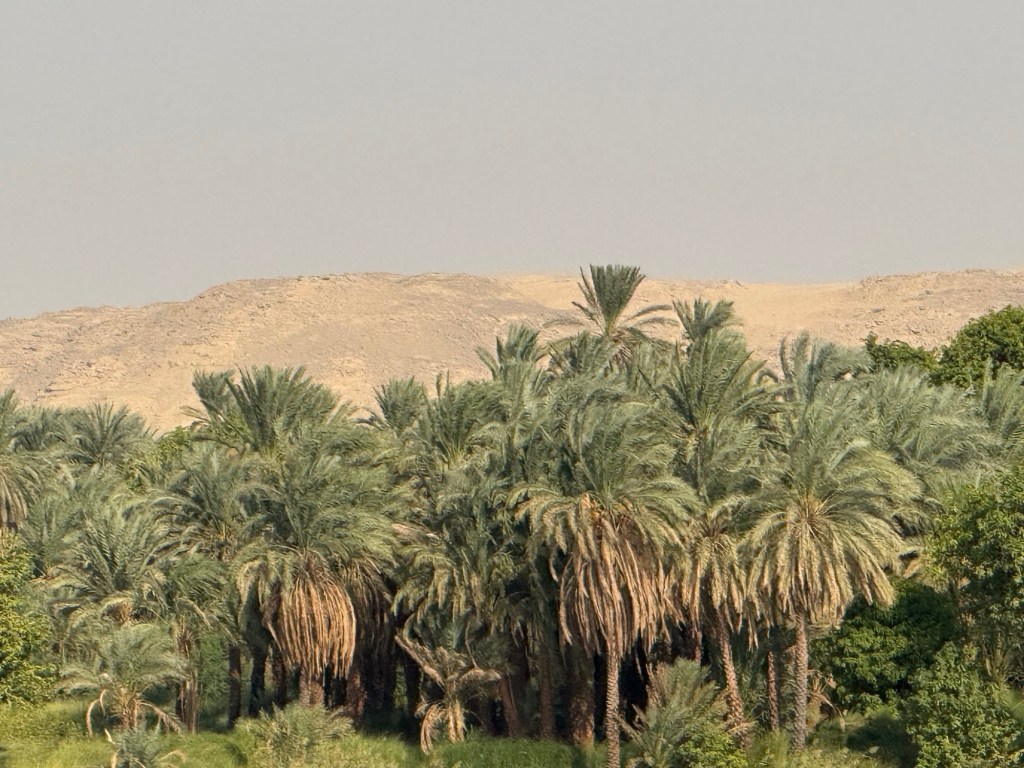
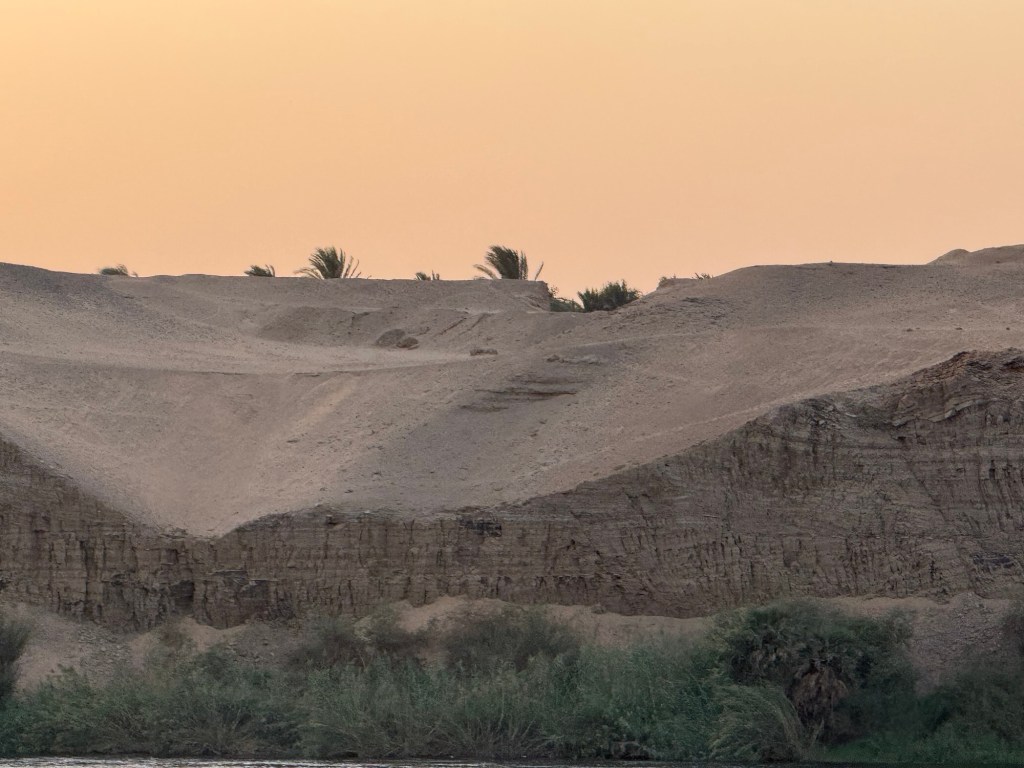
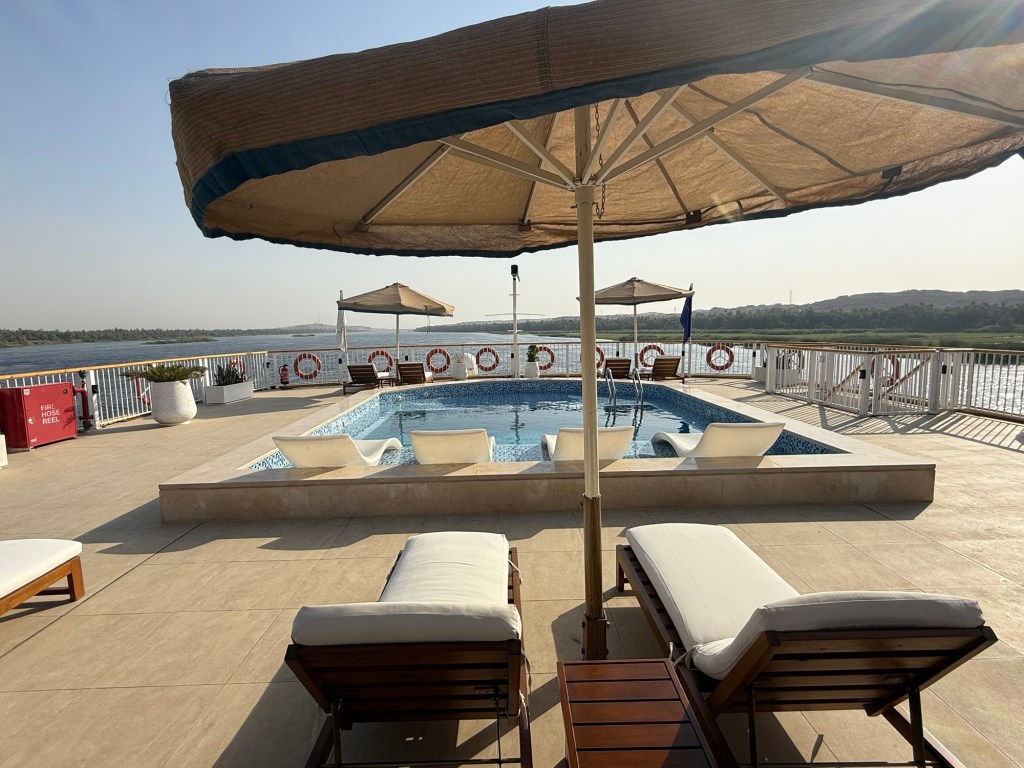
Following the exertion of visiting the Temple of Horus, we had a lovely afternoon and evening cruising the Nile, during which I took photos, enjoyed a massage, spent time by the pool, attended the AMA Family Reunion (as a past AMA cruiser, this being my sixth), Happy Hour, and had dinner at Chef’s Table.
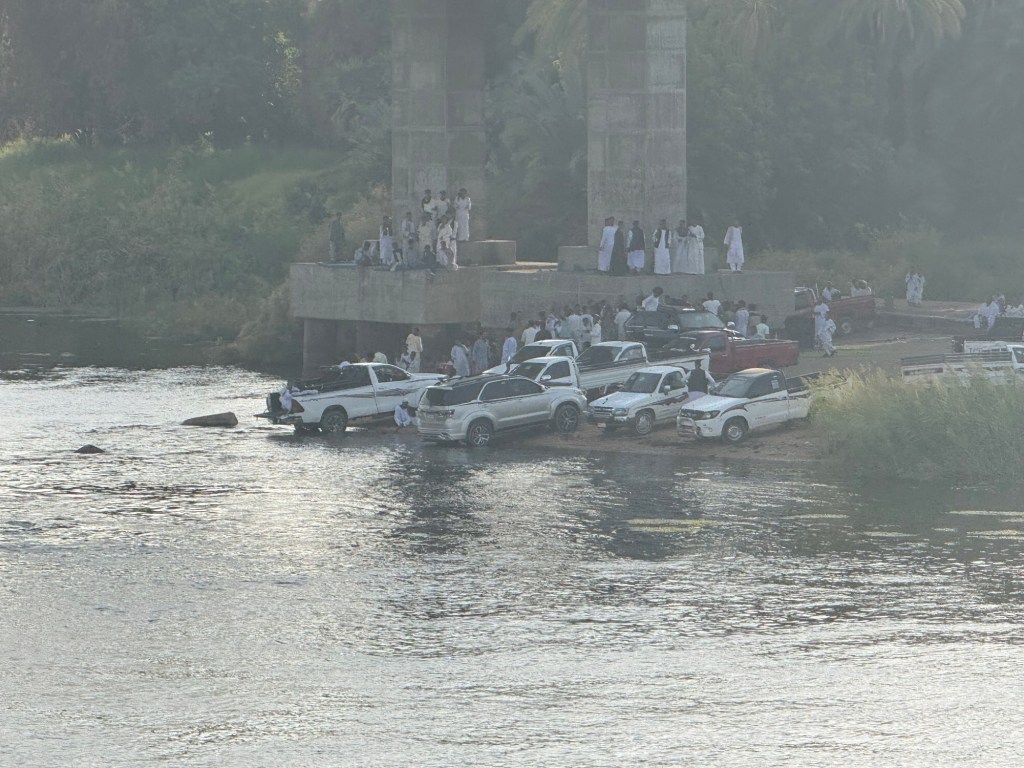
Then, there was the Nile Party for Blokes with Trucks.













































 seetheworldtravelblog