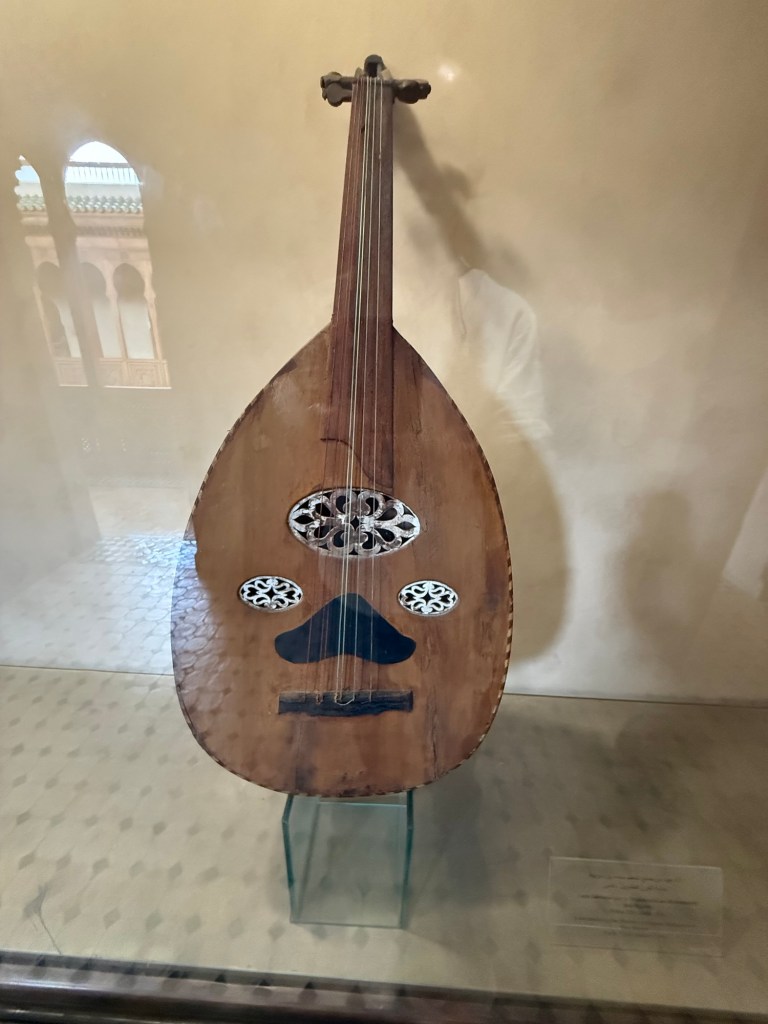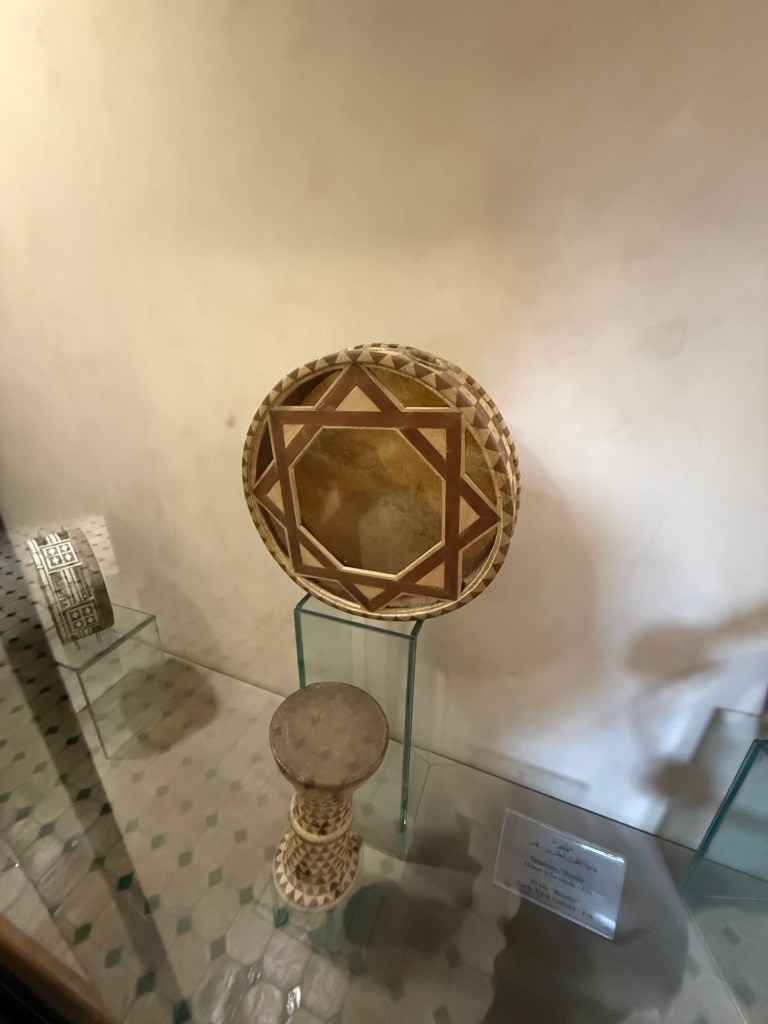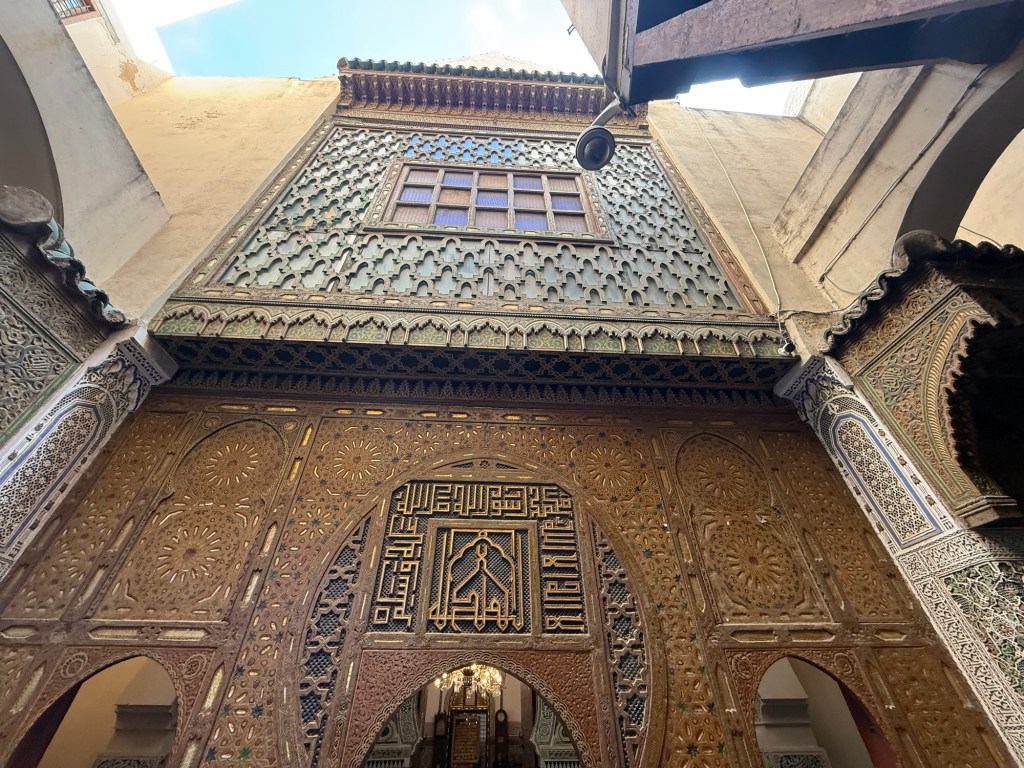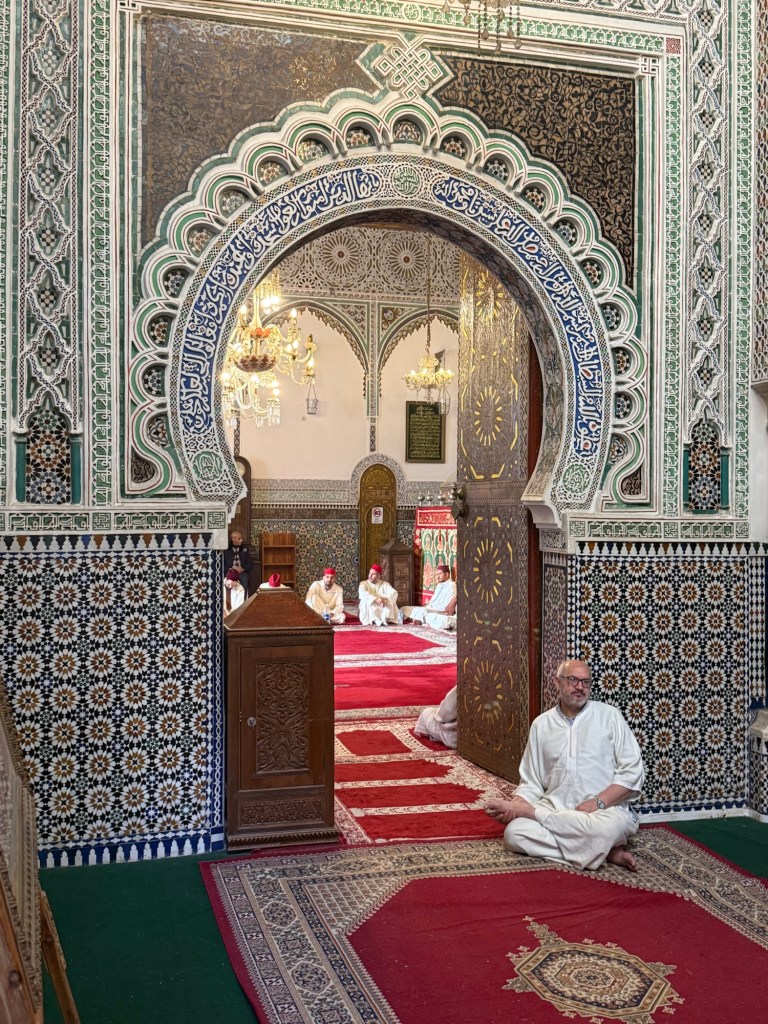
Day 14: Morocco – 14 Days Private Land Tour

By Paul Bryers

  • Day Itinerary: Drive Dades Valley – Ouarzazate – Ait Ben Haddou – Cross High Atlas – Marrakech
  • Accommodation:
  • Driver: Said

Driver:
So on this last day of my 14 day private road trip, I highly recommend Said as a driver. His primary focus was always safety, while being courteous, helpful, and punctual. Said was provided via Luxury Tours Morocco (contact MaryAm).

Last Day:
Today, we embarked on the final leg of our stunning journey, from the Dades Valley through Morocco’s cinematic landscapes to the vibrant city of Marrakech.

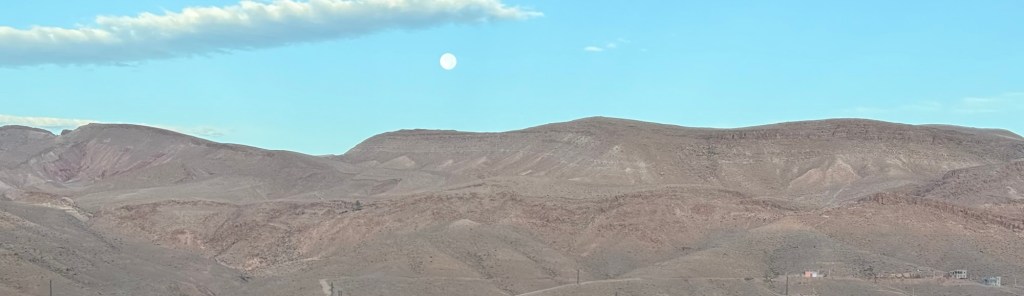
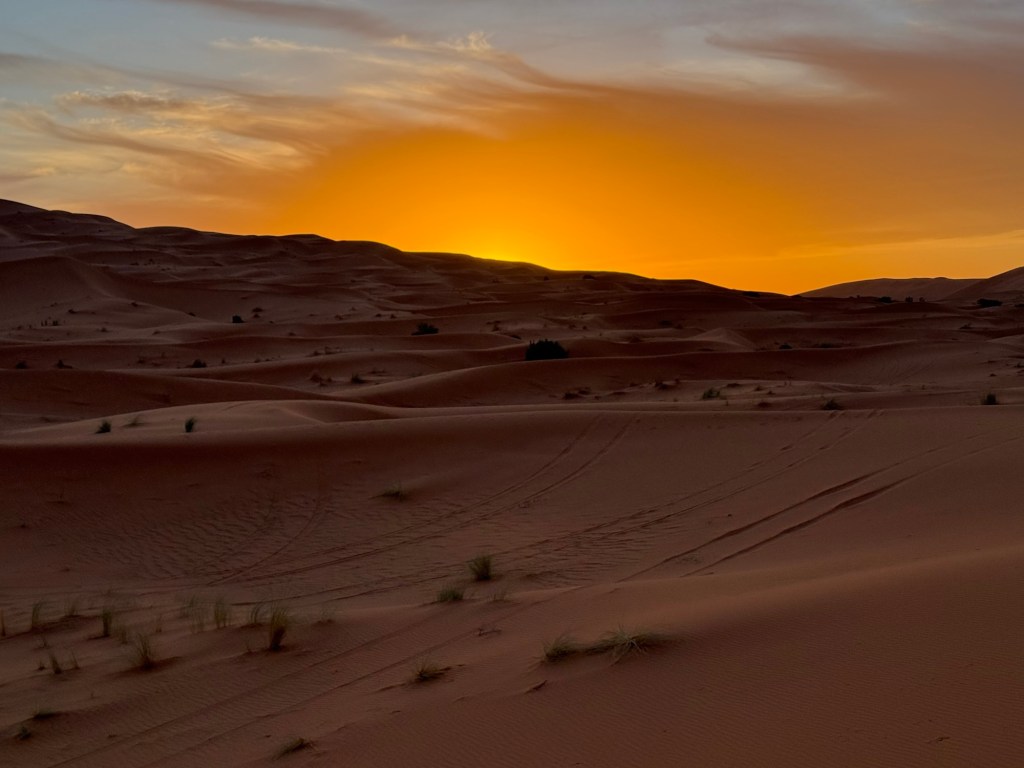
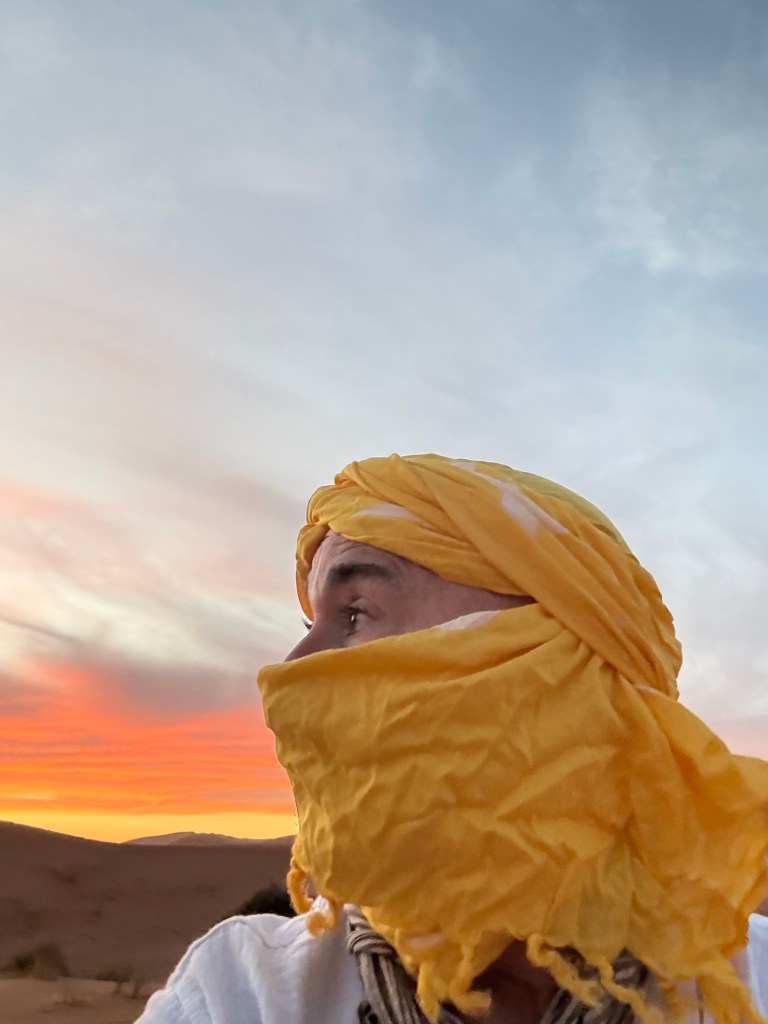
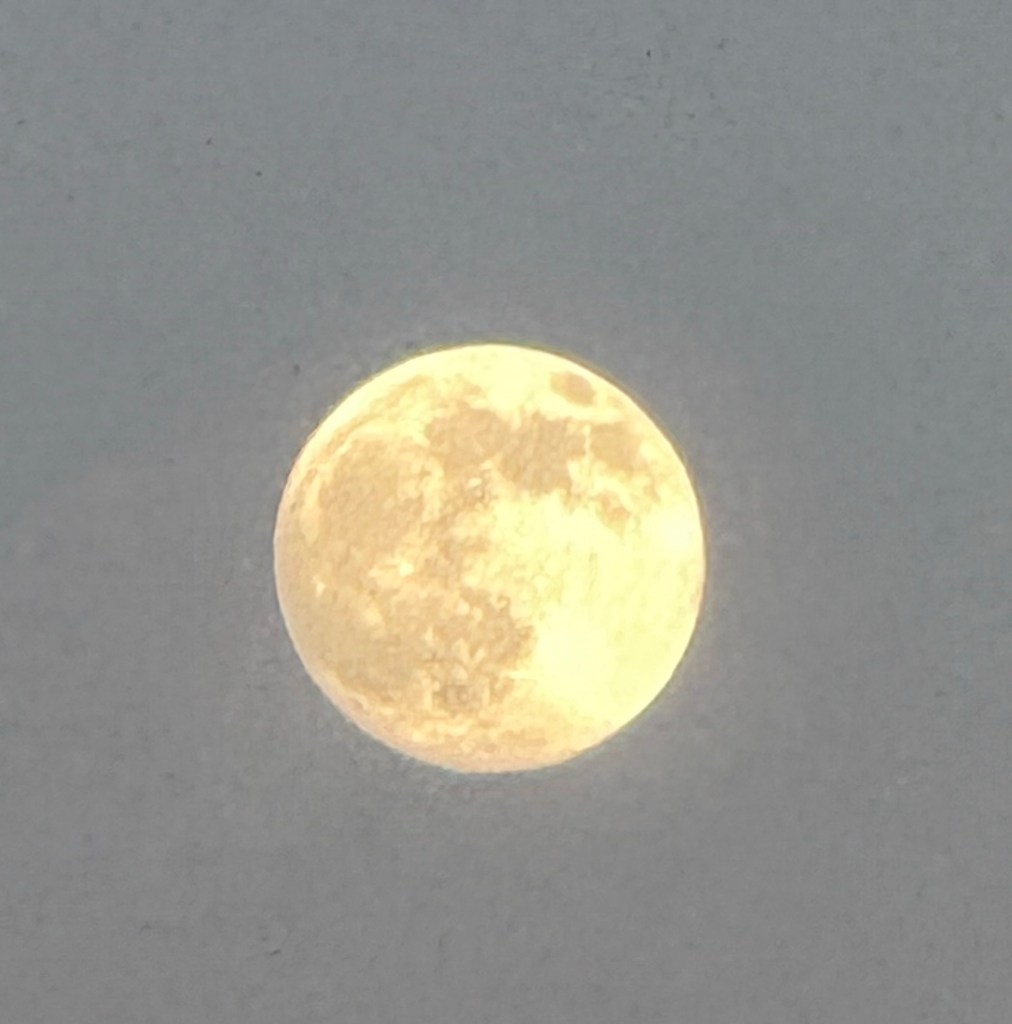
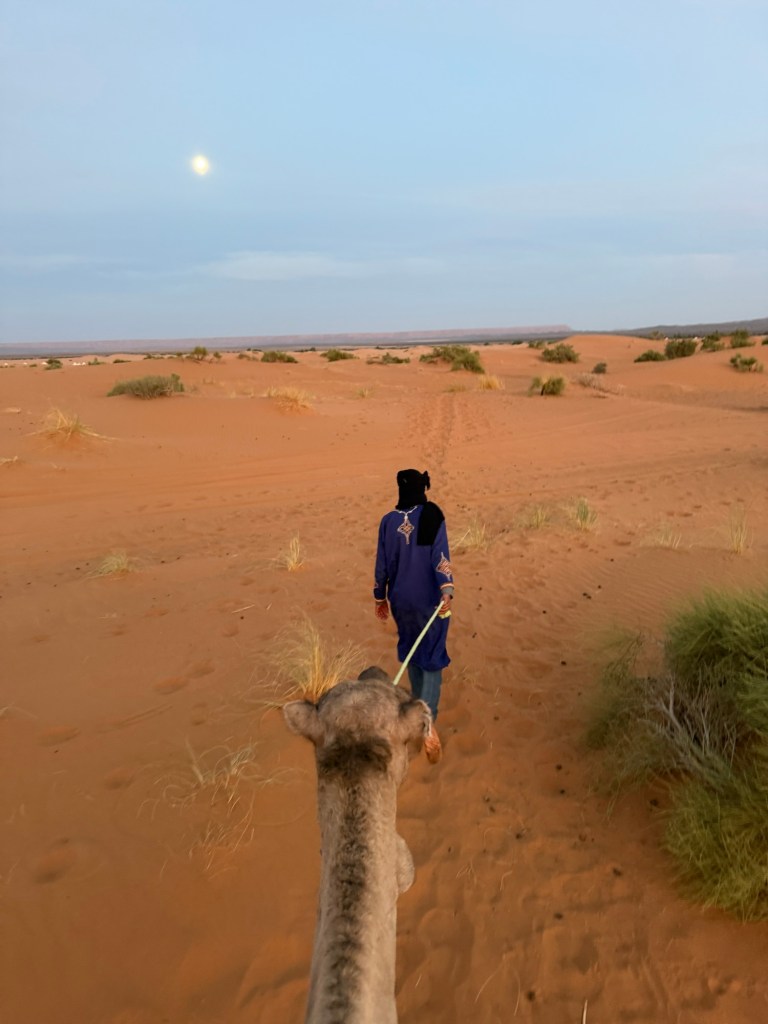
After a lovely Moon rise (or was it set), …..

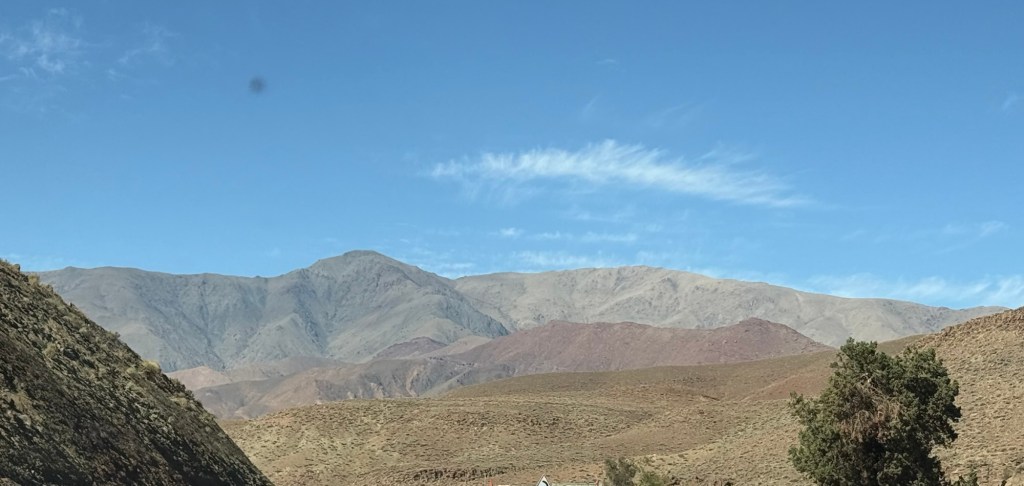
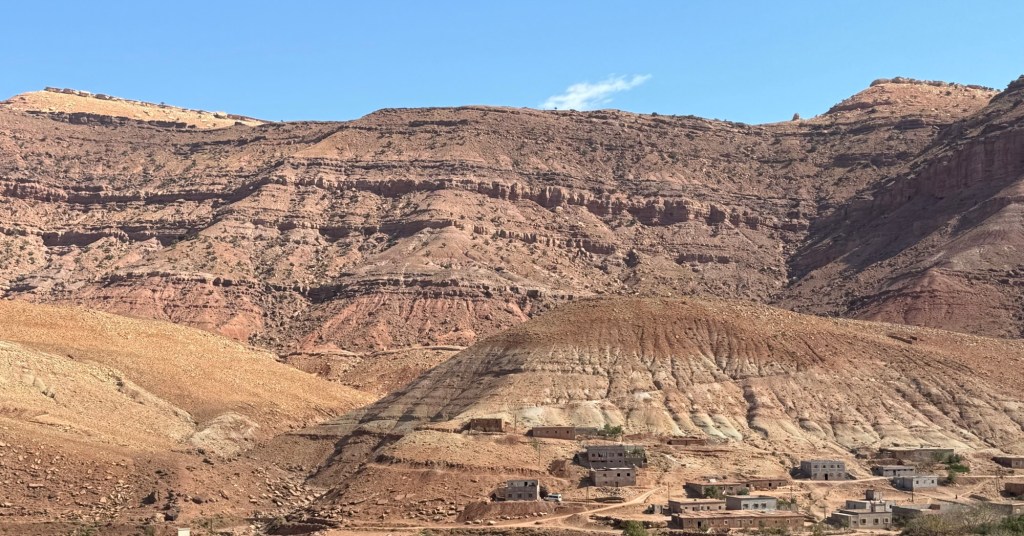
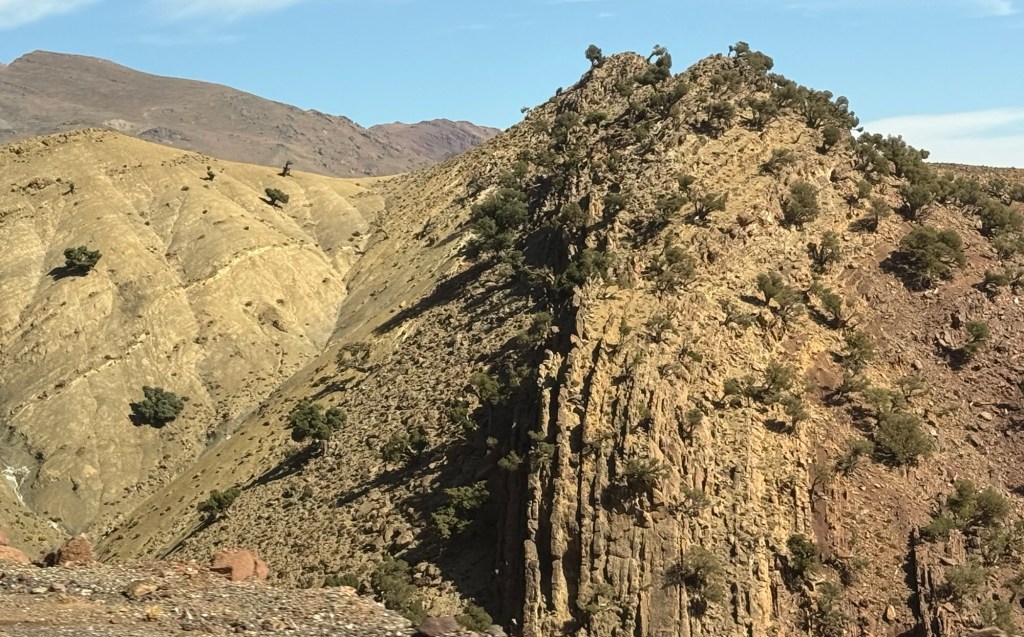
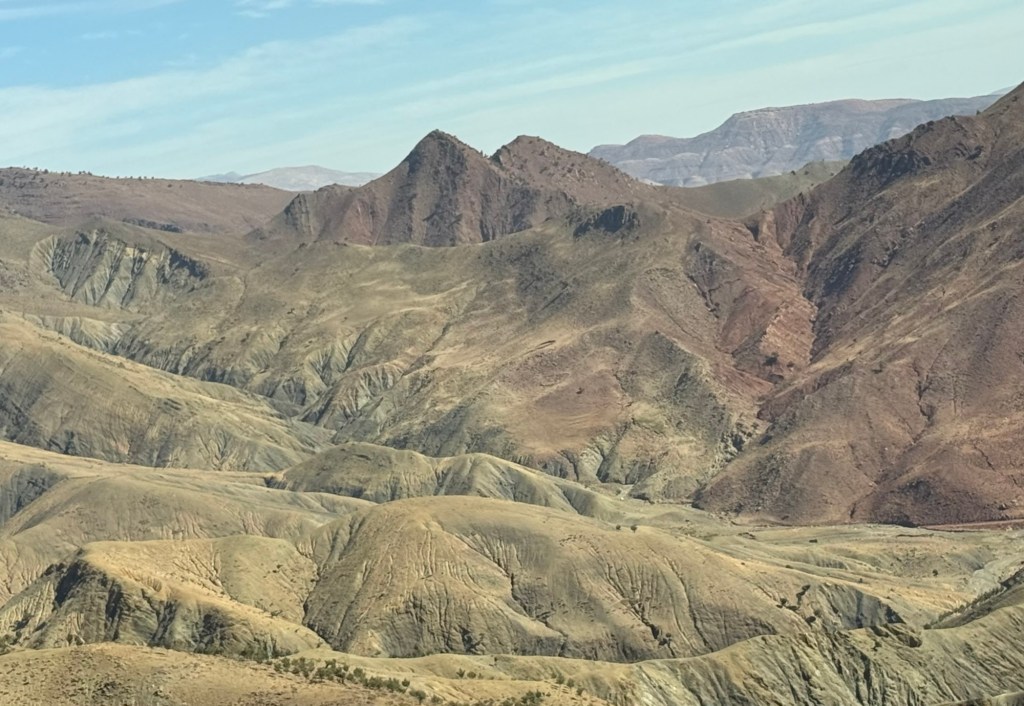
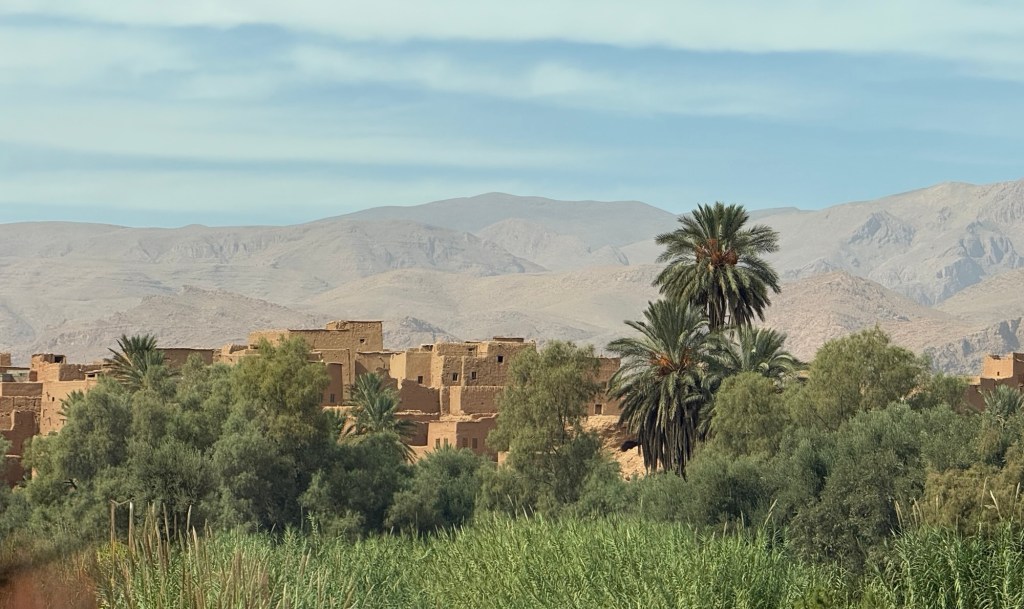
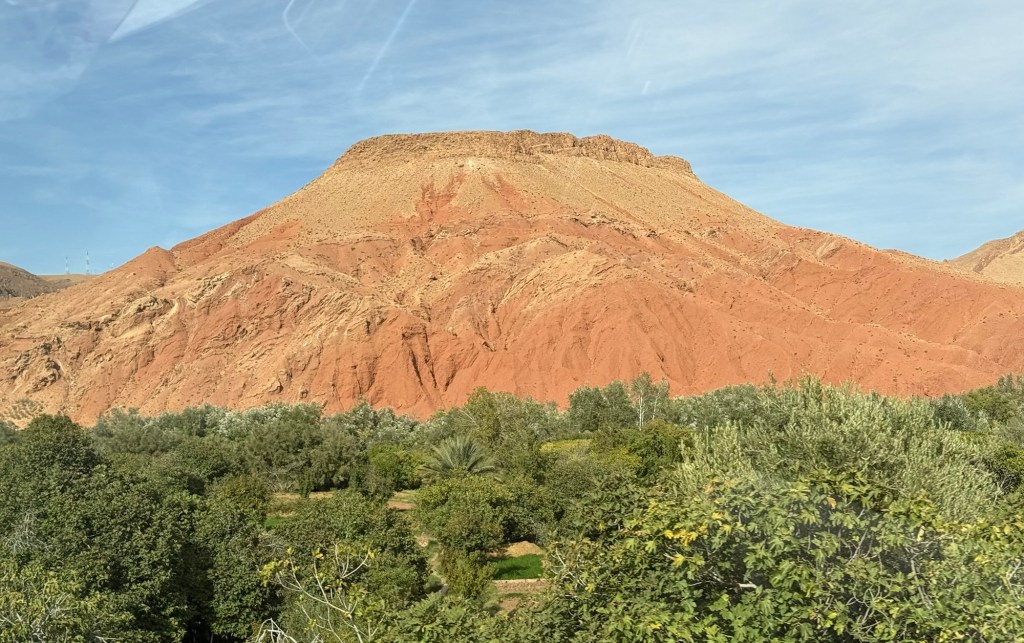
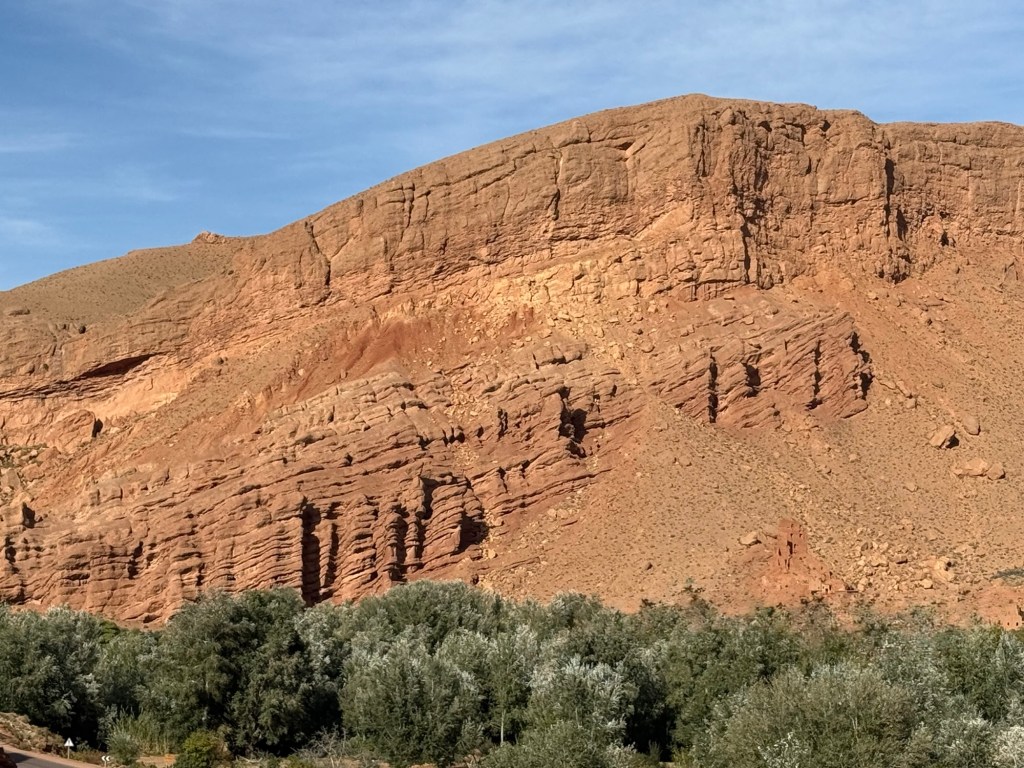
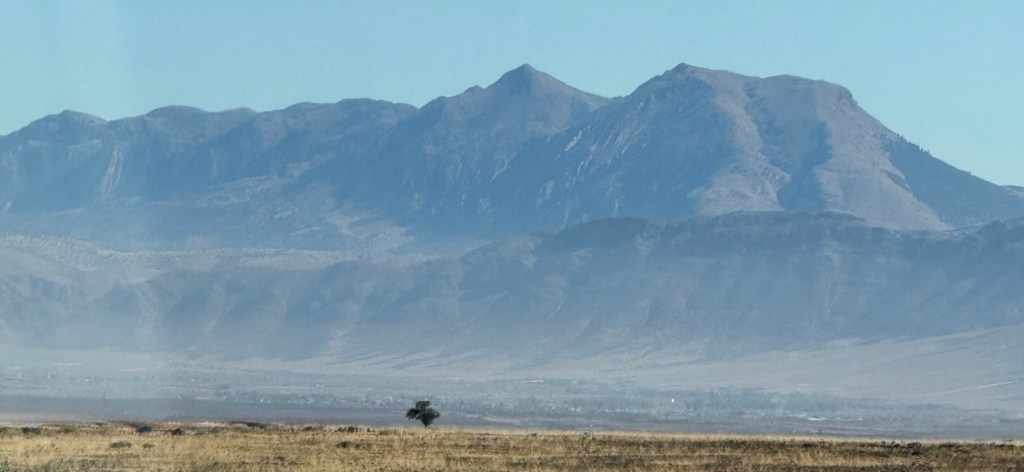
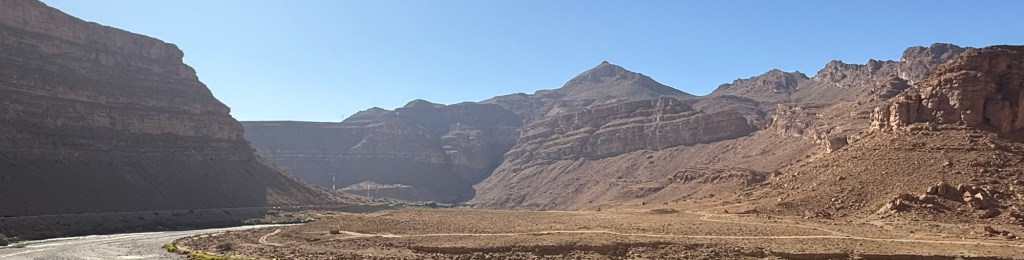
….we departed from the dramatic Dades Gorges, winding through the High Atlas Mountains and passing traditional Berber villages.

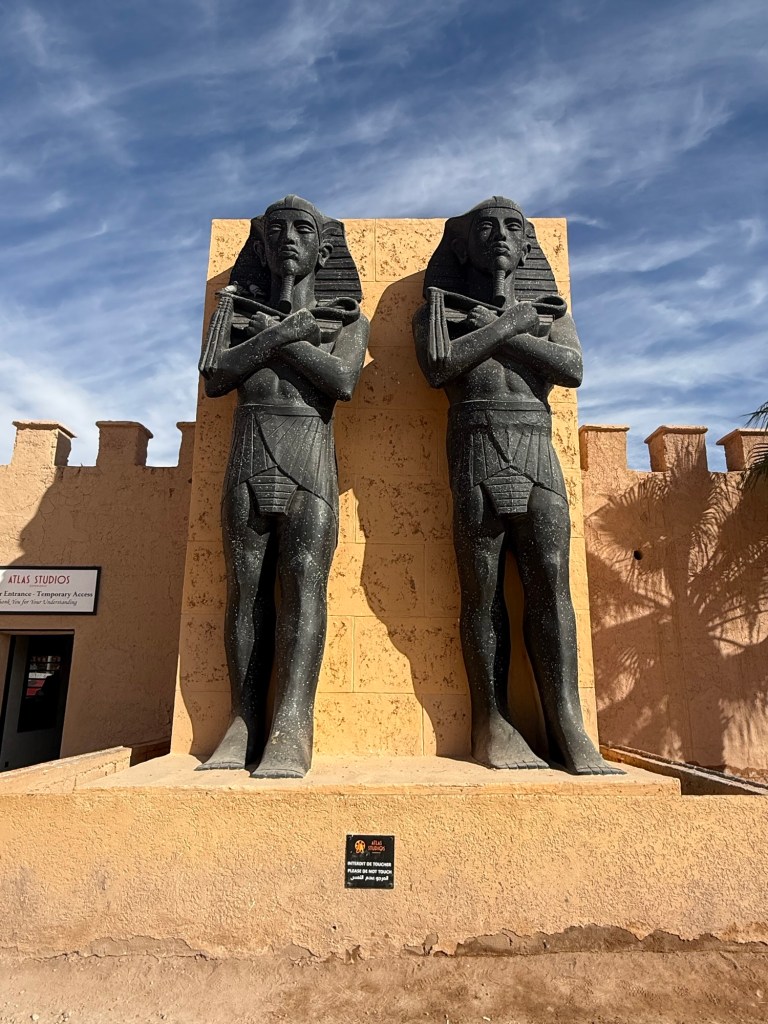
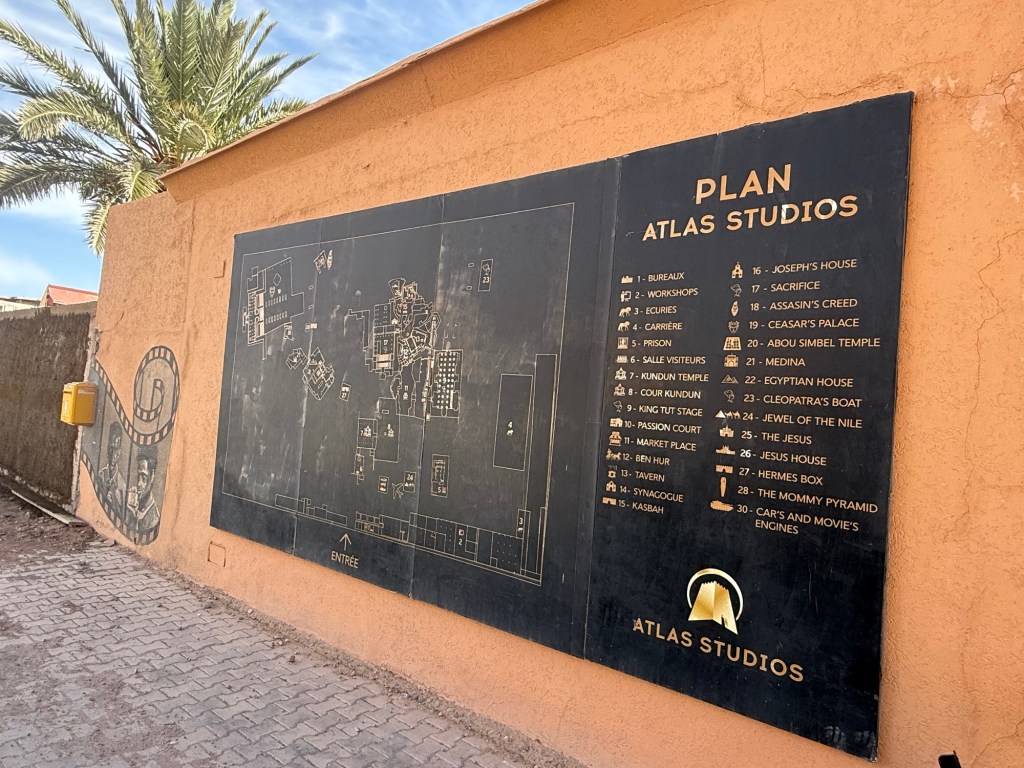
We stopped in Ouarzazate, the “Gateway to the Desert,” famous for its film studios, especially Atlas Studios, and kasbahs.

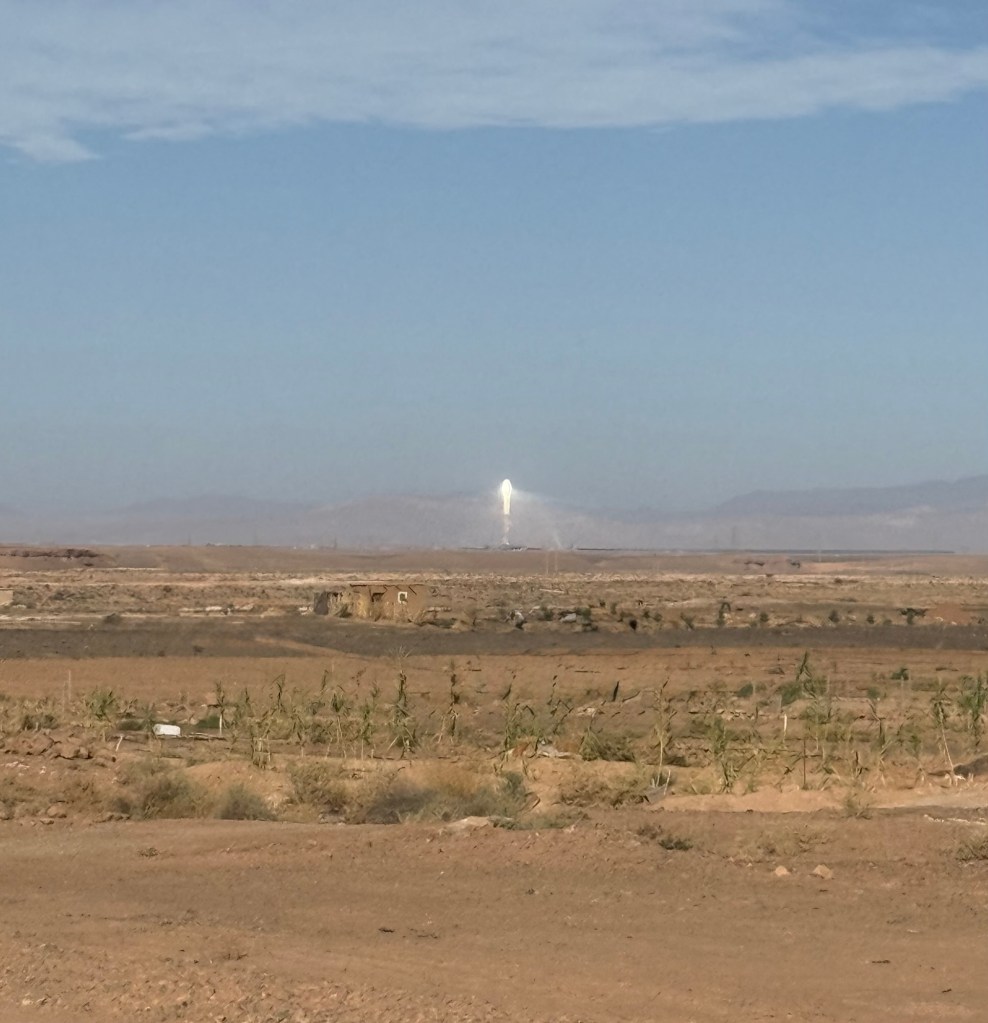
Ouarzazate is also globally recognized for its Noor Power Station, a solar power complex and auxiliary diesel fuel system.

At 510 MW, it is the world’s largest concentrated solar power (CSP) plant. The solar tower utilizes thousands of heliostat mirrors to reflect and focus sunlight onto a receiver atop a central tower. Inside the tower, the concentrated solar energy heats molten salt, which is then used to create steam to drive a turbine generator. This process converts light into electricity, and the molten salt storage allows for power generation even after sunset. The plant was completed in four phases and covers an area of over 3,000 hectares (12 sq mi).

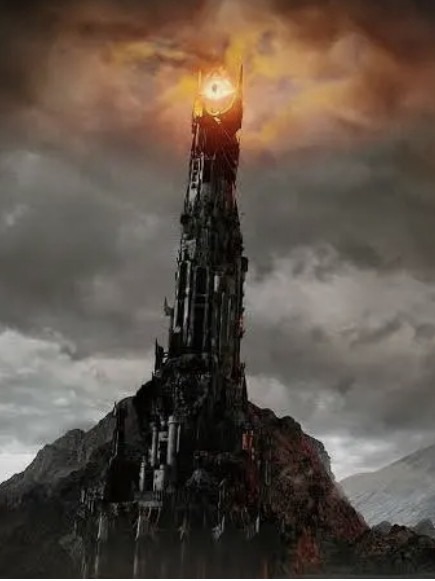
Actually, I don’t think it’s a solar complex at all – no, it’s The Eye of Sauron atop Barad-dûr!

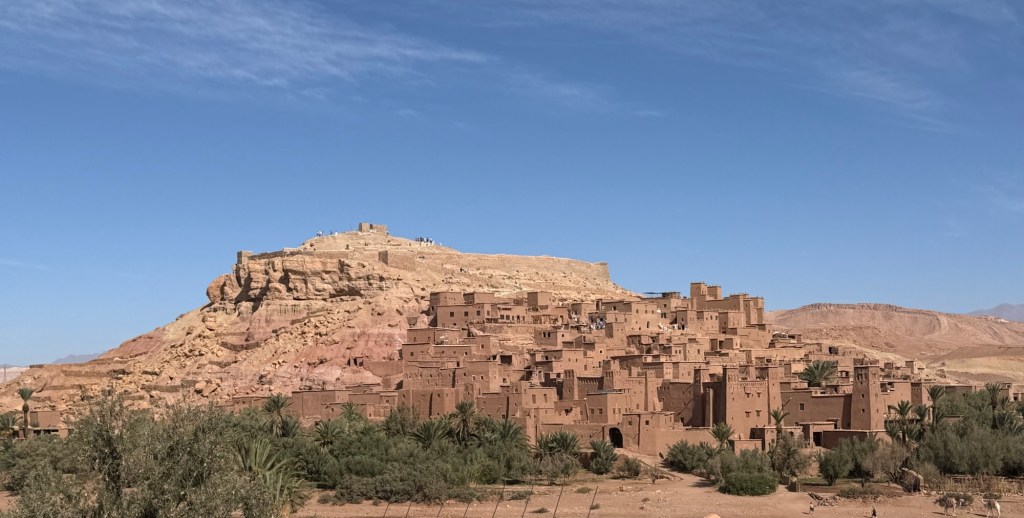
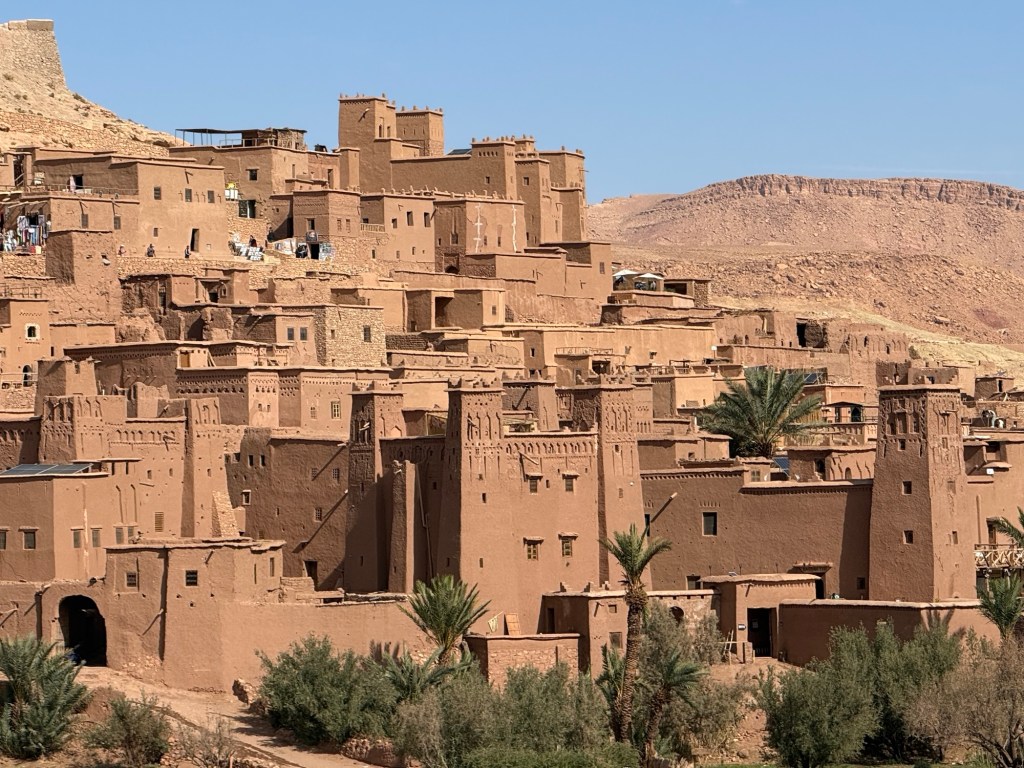
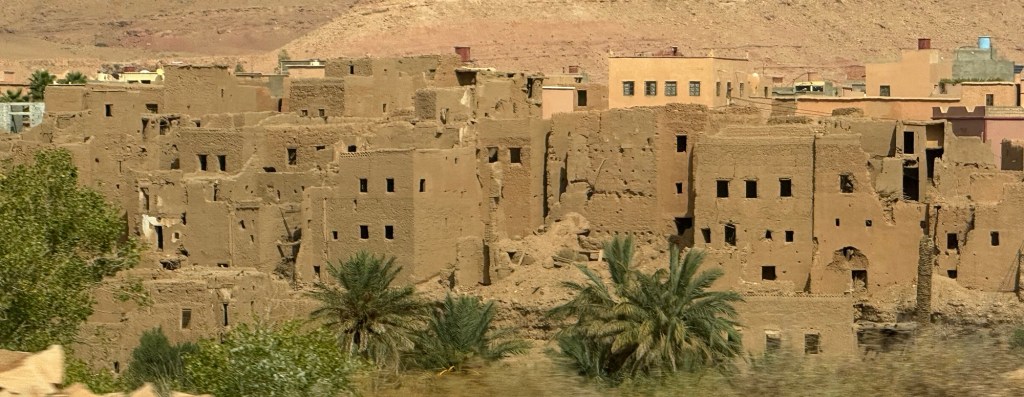
Our next stop, Aït Benhaddou, is a historic fortified village (ksar), located along the former caravan route between the Sahara and Marrakech. It is a UNESCO World Heritage site famous for its stunning mud-brick architecture and as a popular filming location for movies like Gladiator and Game of Thrones. I am done with red mud brick buildings in the heat, so I had a coffee and contemplated my return to chilly Glasgow with its red brick/stone buildings. Mmmmmh…

Next up was re-crossing the High Atlas. I love mountains! The best thing is mountains with wee lochs or tarns.

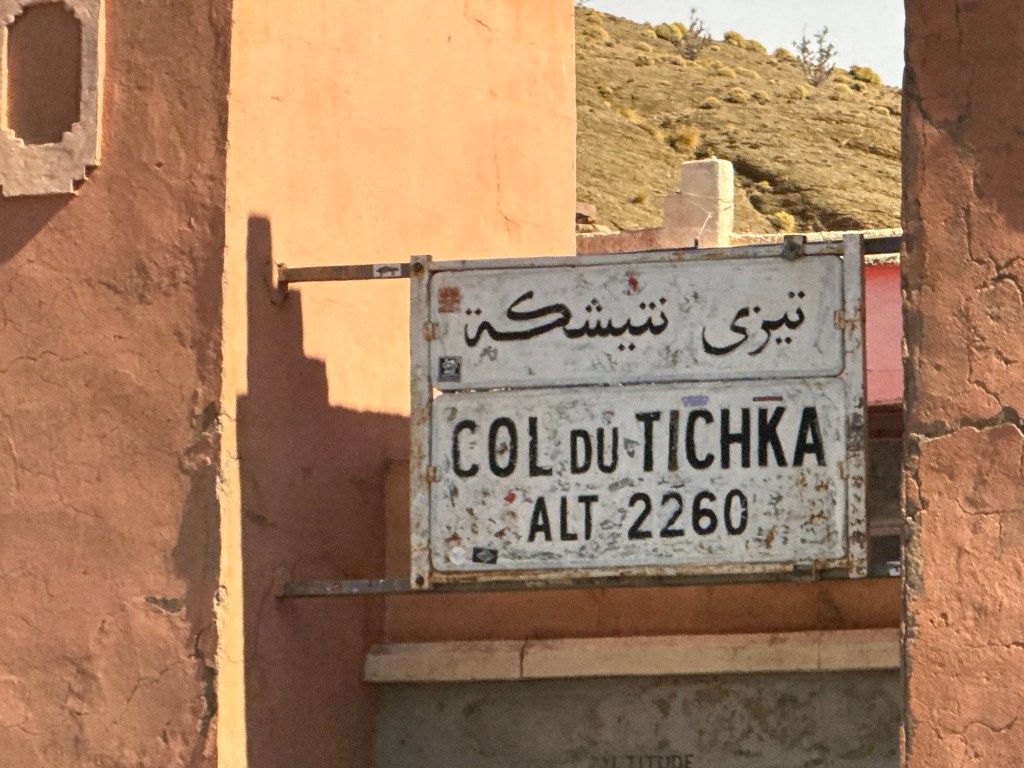
We ascended to Col du Tichka at 2,260 meters (7,400 feet).

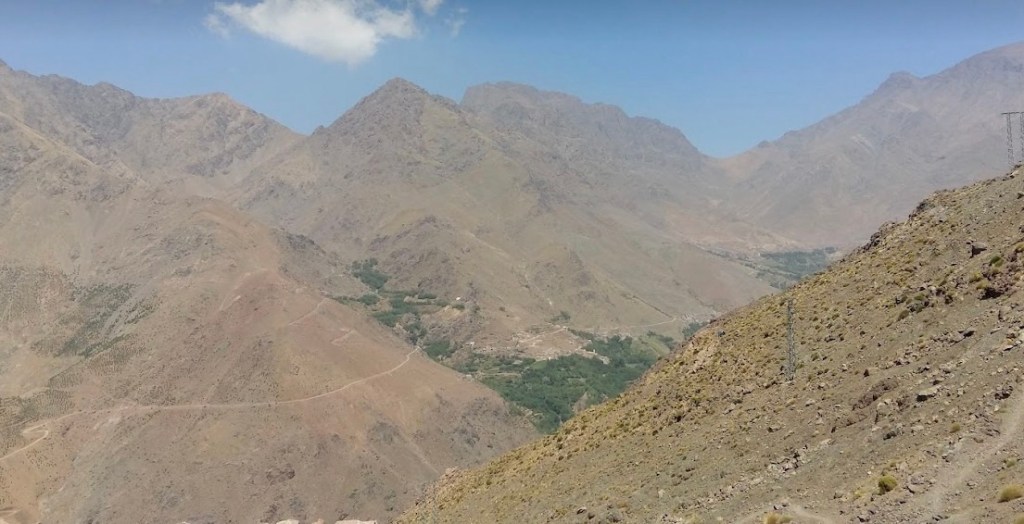
Ouanoukrim, towering close by, has two peaks, with the highest, Timzguida, reaching 4,088 meters (13,415 feet), and the second, Ras Ouanoukrim, standing at 4,083 meters (13,396 feet). These peaks are the second and third highest in the Atlas range in Morocco.

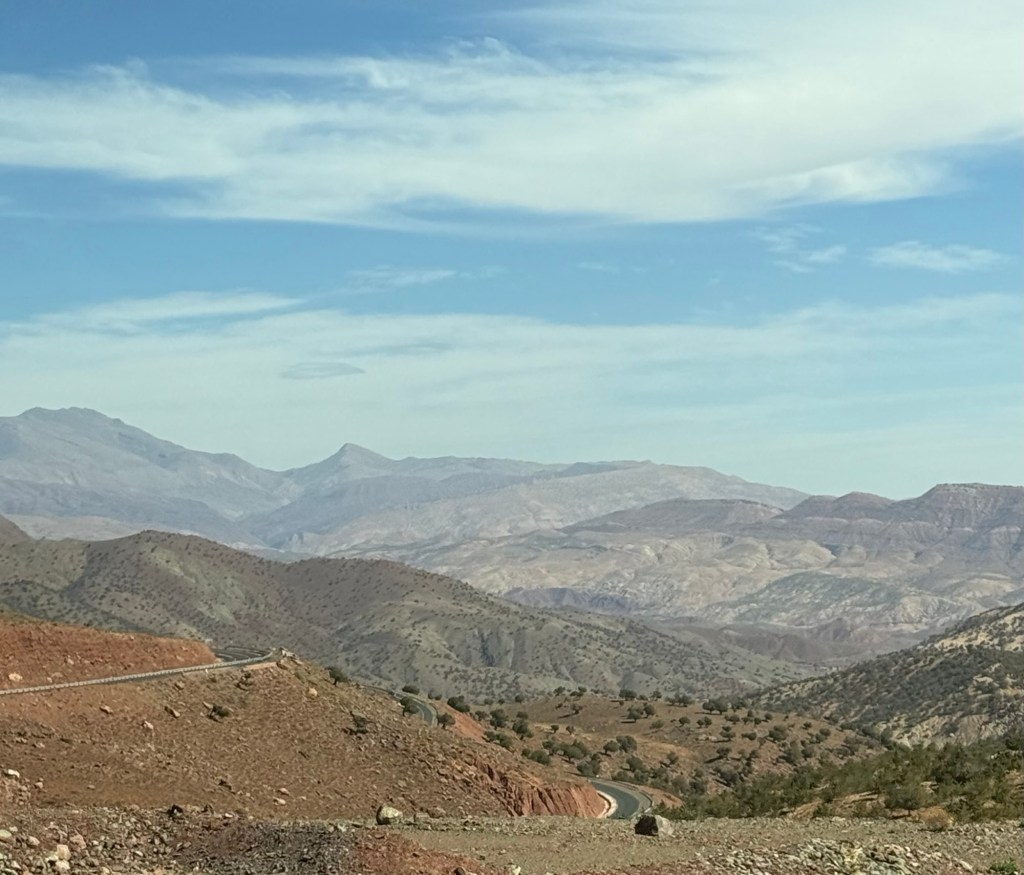
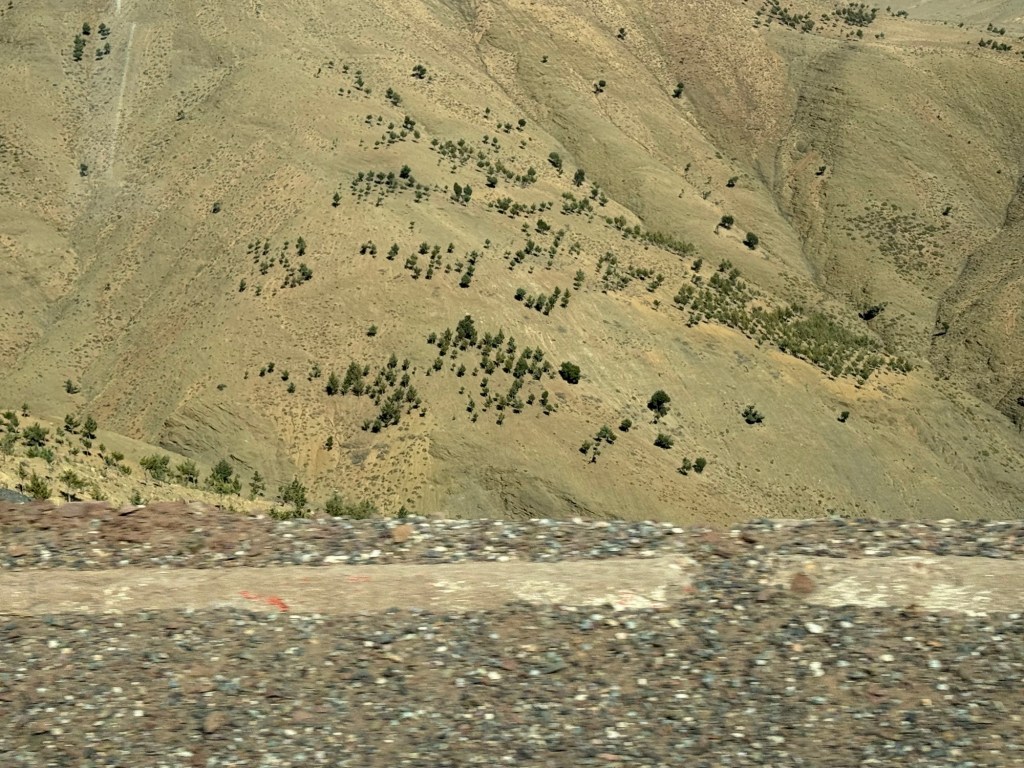
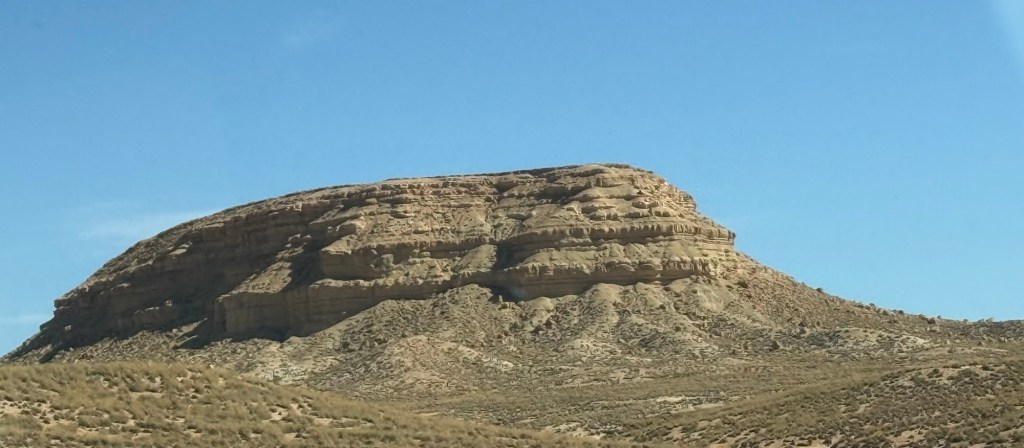
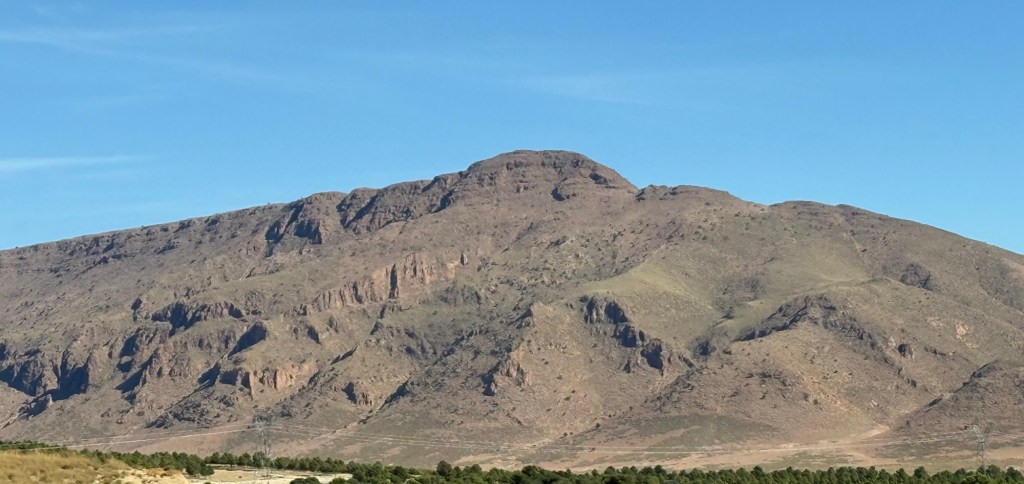
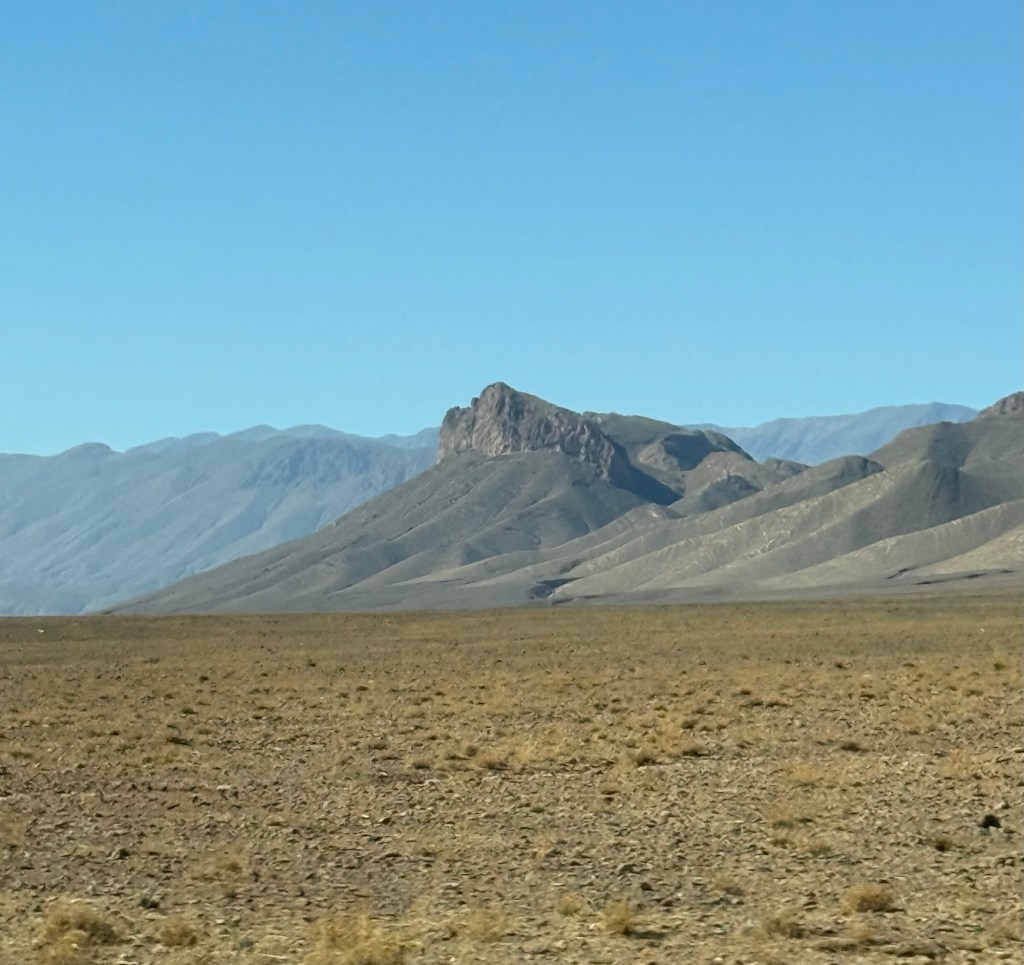
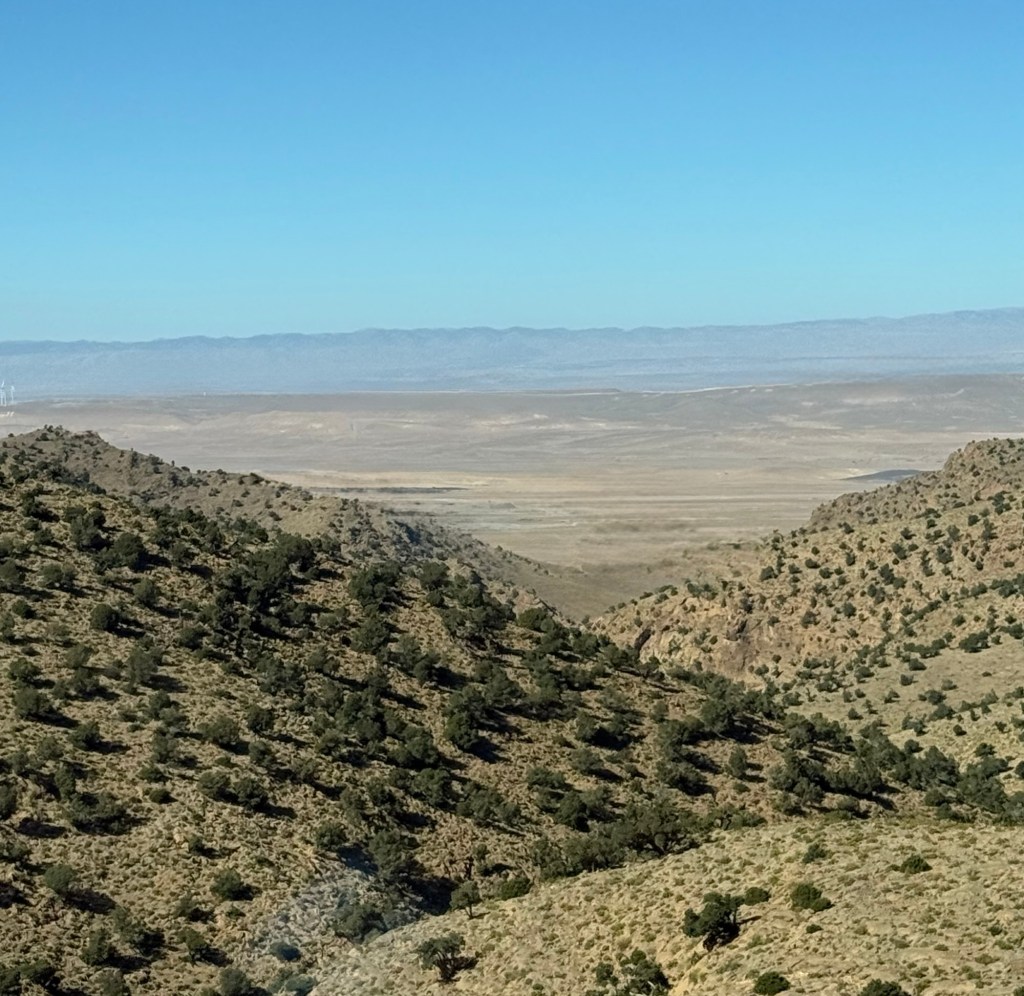
And then down and down …..

….and sometimes the road was alarmingly close to the edge but trusty Said was in full control…

Yes, that’s the outer white line of the road..

….and down to Marrakech and that’s a wrap for this trip.

Sorry it is over but excited to see my new home in Glasgow!

Thanks for following me. I’ll be back posting trips in April 2026….

Day 13: Morocco – 14 Days Private Land Tour

By Paul Bryers

  • Day Itinerary: Drive Erg Chebbi, Sahara – Tingher – Todgha Gorges – Dades Valley
  • Accommodation: Ksar Sultan Dades

Today’s journey was characterized by diverse landscapes, transitioning seamlessly from desert serenity to mountain majesty as we traveled from the golden dunes of Erg Chebbi, Sahara to the dramatic landscapes of the Dades Valley, one of Morocco’s most scenic desert-to-mountain routes.

We departed Merzouga after sunrise over the dunes.

The Tafilalet palm groves are the largest oasis in Morocco, representing a vital agricultural and ecological area, renowned for date palm cultivation, and historically significant as the origin of the Alaouite dynasty (current monarchy). This vast area includes fortified villages like Rissani and Erfoud, which I visited a couple of days ago, and is irrigated by underground waters from the Ziz and Gheris rivers.

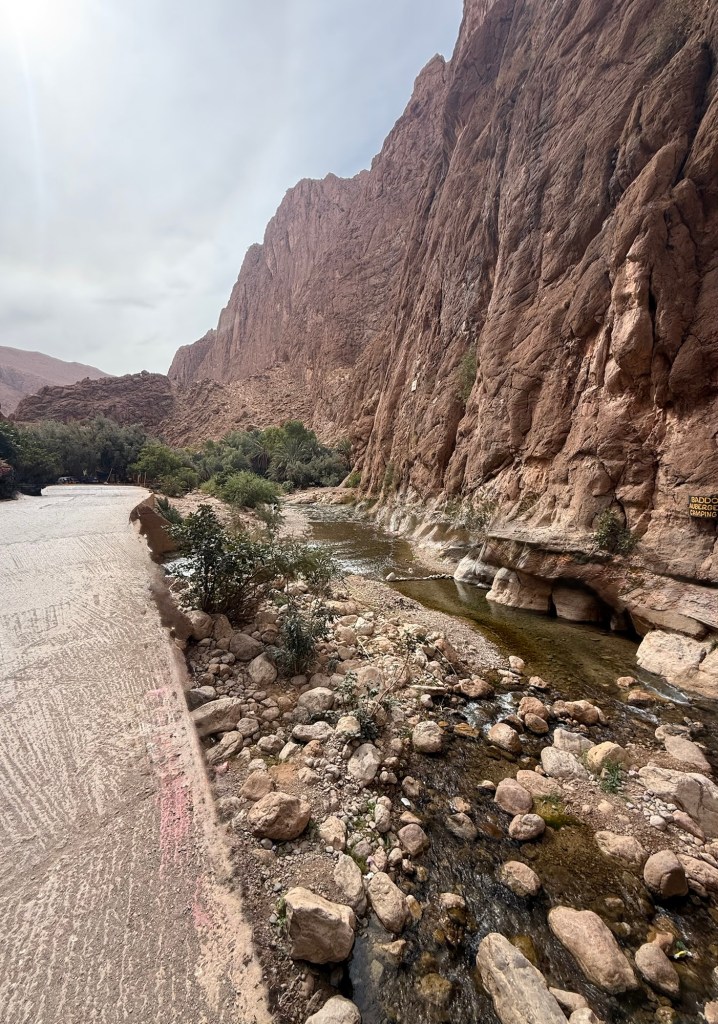
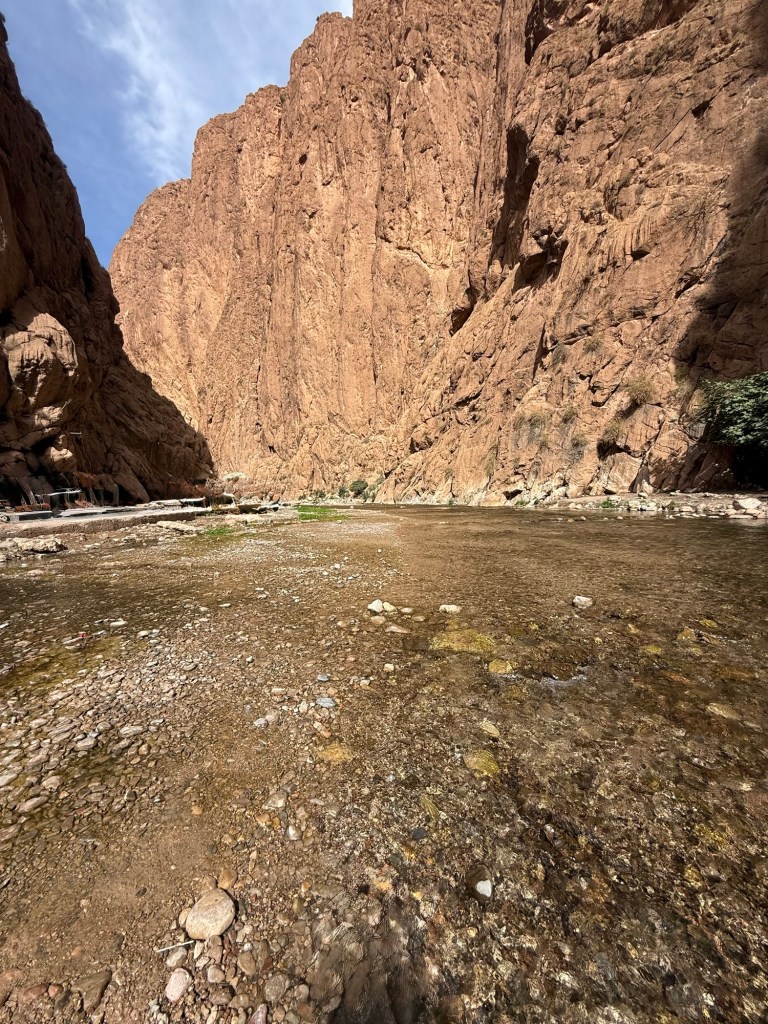
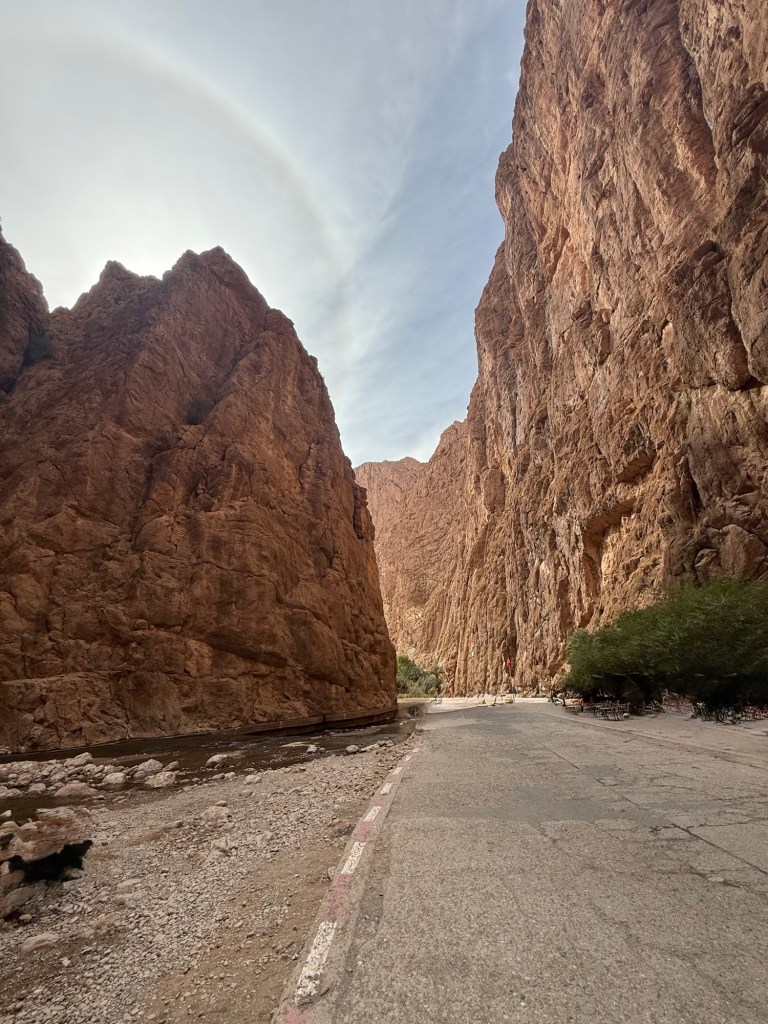
Next, we visited the Todgha Gorges, a series of limestone river canyons, or wadi, in the eastern part of the High Atlas Mountains, near the town of Tinerhir.

Both the Todgha River and the neighboring Dadès River are responsible for carving out these impressive deep cliff-sided canyons, on their final 40 kilometers (25 mi) through the mountains. The height of the canyon walls can vary, but in some places can reach up to 400 meters (1,312 ft) high.

The cliffs are a favorite among rock climbers, who were evident today. I would have joined them, but I’m on a tight schedule.

After Todgha, we continued through winding roads carved into red canyons until reaching the breathtaking Dades Gorge.

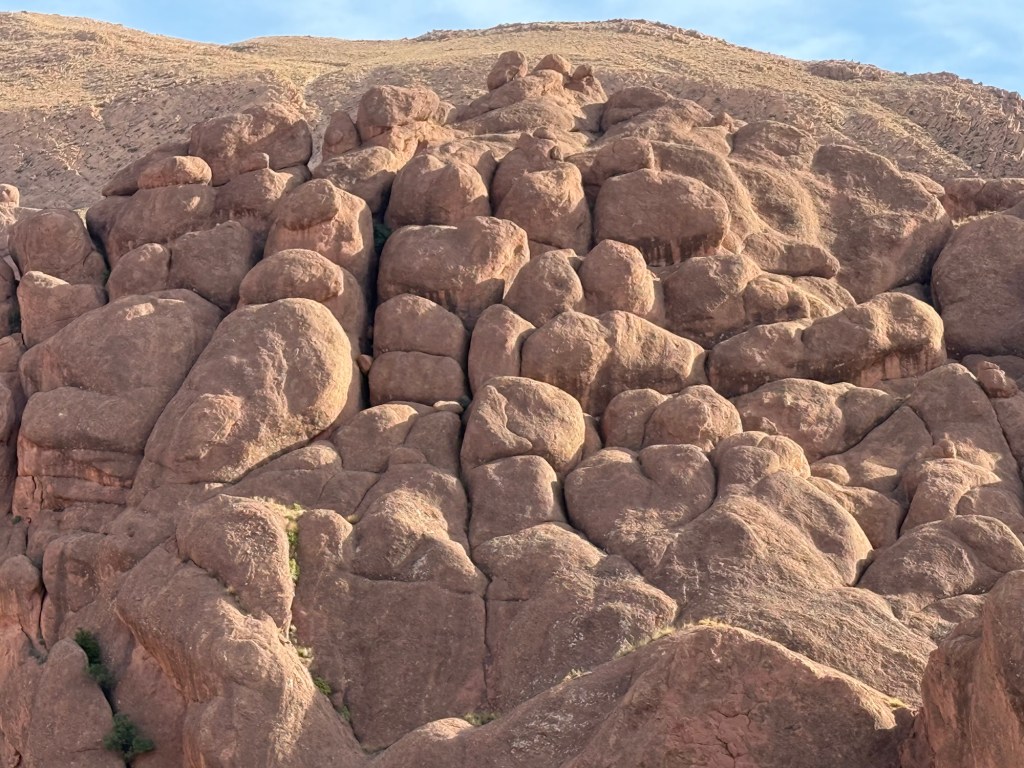
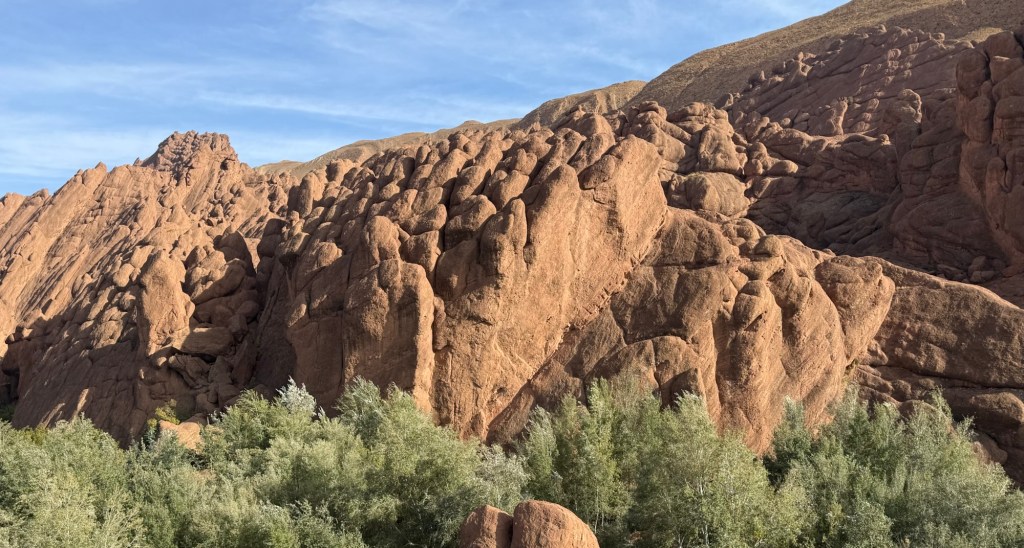
The gorge is known for its “monkey fingers” rock formations and panoramic viewpoints. I’m not sure why they are called monkey fingers – monkey finger tips would be a more accurate description.

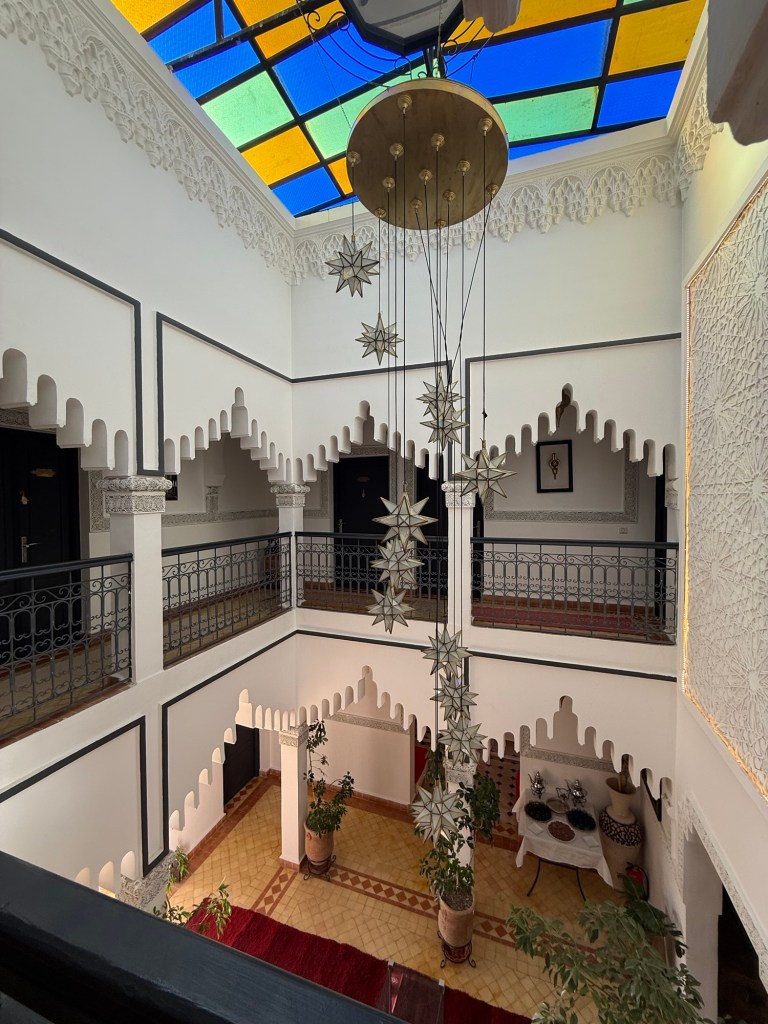
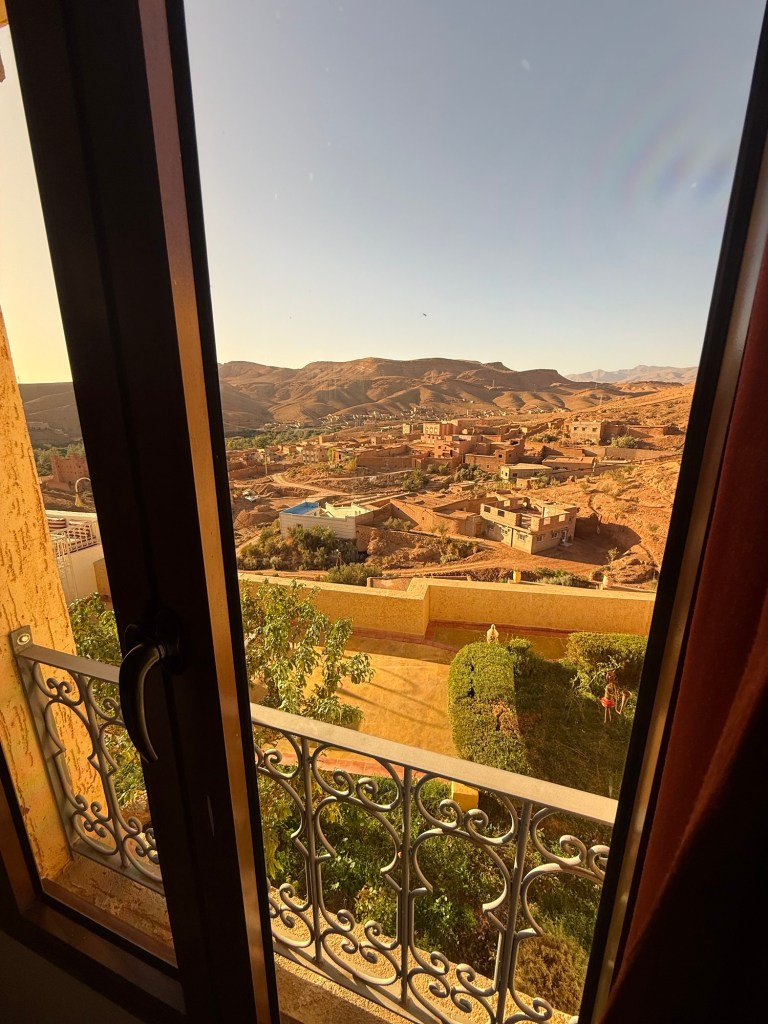
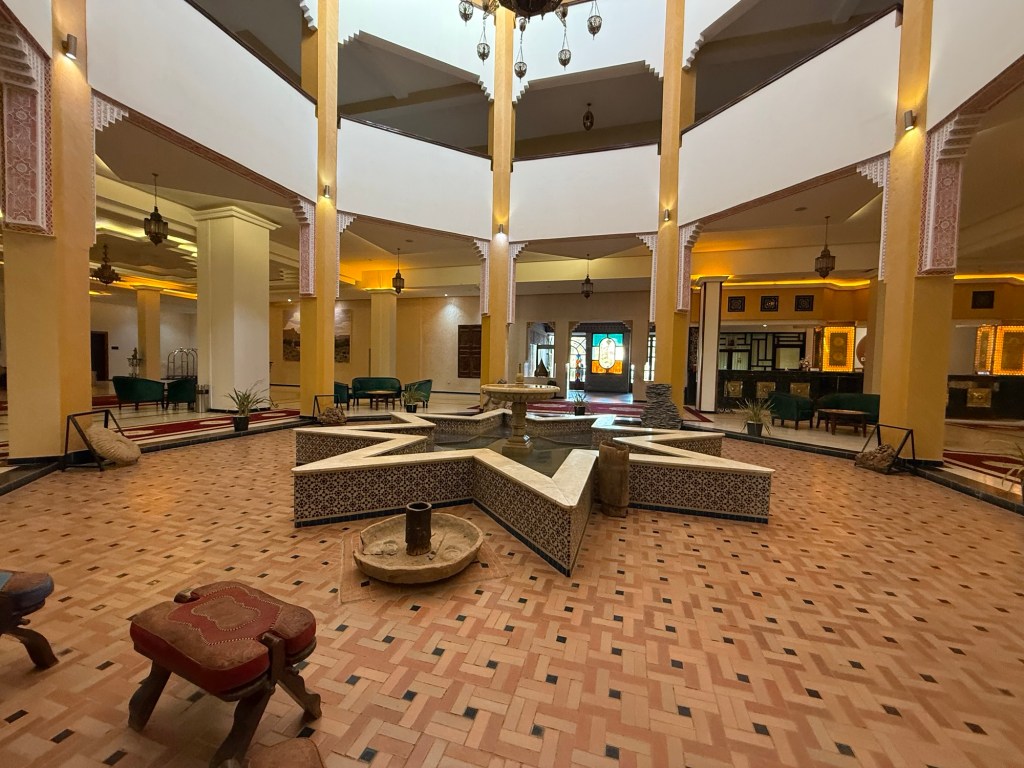
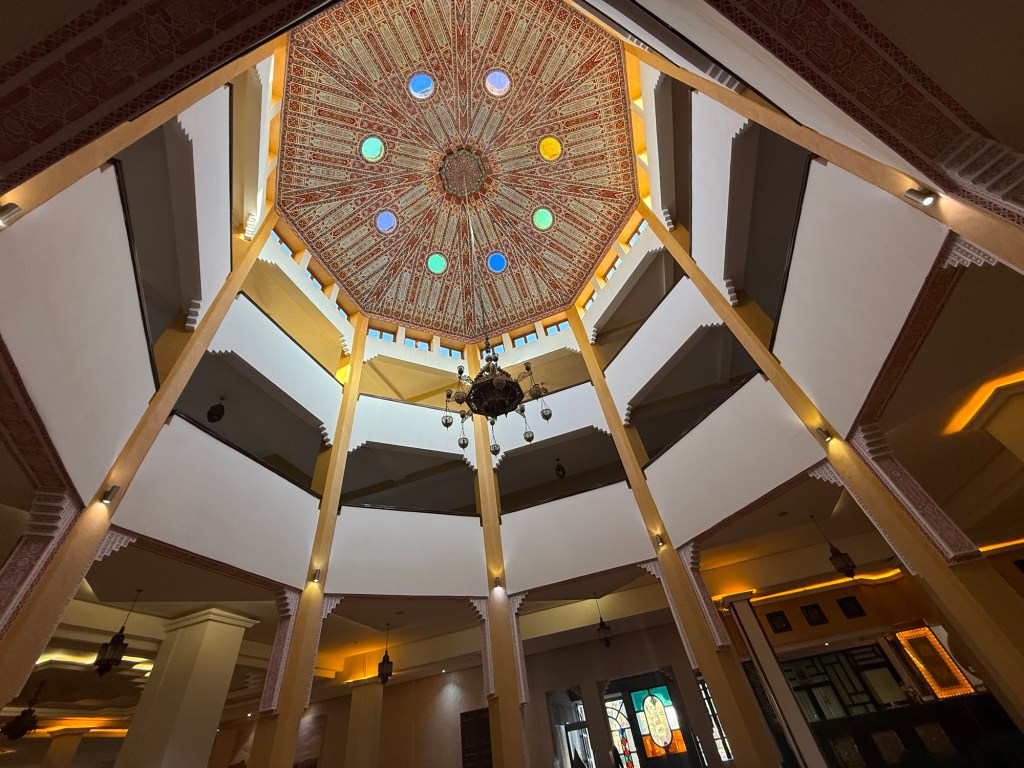
Then, it was straight to my accommodations – The Ksar Sultan Dades. This hotel is very elegant with great views.

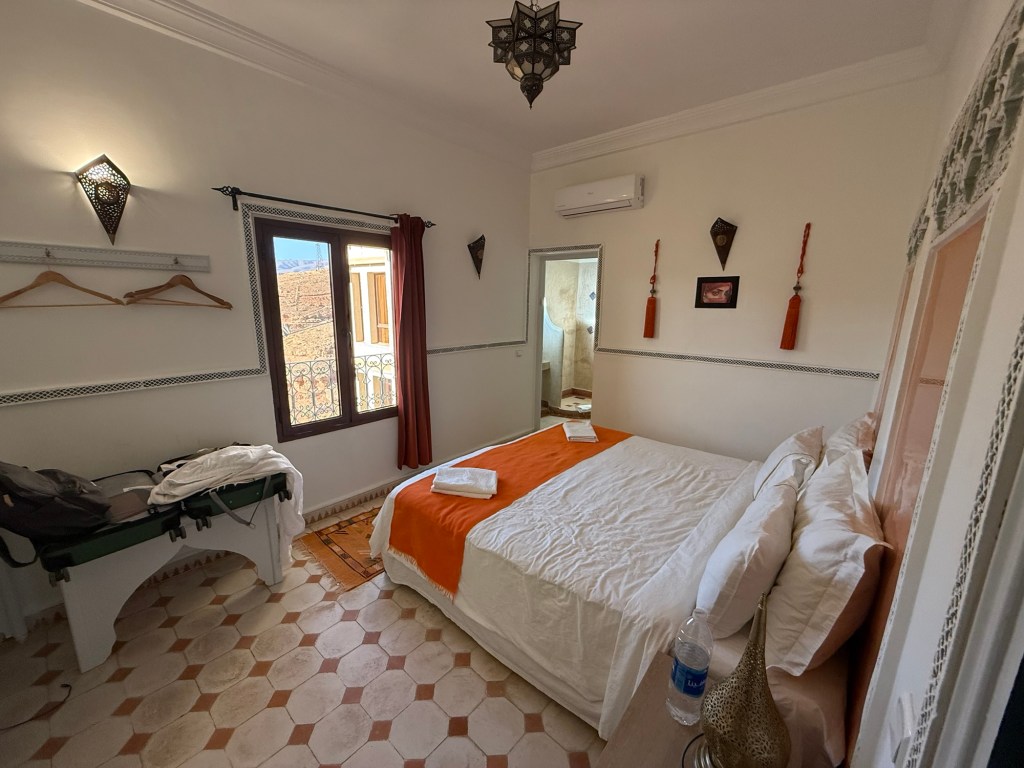
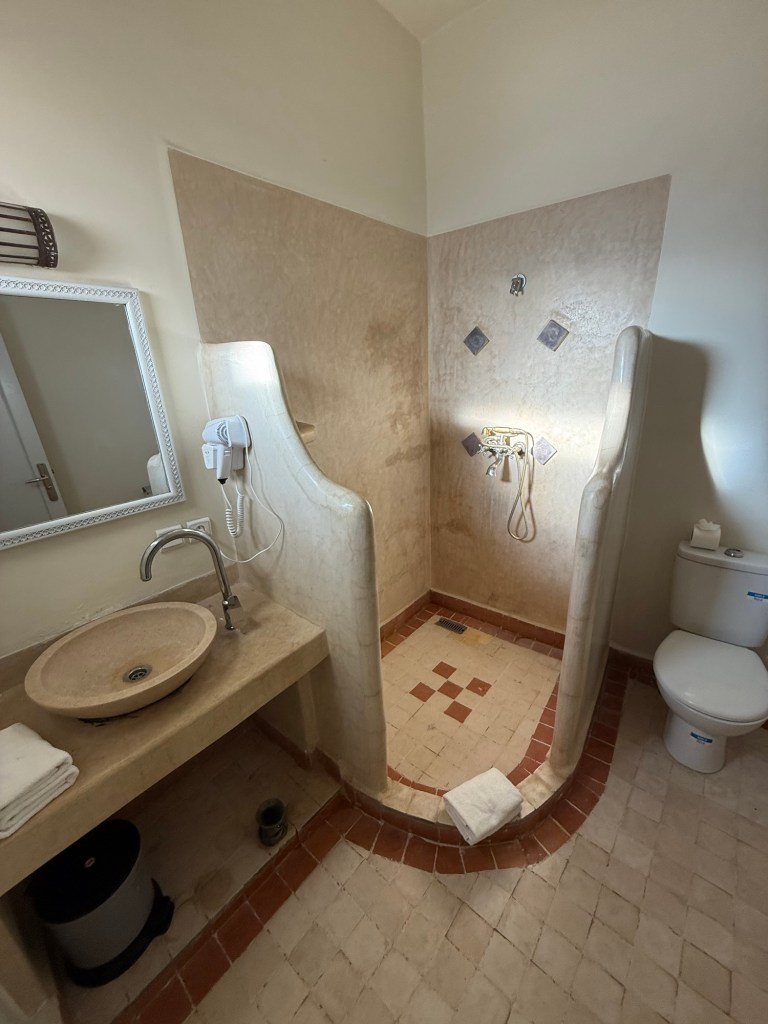
My room was fine.

And so another day ends. One more full day and that’s a wrap.

Day 12: Morocco – 14 Days Private Land Tour

By Paul Bryers

  • Day Itinerary: Drive Arfoud (Gate to Sahara) to Sahara
  • Accommodation: Sandy Tents, Sahara

After departing Afoud, I visited a local town, Rissani, to see a typical, non-touristy Medina and local market.

The guide was, I think, Achmed – nice guy who knew everyone.

Achmed (?) – Guide at Rissani Market

I must admit that I didn’t enjoy the experience.

Firstly, because I became possessed by vaporous demons coming out of the open sewer drains while in the dark, dank alleyways – poor guys working on them looked green.

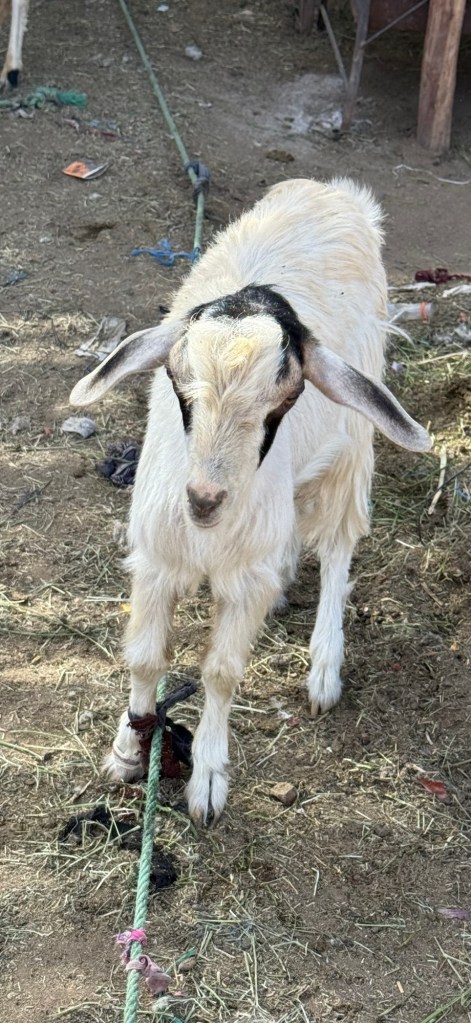
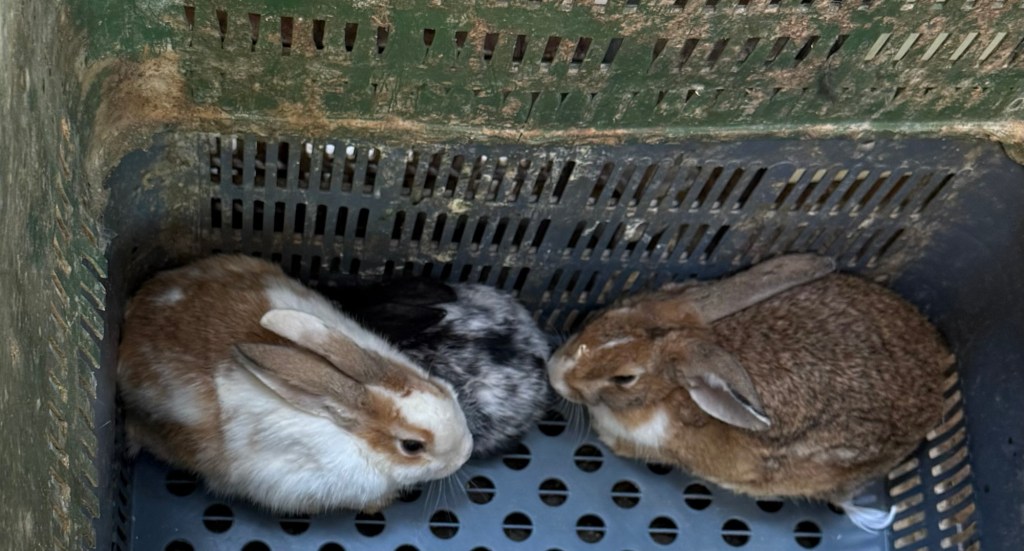
Second, due to the live animals being sold for food … I enjoy my meat like the next carnivore but I don’t need to see the details.

And finally, the pressure to make purchases. I informed my guide, who was fine, that I had had enough early on in the tour, and Said and I left.

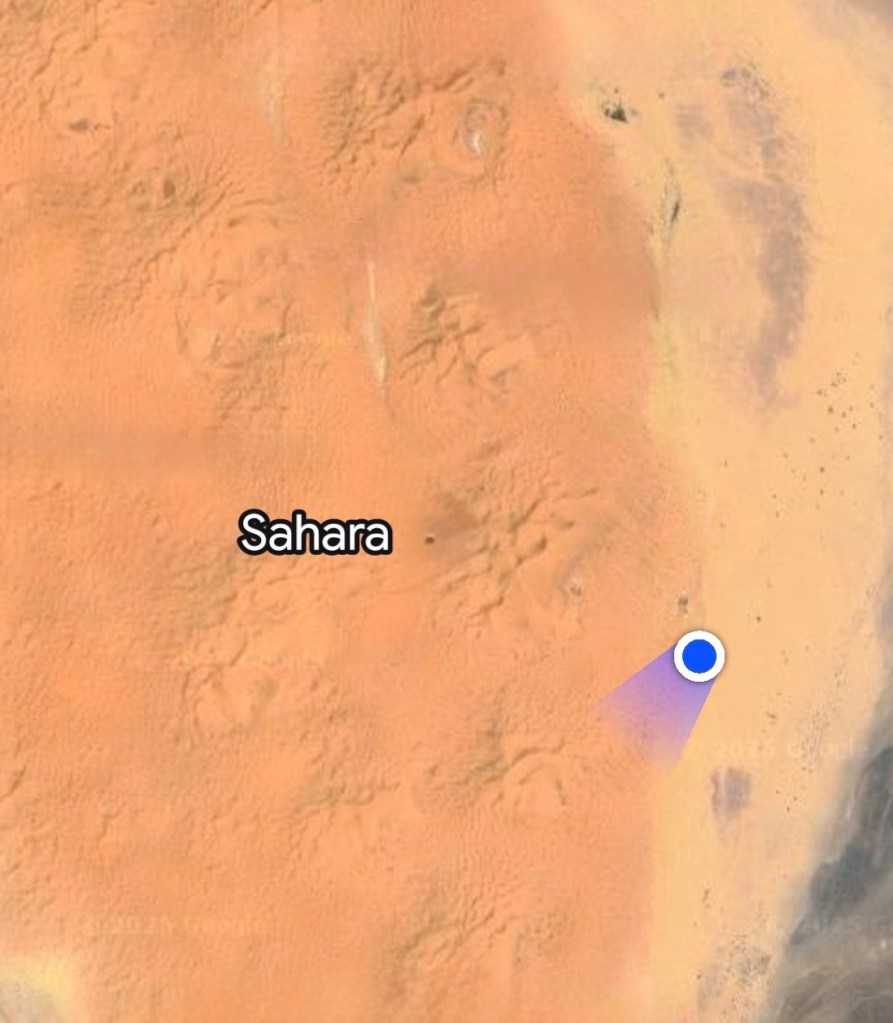
The Sahara is often referred to as “The greatest desert” – Aṣ-ṣaḥrā’ al-kubrá in Arabic.

It spans much of North Africa, excluding the fertile region on the Mediterranean Sea coast, the Atlas Mountains of the Maghreb, and the Nile Valley in Egypt and the Sudan.

With an area of 9,200,000 square kilometres (3,600,000 sq mi), it is the largest hot desert in the world and the third-largest desert overall, smaller only than the deserts of Antarctica and the northern Arctic.

The Sahara is a desert primarily due to atmospheric circulation patterns that create a high-pressure zone, but its history has also been shaped by cyclical changes in Earth’s orbit and, more recently, by human activity.

For a long time, the Sahara experienced periods of heavy rainfall and lush vegetation when its location was wetter due to a strengthened monsoon, but the current arid state is due to the persistent high-pressure system over the region, which causes air to descend, dry out, and prevent cloud formation.

The deathstalker scorpion can be 10 cm (3.9 in) long. Its venom contains large amounts of agitoxin and scyllatoxin and is very dangerous; however, a sting from this scorpion rarely kills a healthy adult. I find that comforting (as I check all corners of my tent)…

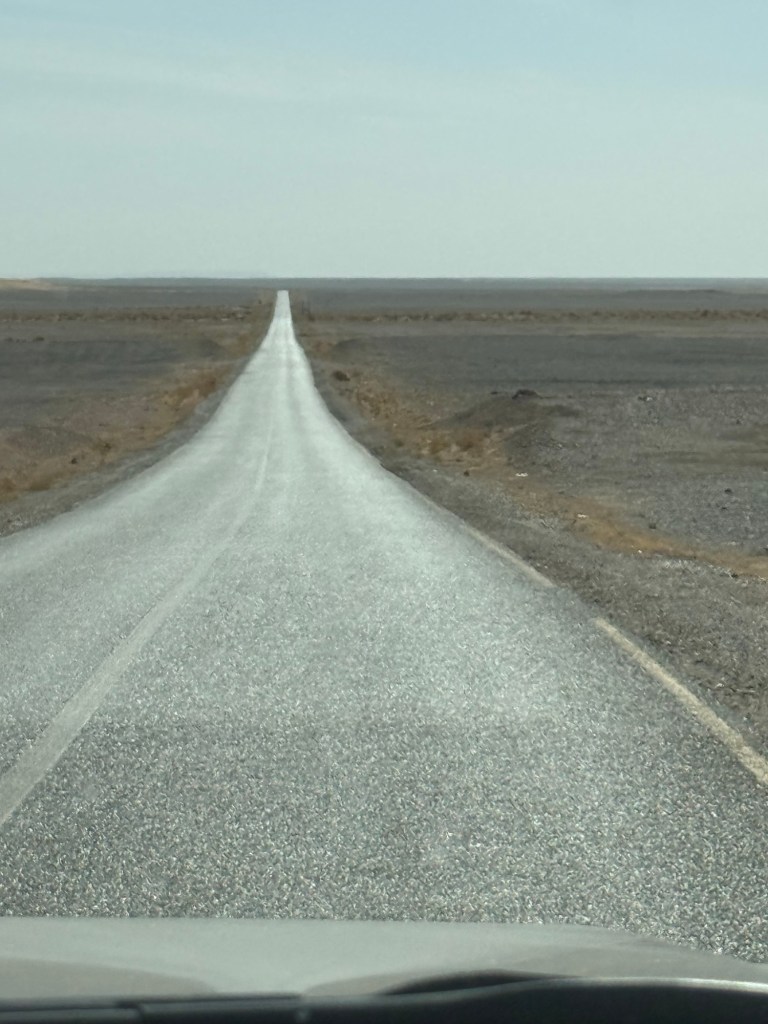
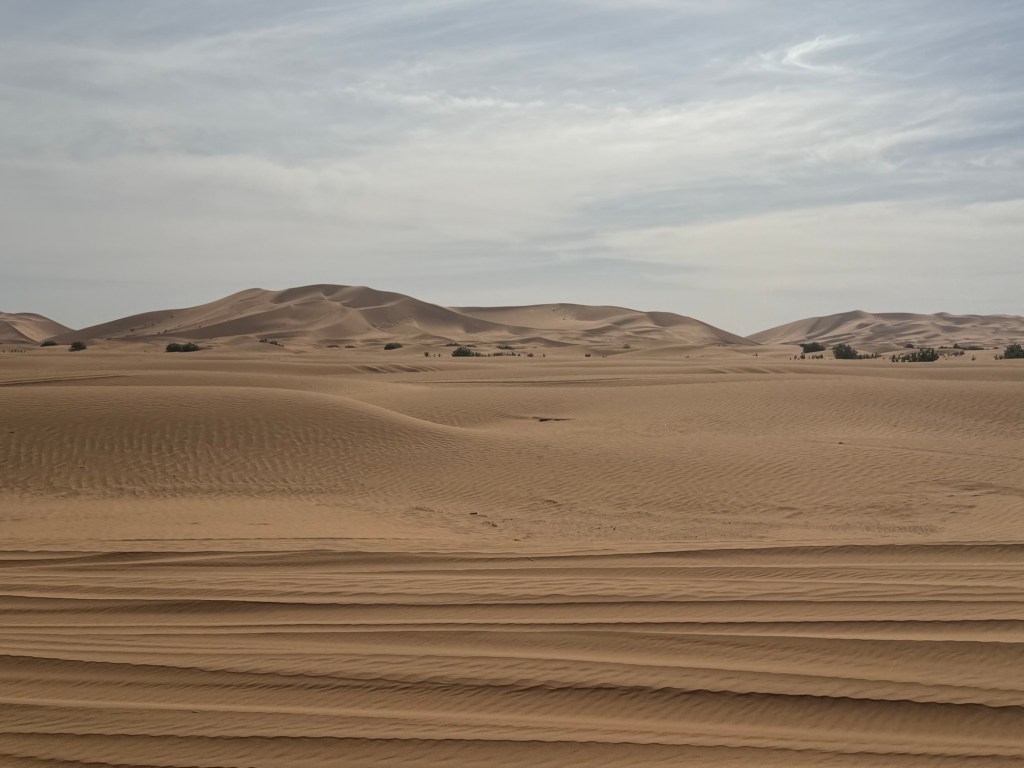
As we approached the Sahara’s sand dunes, the remaining greenery disappeared apart from some succulents.

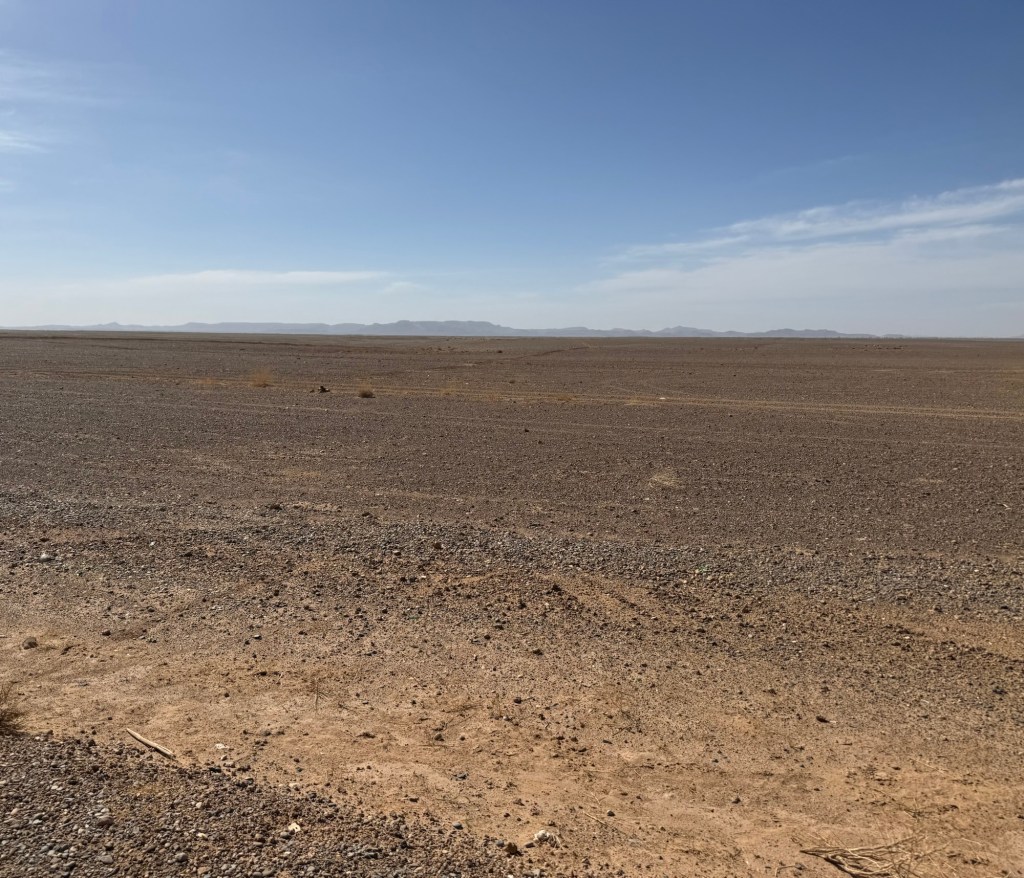
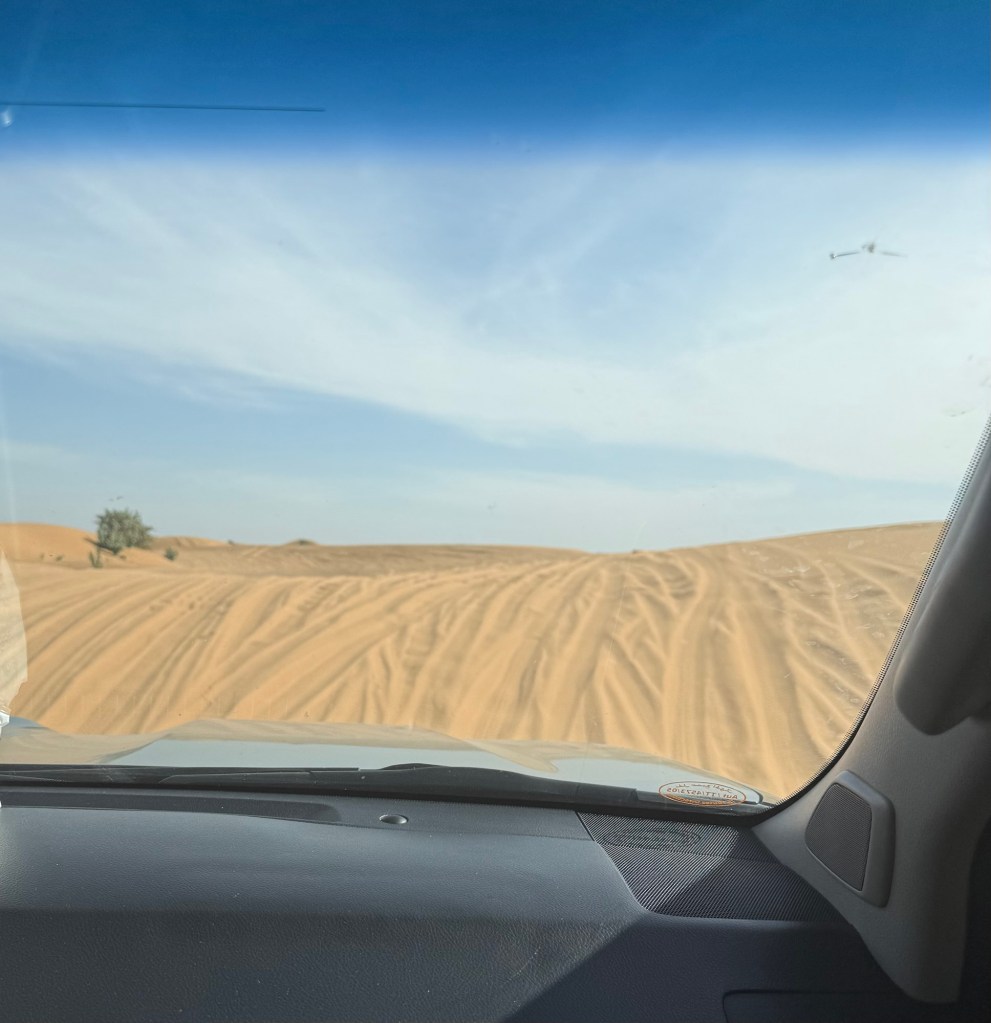
As we ventured off-road, the gravel that comprises about 90% of the Sahara…..

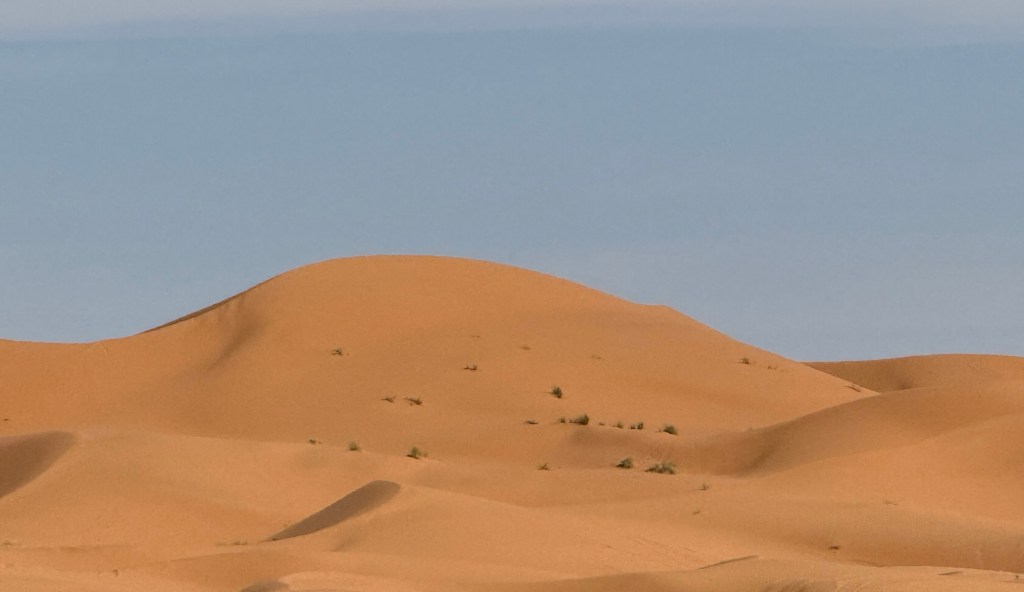
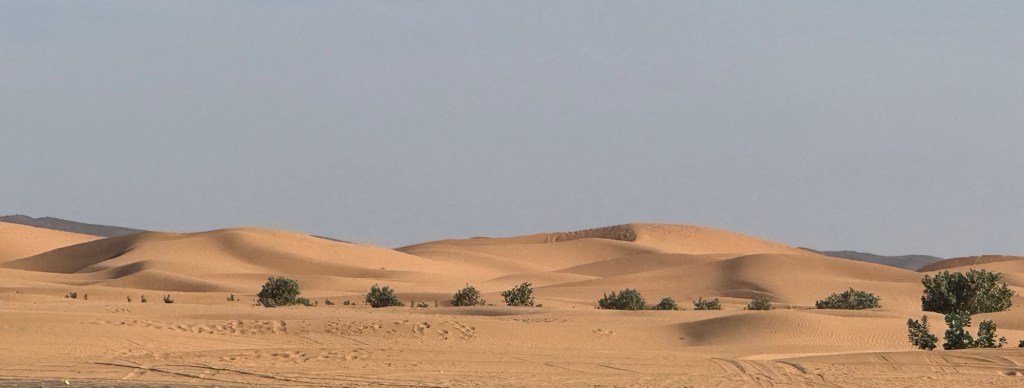
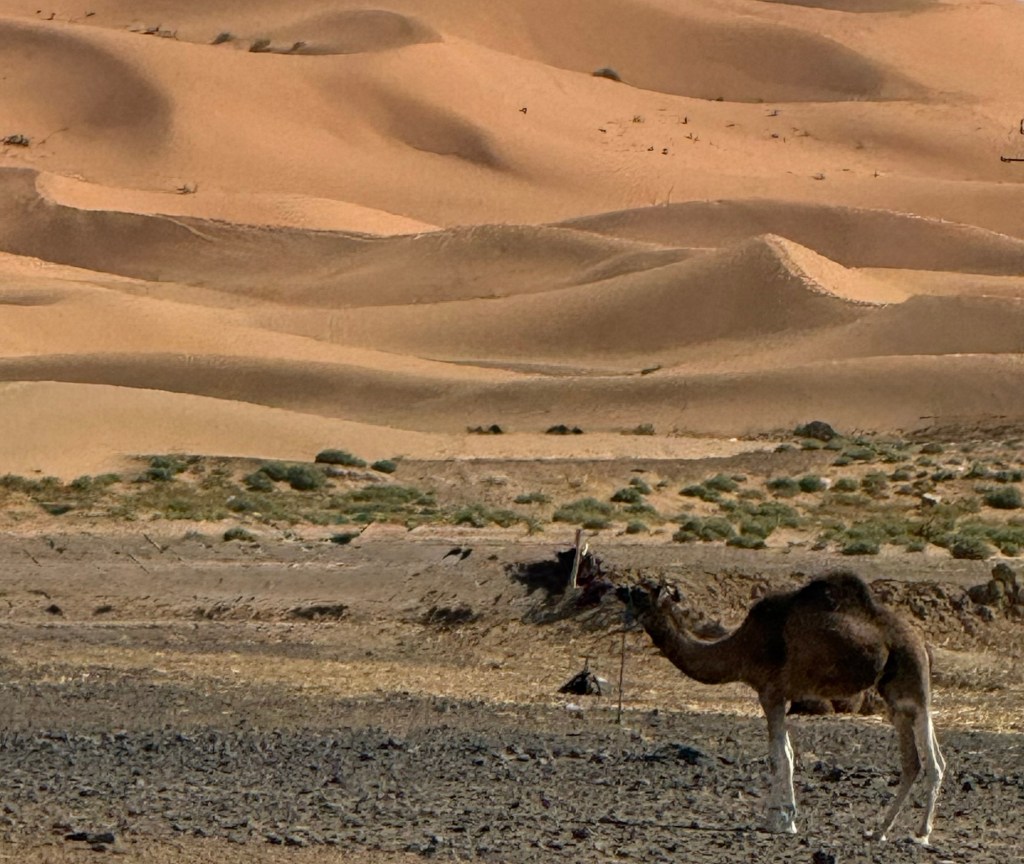
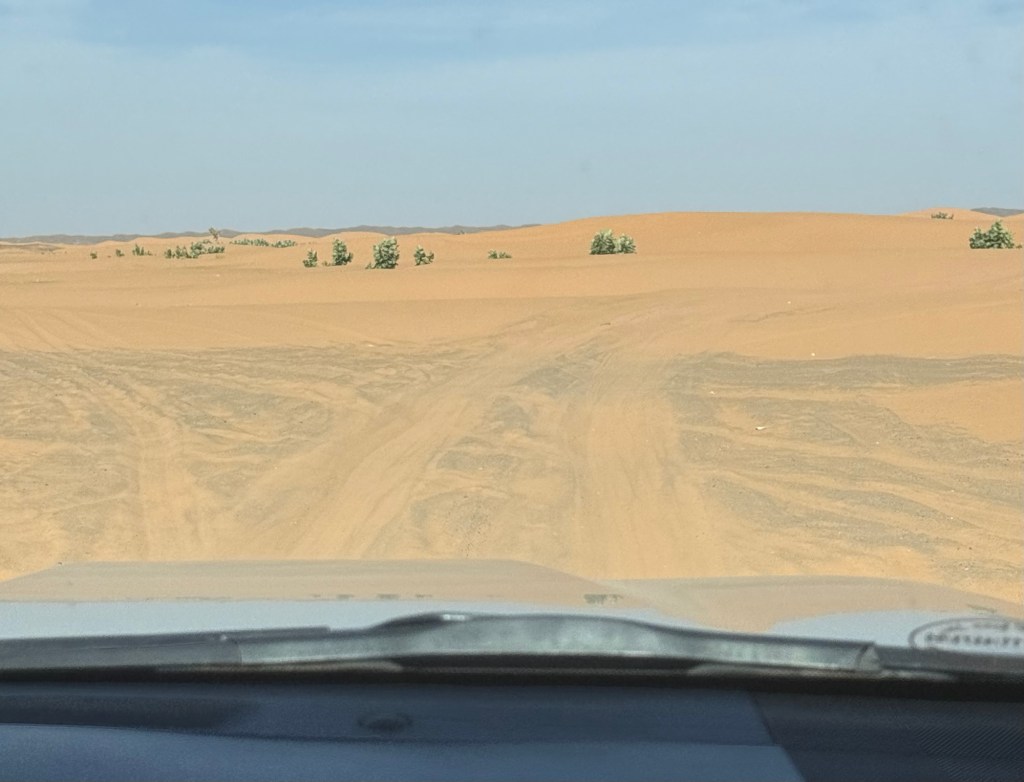
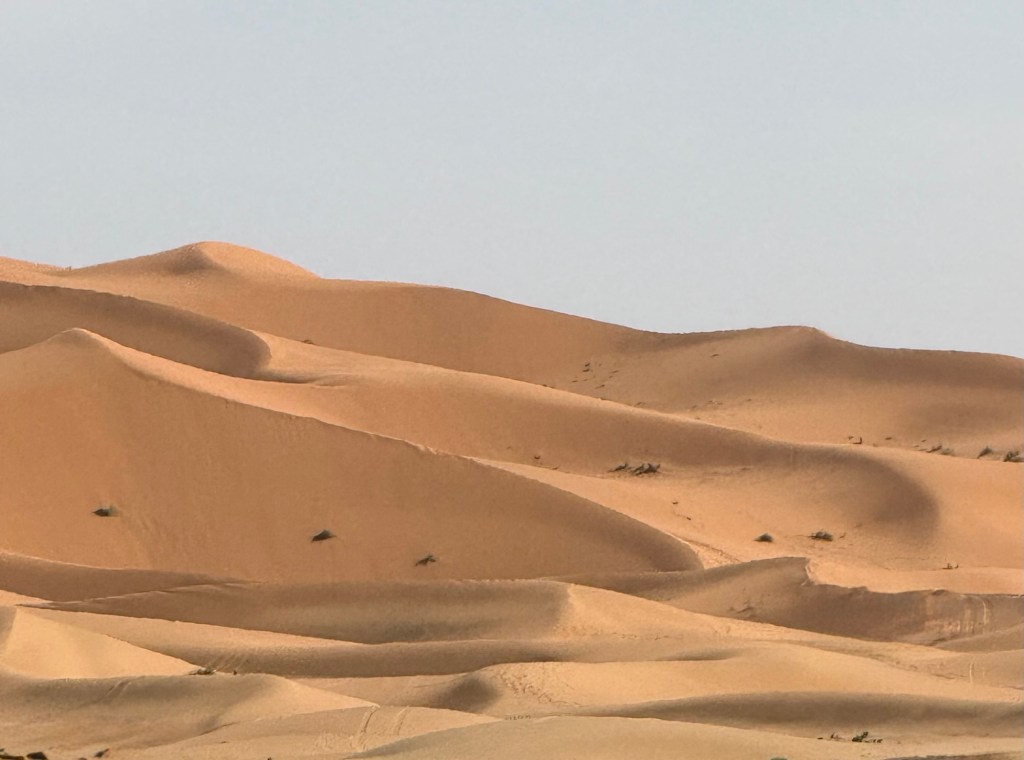
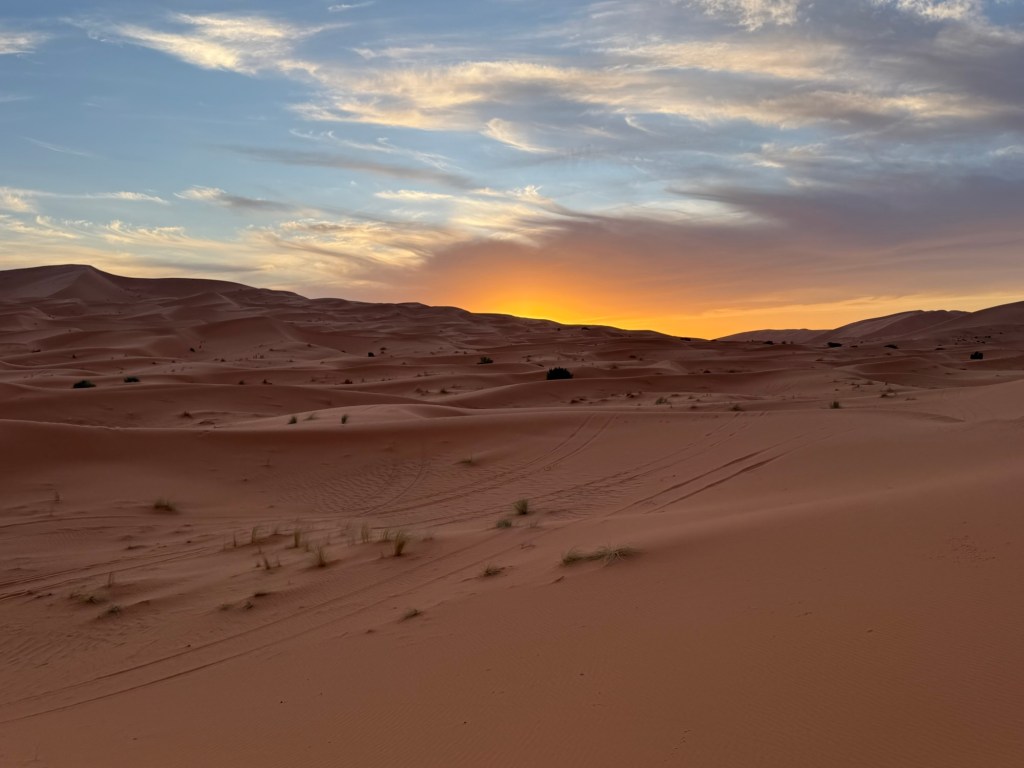
…..gave way to the golden sand dunes we see in the movies. The scenery was wonderful and beautiful.

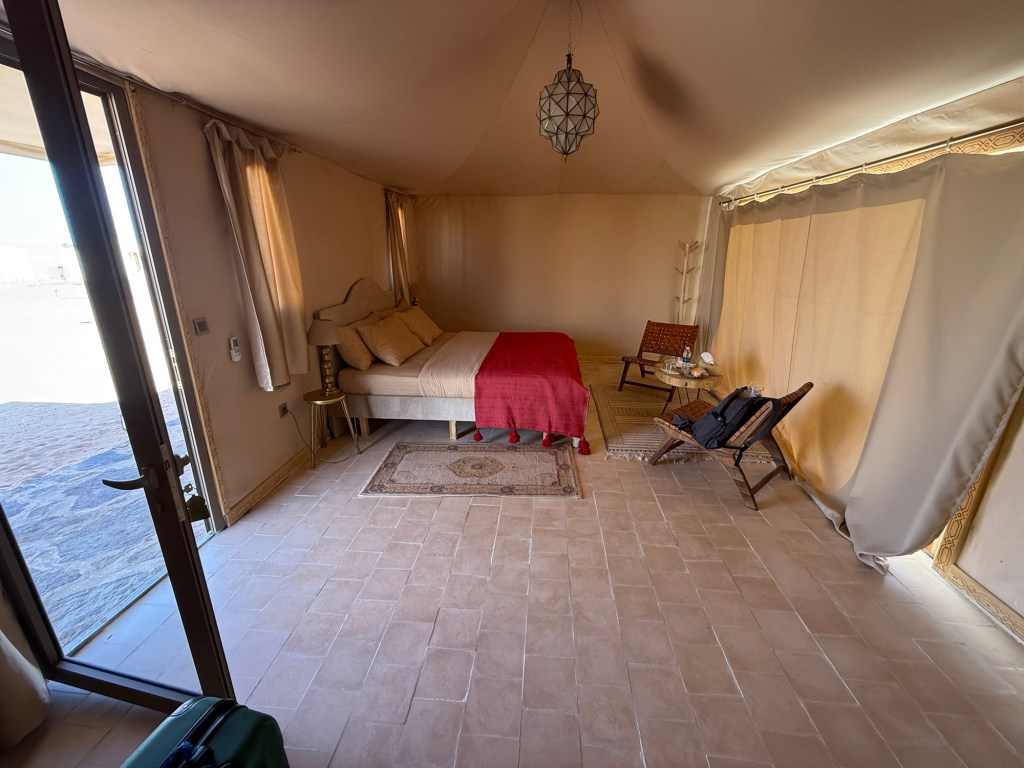
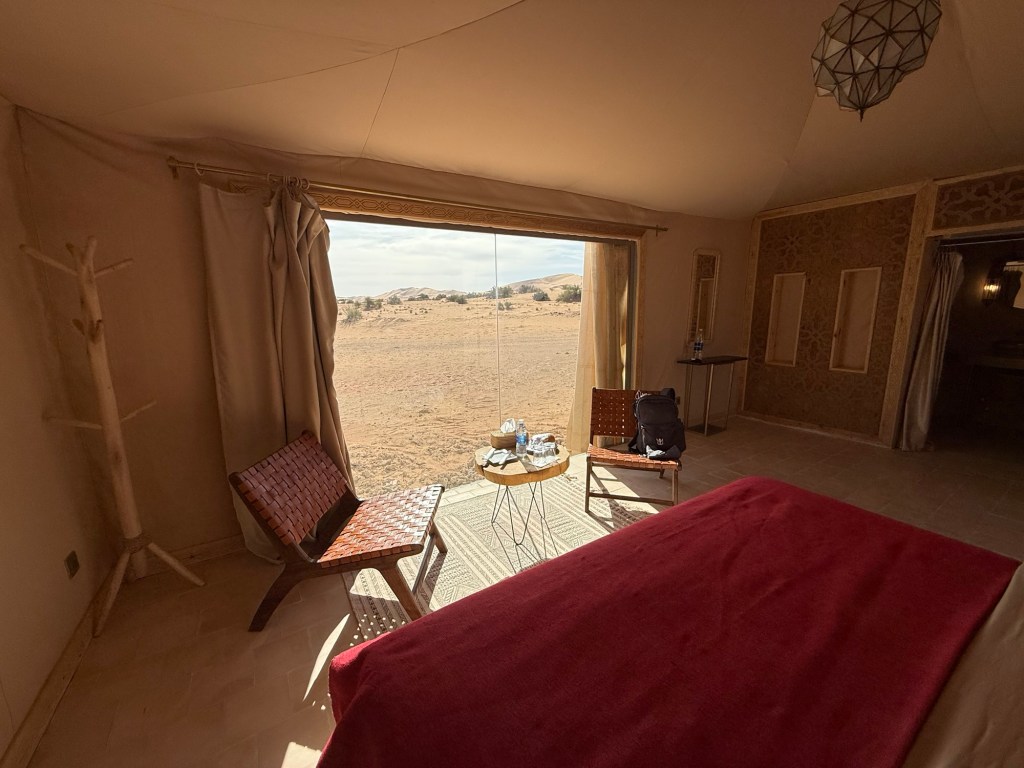
Upon arrival at my Sandy Tents camp, I checked my room, which was very nice with a large panoramic window facing west.

I then took a short siesta after checking for deathstalkers.

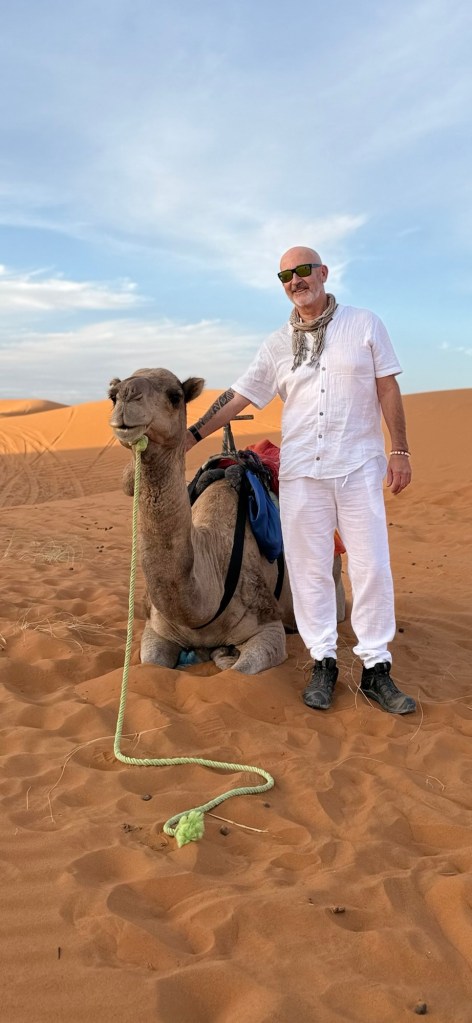
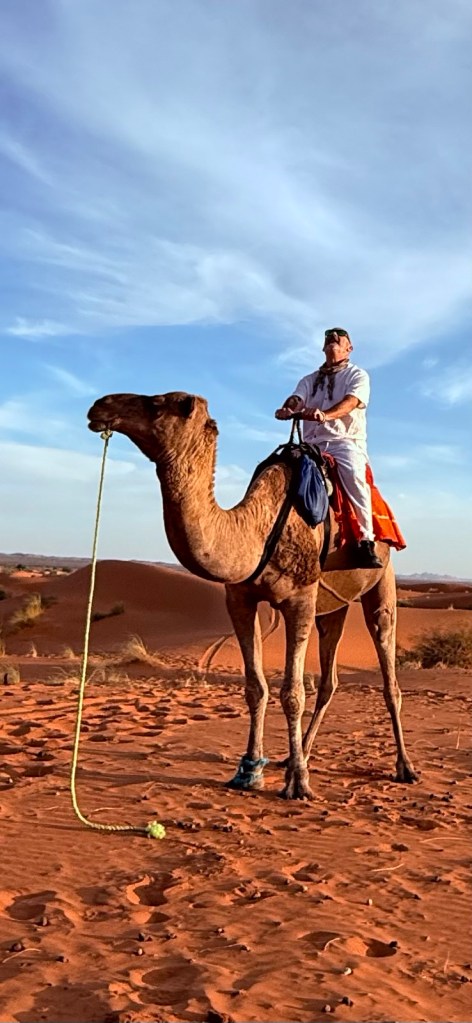
At 5:30 pm, I embarked on a camel ride to the dunes to witness the sunset (6:24 pm).

Hassan was my camel lad – a nice guy with a naughty sense of humor, or so I thought, as my Arabic is still very limited after four weeks.

Callum The Camel, was nice enough but quite flatulent. He blamed Hassan, but I’m not so sure…

We set off to catch the last minutes of the sun…

As the sun set, the color of the dunes changed, and there was no sound other than Callum’s occasional flatulence. The experience was beautiful and moving (not the farting, the solitude).

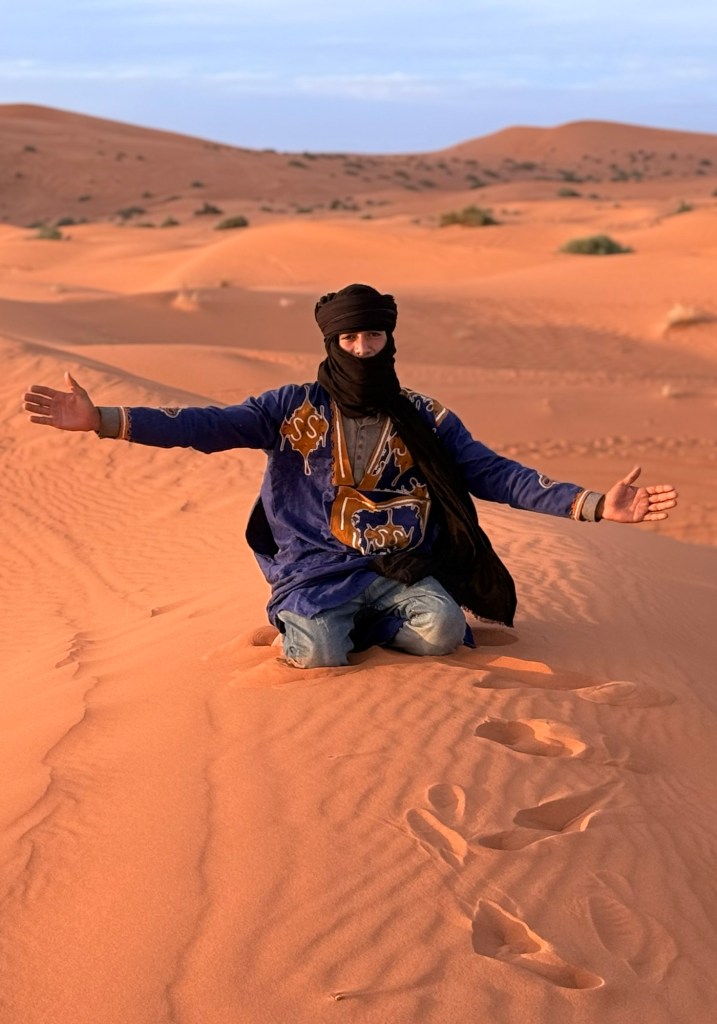
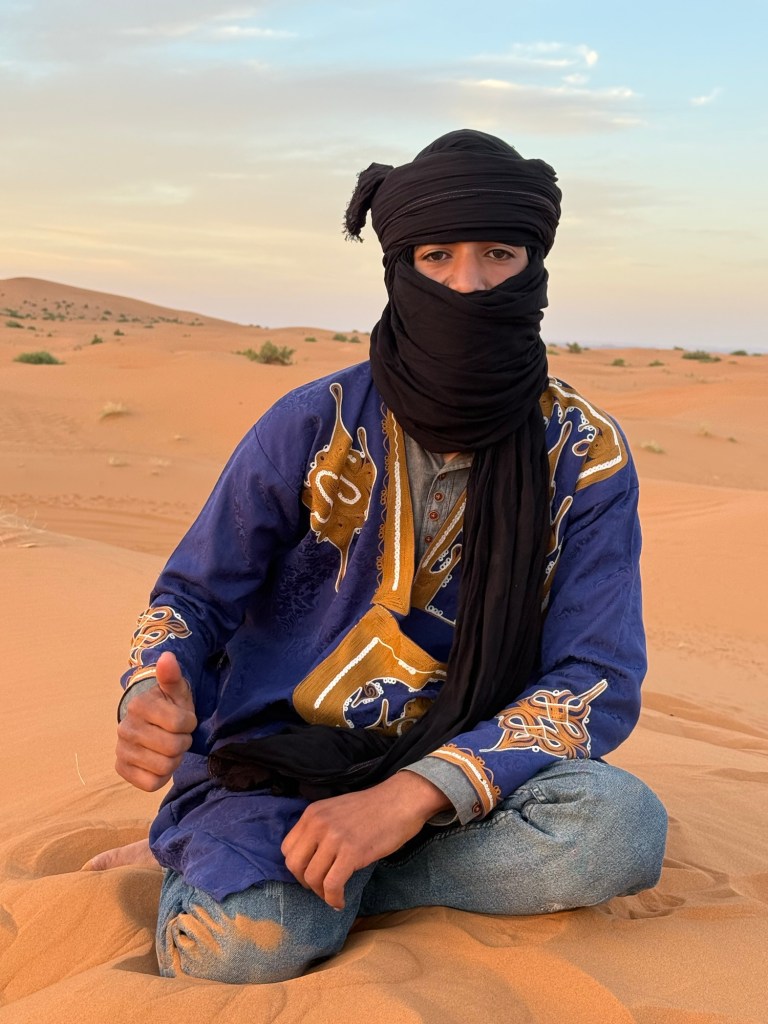
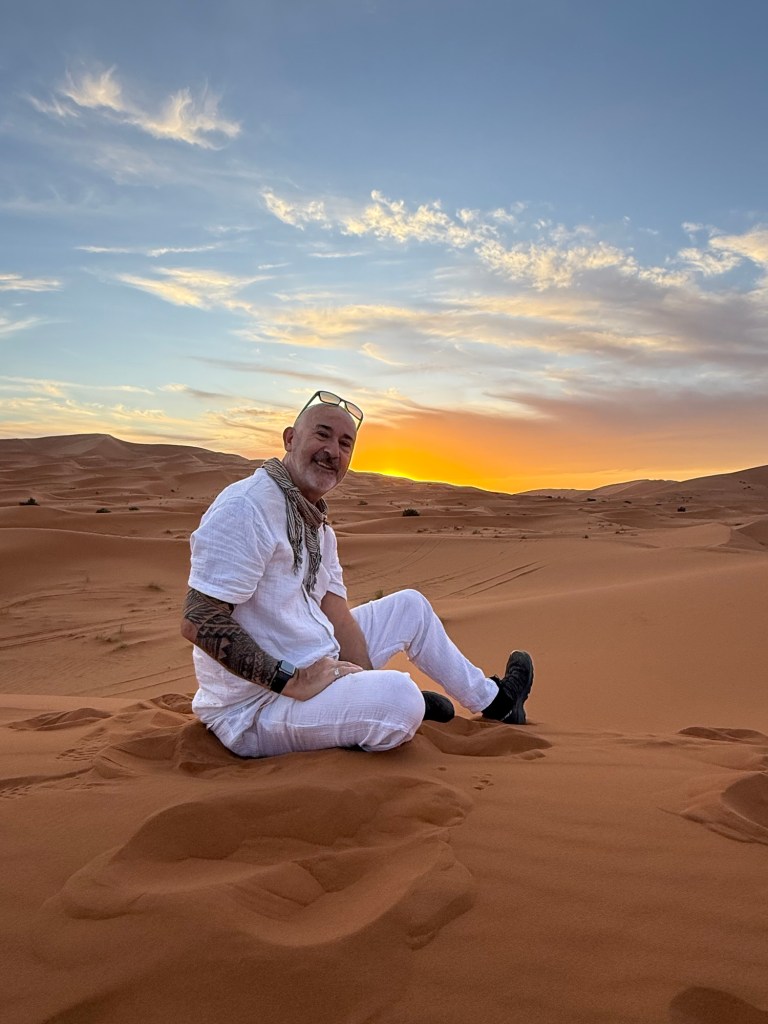
We took some artistic shots.

The sunset got even more beautiful.

Then it was time to wear something yellow and get back on Callum……

….and trek back to the camp under the moon, which was rising over the border with Algeria – easily visible due to a high mountain range.

Dinner at the camp was excellent, although there was far too much food, as usual.

Now it’s time to retire, knowing that the desert is just beyond my uncurtained window…view at midnight…

Day 11: Morocco – 14 Days Private Land Tour

By Paul Bryers

  • Day Itinerary: Drive Fez to Arfoud (Gate to Sahara)
  • Accommodation: Arfoud Palace Hotel

Today’s drive was quite lengthy, spanning 8 hours. My driver, Said, demonstrated exceptional skill and professionalism throughout the journey, even when interacting with a police officer who expressed concerns about our vehicle’s tinted windows. Phah!

The initial part of the drive continued to showcase the somewhat green landscapes I had grown accustomed to prior to arrival in Fez.

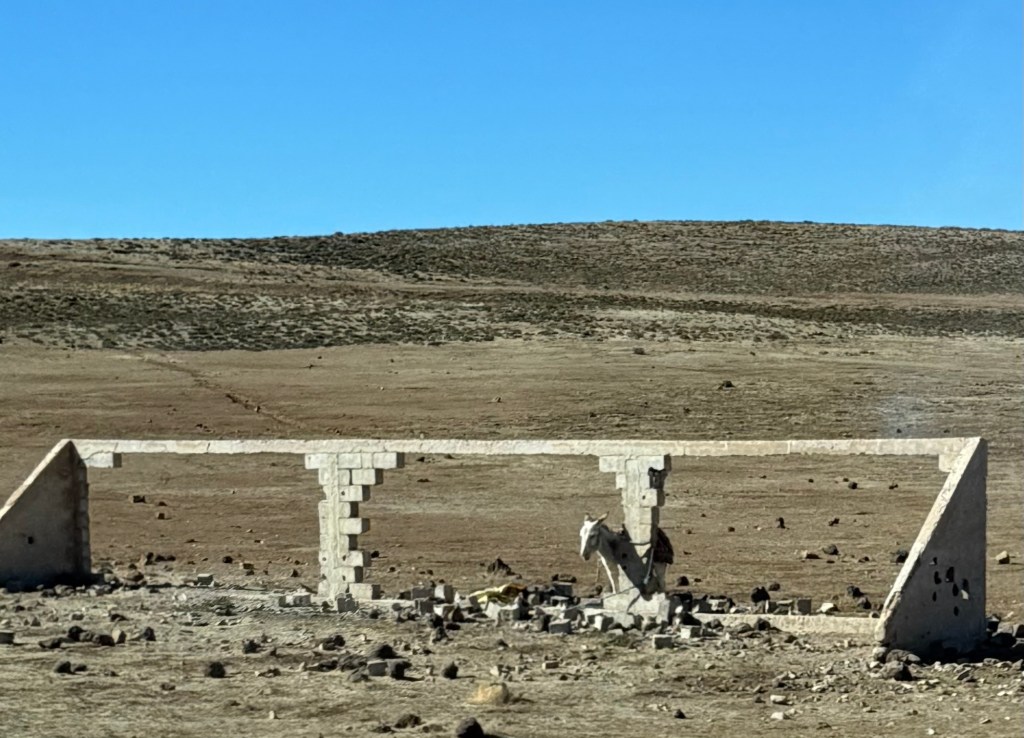
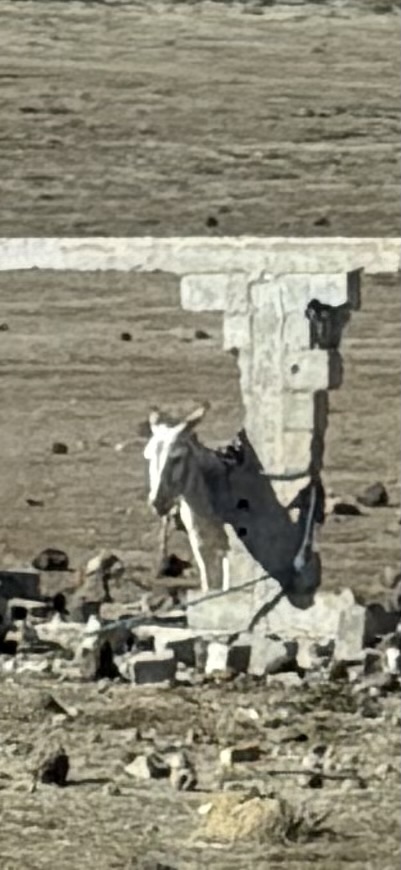
Notably, we encountered a greater number of sheep, goats, and wild donkeys. One domesticated donkey was spotted hiding behind a collapsed snow shield.

Nomadic settlements were prevalent along the route. Said informed me that these settlements have become increasingly stationary in recent times.

Our first point of interest was the cedar woods, which supply a significant amount of wood for house construction/decoration in Morocco.

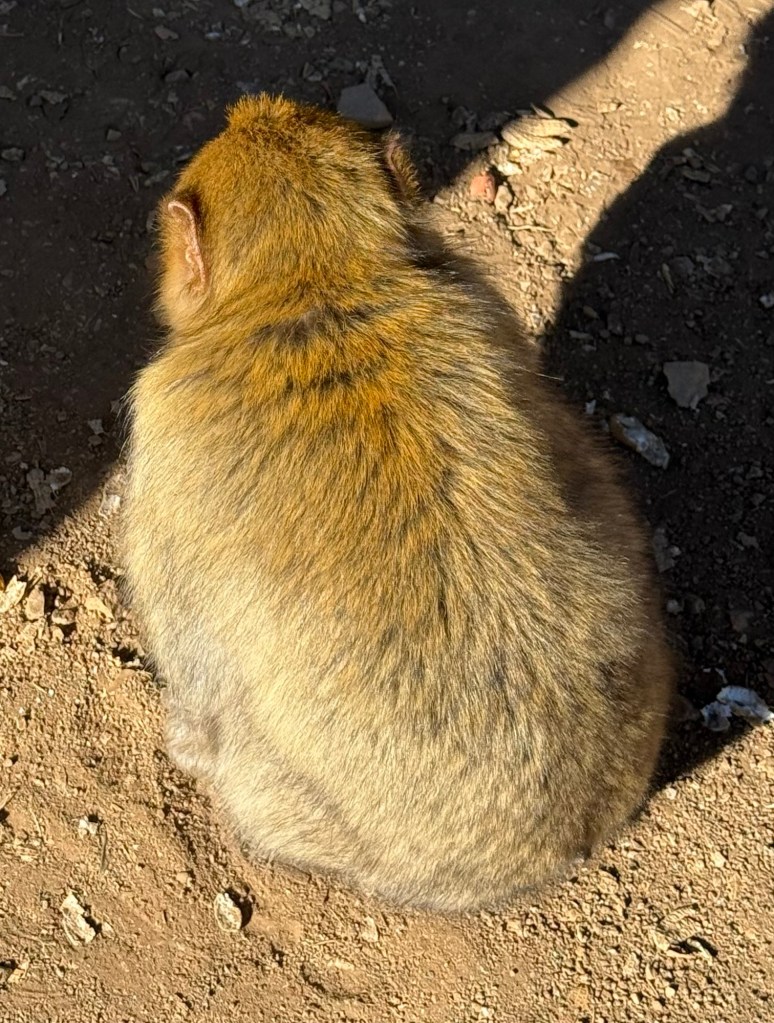
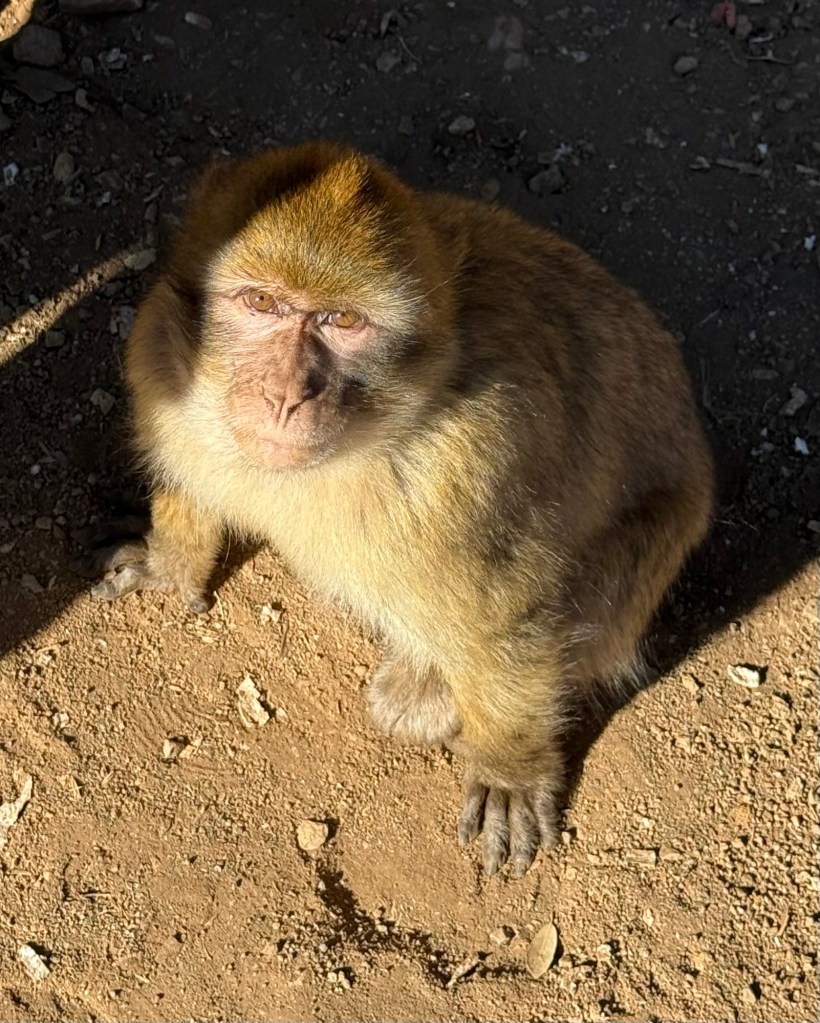
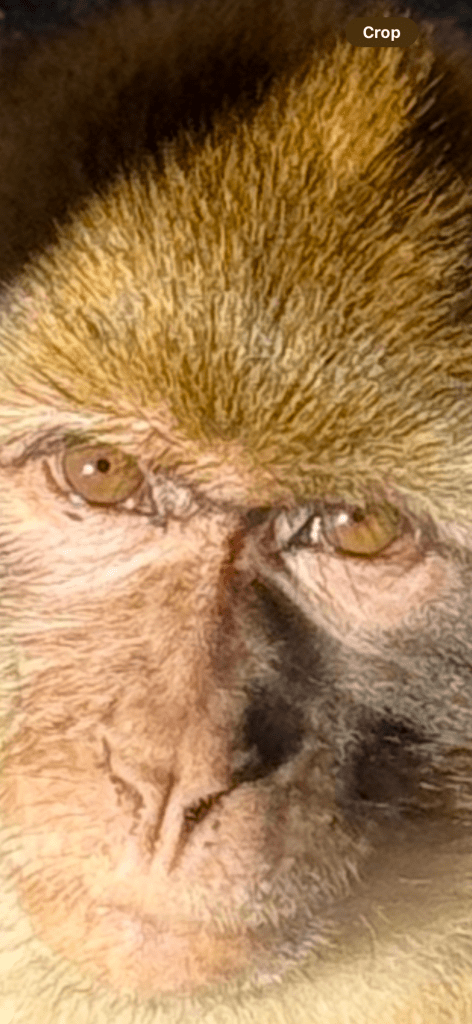
Next, we encountered a group of mischievous macaques who were eager to receive peanuts. Michael the Macaque ignored me at first but with crack of a nutshell we were best budies. I managed not to get bitten this time – in any case, my rabies vaccine is valid for another year.

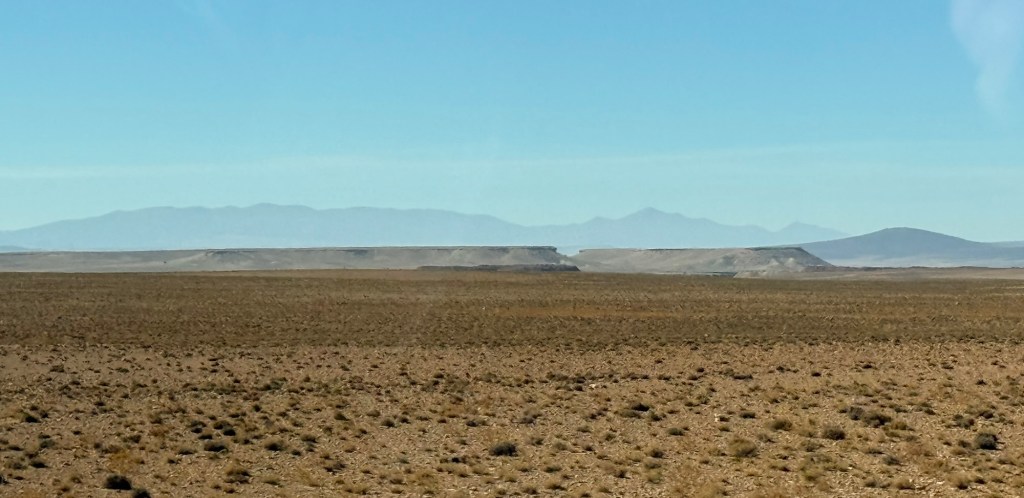
As the High Atlas Mountains came into view in the distance, the landscape gradually lost its green hue and transitioned to various shades of red, characterized by rock, sand, and dust.

Our drive took us over the High Atlas Mountains, which feature peaks reaching heights of over 4,000 meters (13,000 feet). The highest summit, Mount Toubkal, stands at 4,167 meters (13,671 feet). We reached a high point on the road of approximately 2,100 meters (7,000 feet).

The range is known for its many snow-covered peaks during the winter months. Although it was not winter, we did observe a small trace of snow.

The views were breathtaking as we descended ……

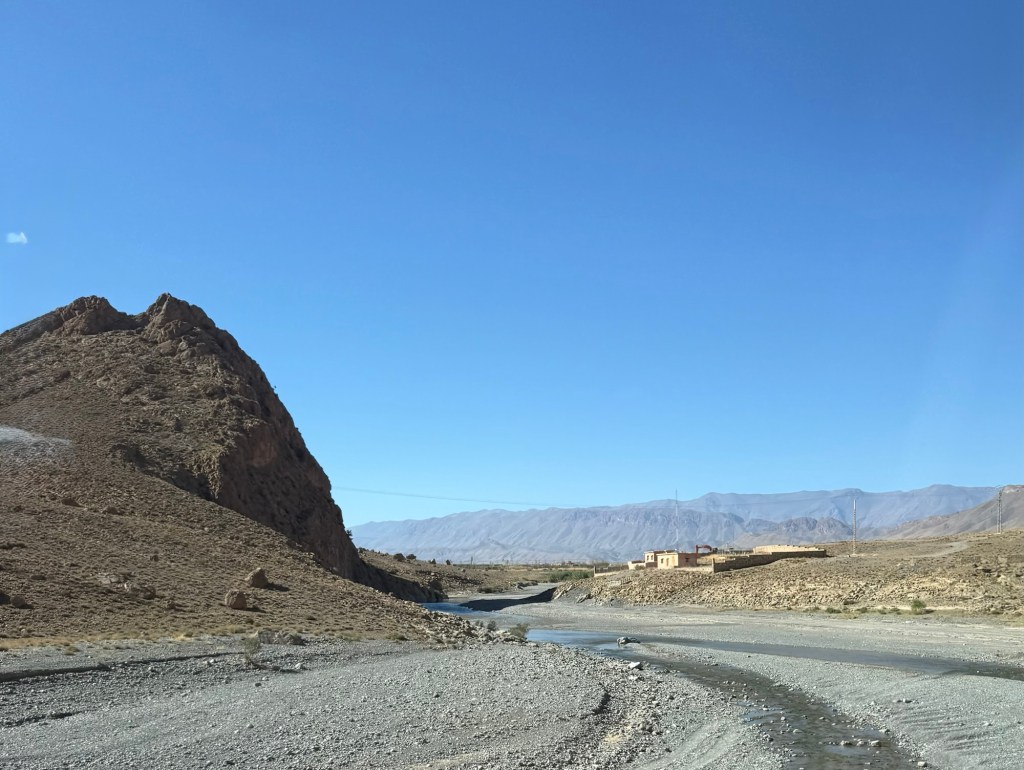
… and drove adjacent to the largely dry riverbed of the Ziz.

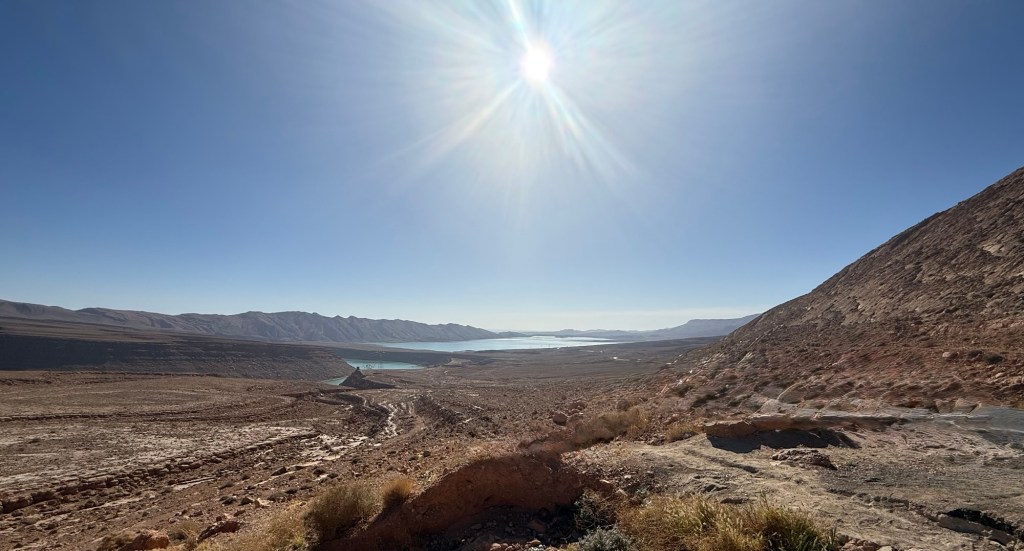
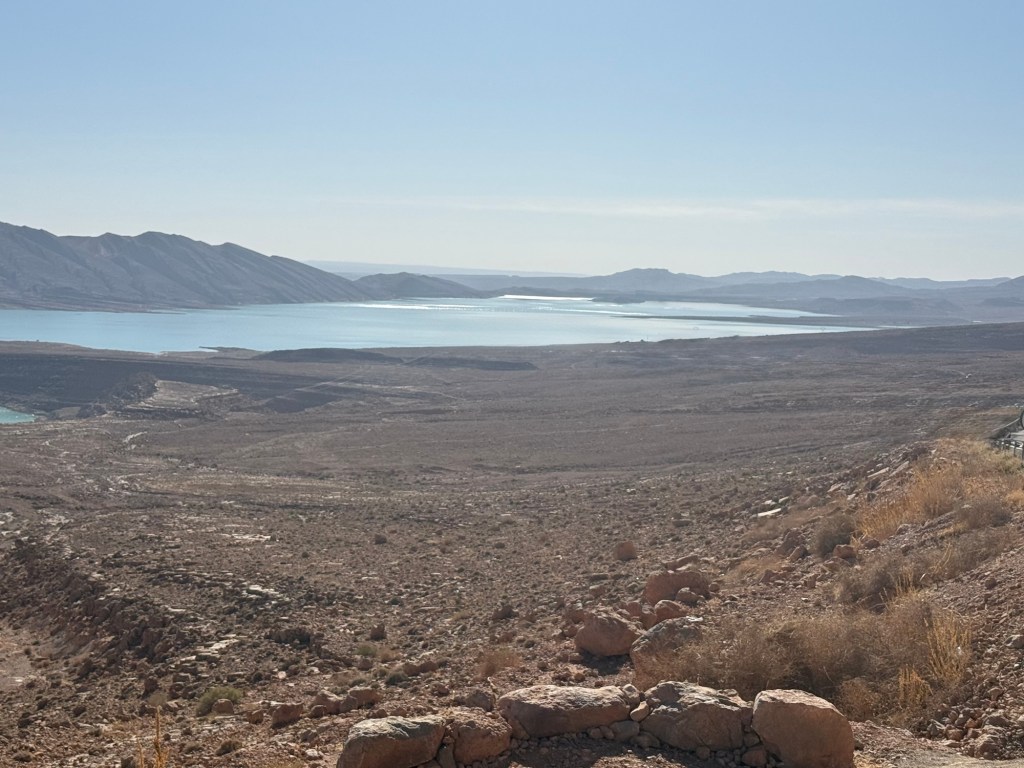
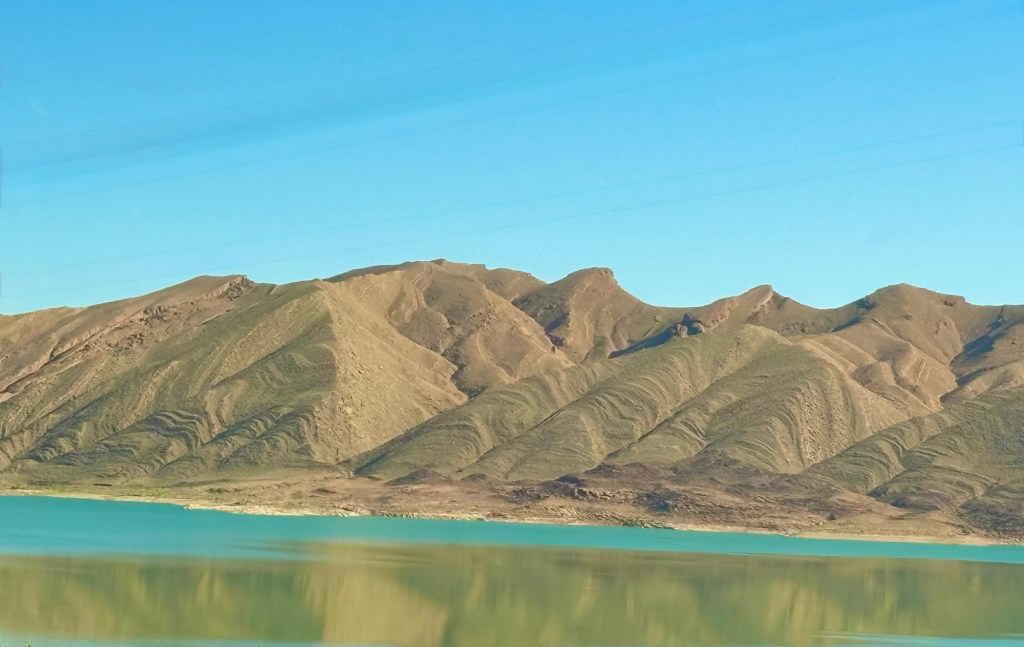
However, after passing the Hassan Reservoir,….

…..which allows for continius slow release of water into the Ziz, we noticed palm trees in abundance.

We finally arrived in Arfoud, Said’s hometown and the gateway to the Sahara.

The Arfoud Palace Hotel, where I am staying overnight, is a large and lavish hotel that caters primarily to tourists going somewhere more interesting in the morning. While the hotel lacks character and appears somewhat empty, my room is satisfactory.

As I am quite exhausted from today’s journey, I will conclude this post and retire for the evening.

Tomorrow, I will embark on a Sahara desert adventure and camping!

Day 10: Morocco – 14 Days Private Land Tour

By Paul Bryers

  • Day Itinerary: Fez
  • Guide: Amine ^
  • Meals: Palais Bab Sahra, Fez

Fez:

The ancient city of Fez, or Fes el Bali, is a UNESCO World Heritage site and one of the world’s largest and oldest living medieval medinas.

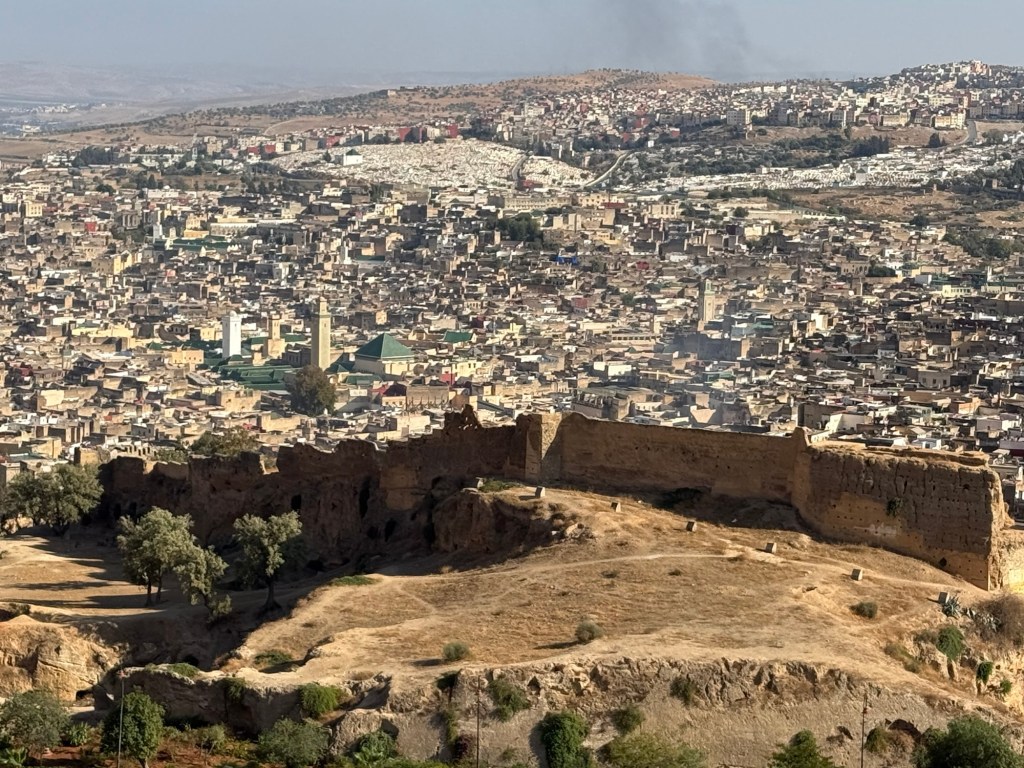
Panorama of Fez
Fez: White cemetery in the background with the Mausoleum on the enter right and the university on the center left.

Founded in 789, it is a car-free, labyrinthine quarter with a maze of narrow, winding streets, approximately 9,000 alleys, and historic monuments that have remained largely unchanged for centuries.

Alleys

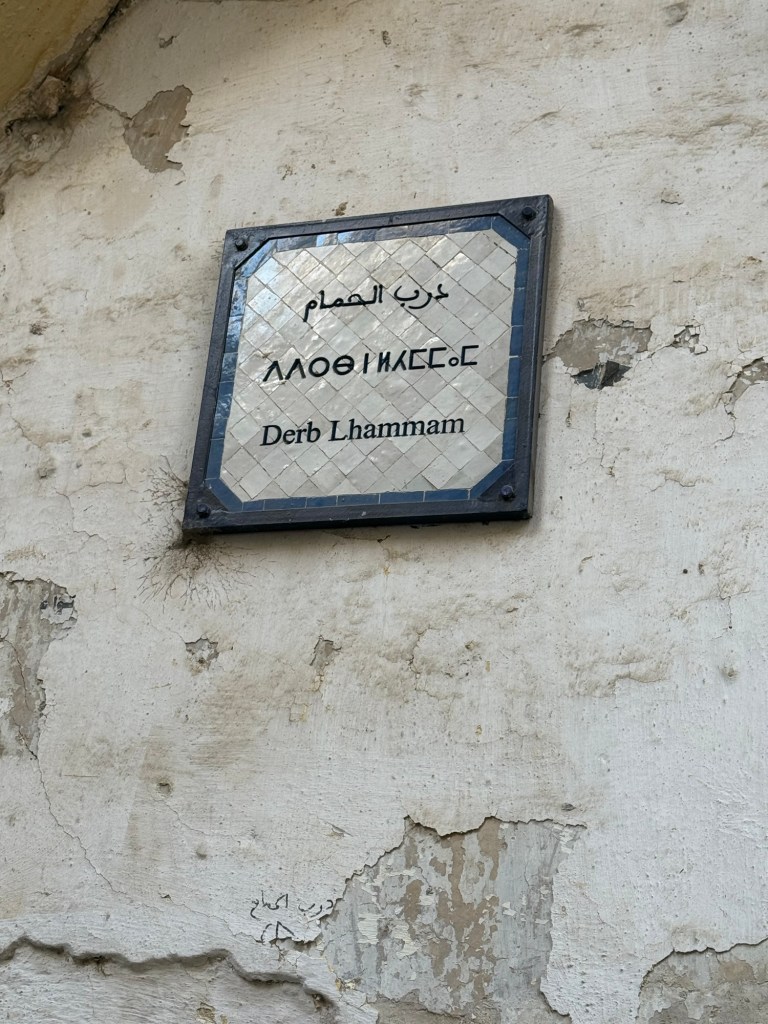
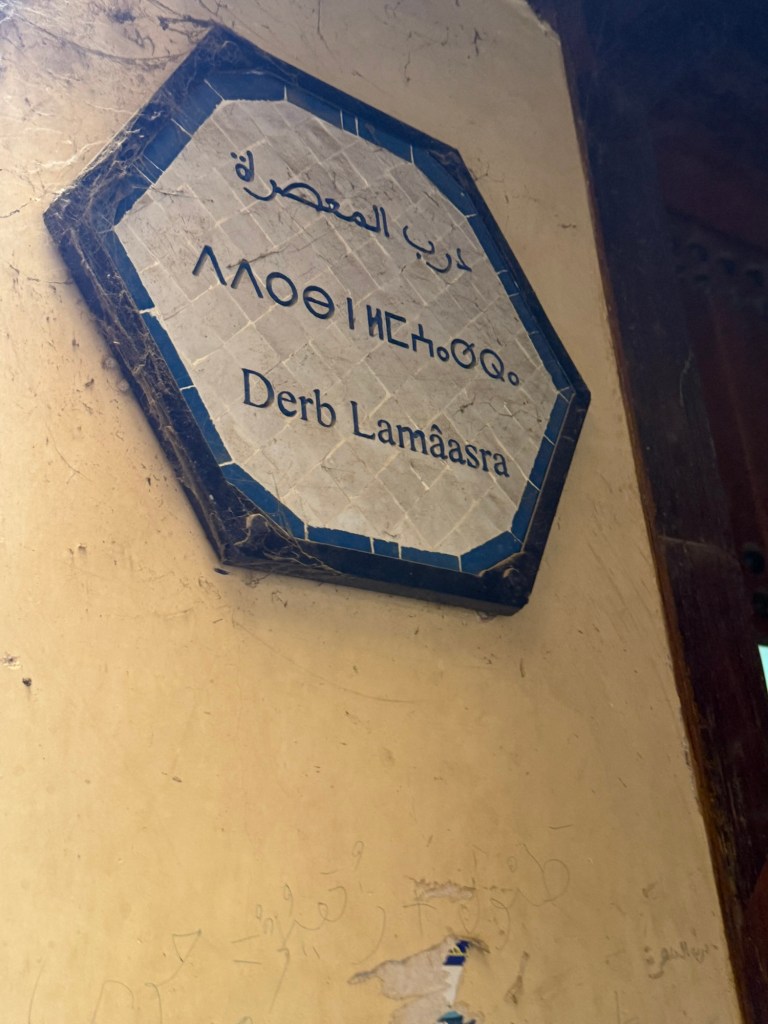
My excellent guide, Amine, stated upfront that even though he is from Fez, he did not know all the 9,000 alleys. To help avoid dead ends, he explained that signs within a square or rectangle are connecting streets, while those within a hexagon are dead ends.

Connecting Alley
Dead-end Alley

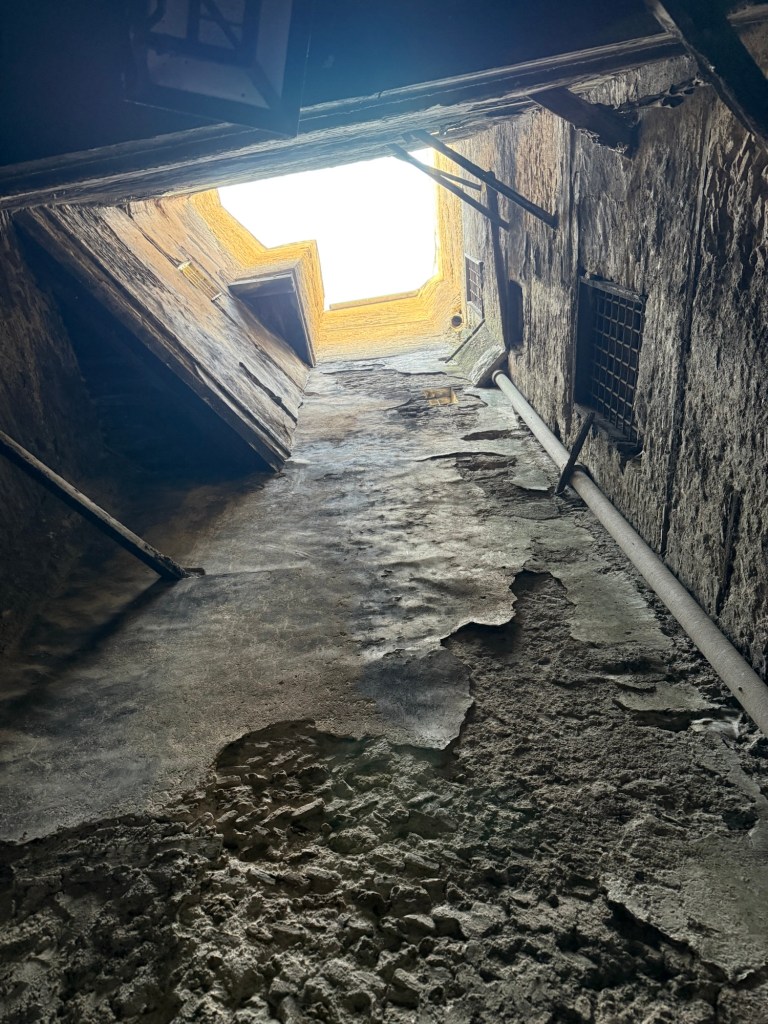
Many of the alleys are dark and damp, with scaffolding supporting the walls.

Dark and Damp Alley
Scaffolding-supported Alley

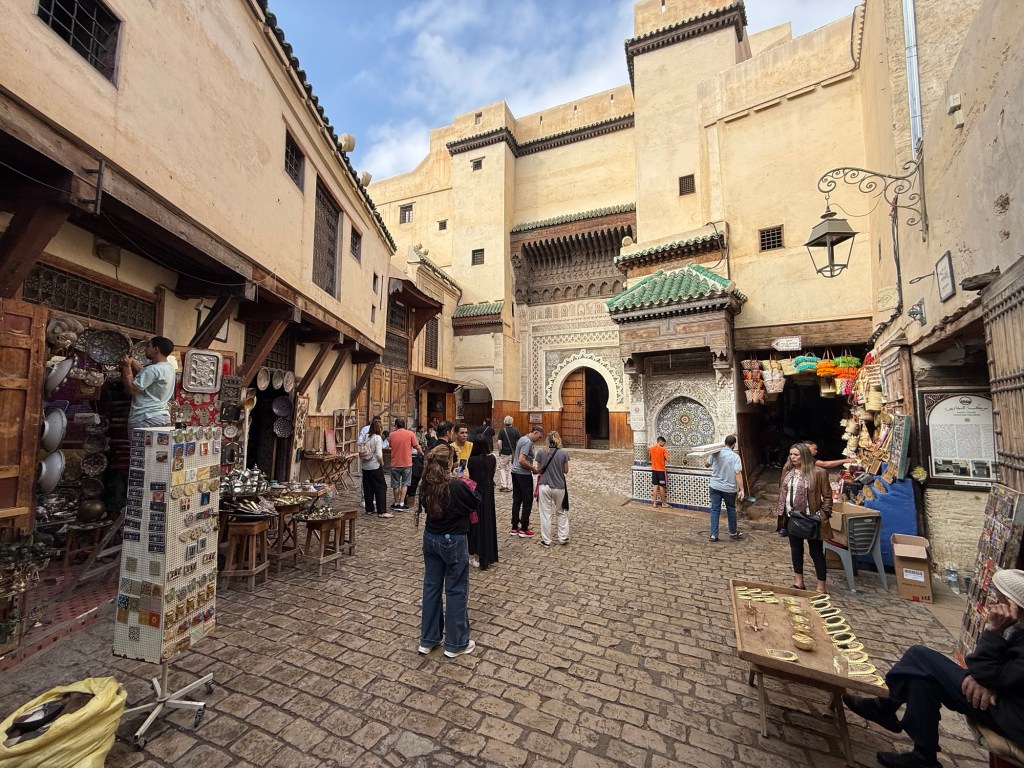
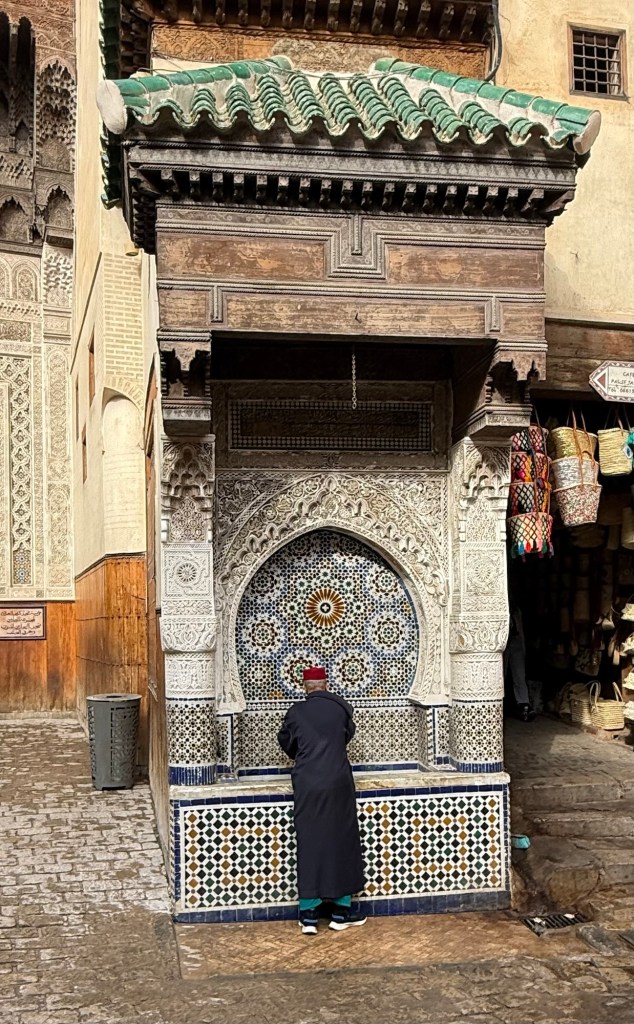
The alley intersections are much brighter and airier, and some have beautiful old public fountains where locals still come to get drinking water.

Alley intersection
Public fountain for drinking water

Amine explained the locations and groupings of the different merchants (which I immediately forgot) and then we headed out into the Medina.

Map of grouped merchants eg Copper merchants
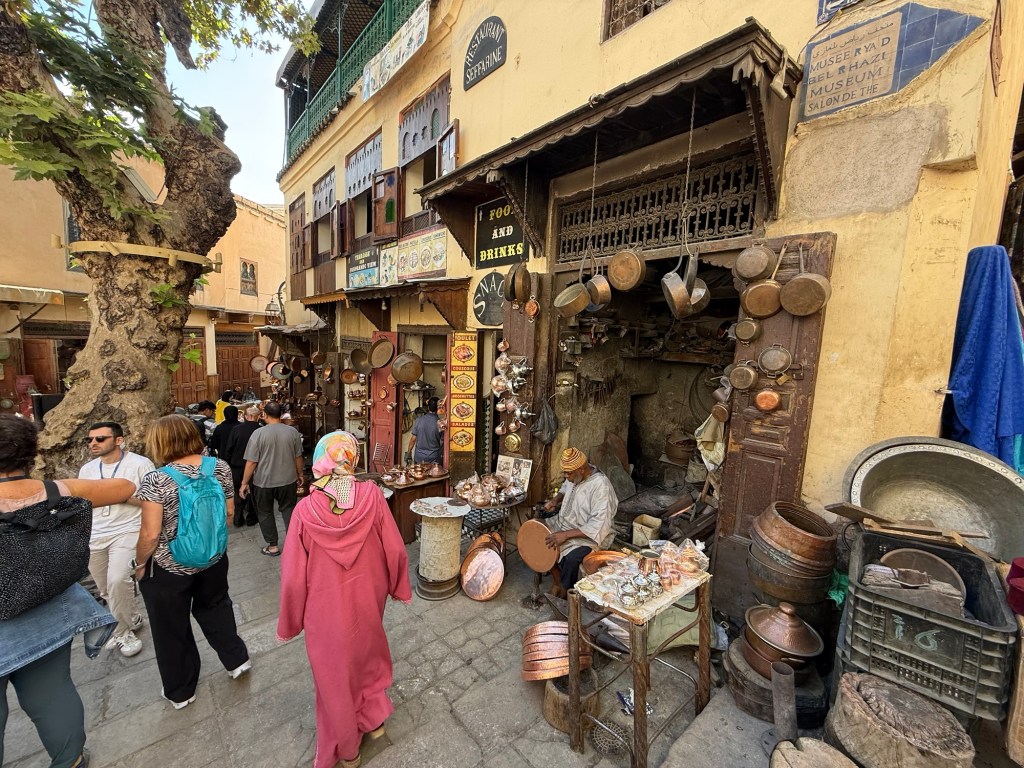
Copper merchant

Nejjarine Museum of Wooden Arts & Crafts:
We commenced our tour at the Nejjarine Museum. This is a beautiful 3-story building with a rooftop overlooking the city.

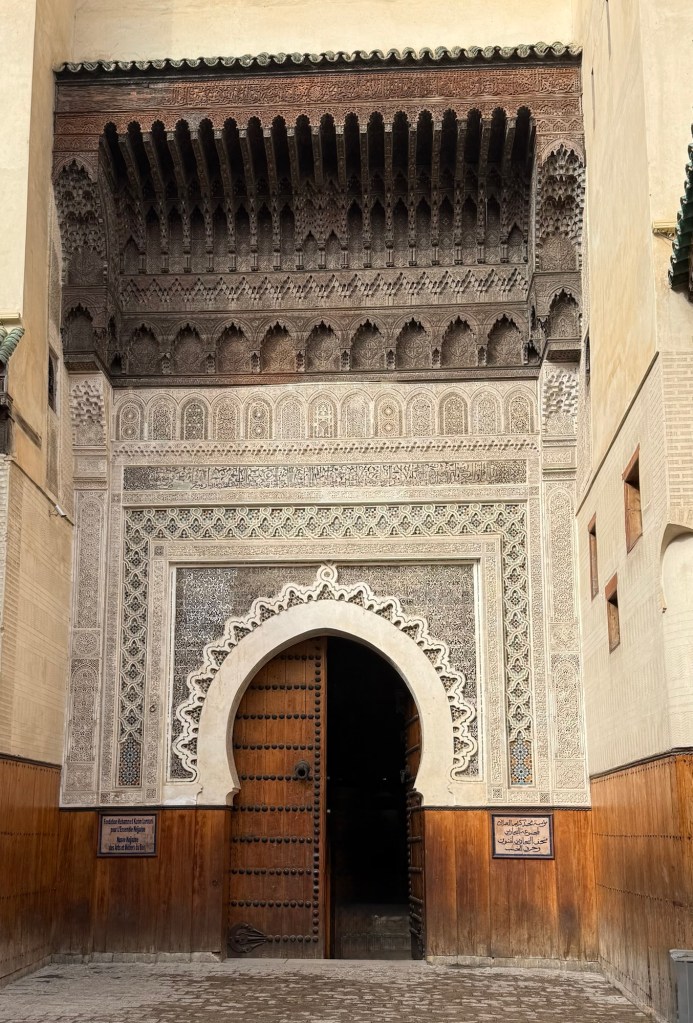
Entrance
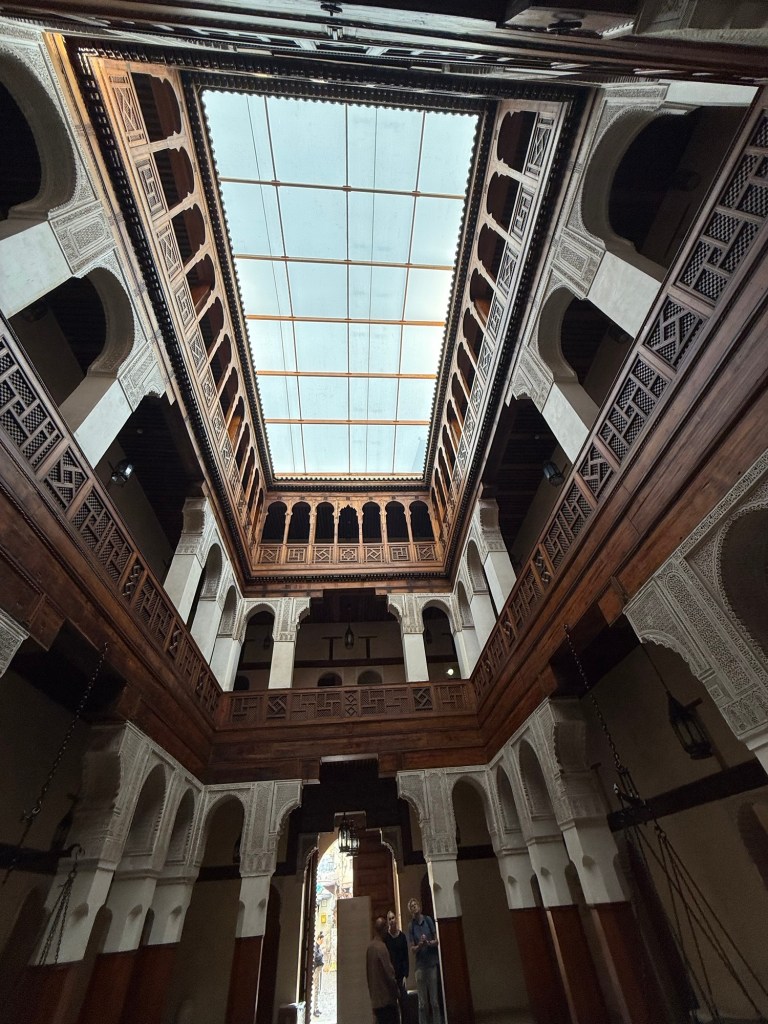
1st floor
View to roof
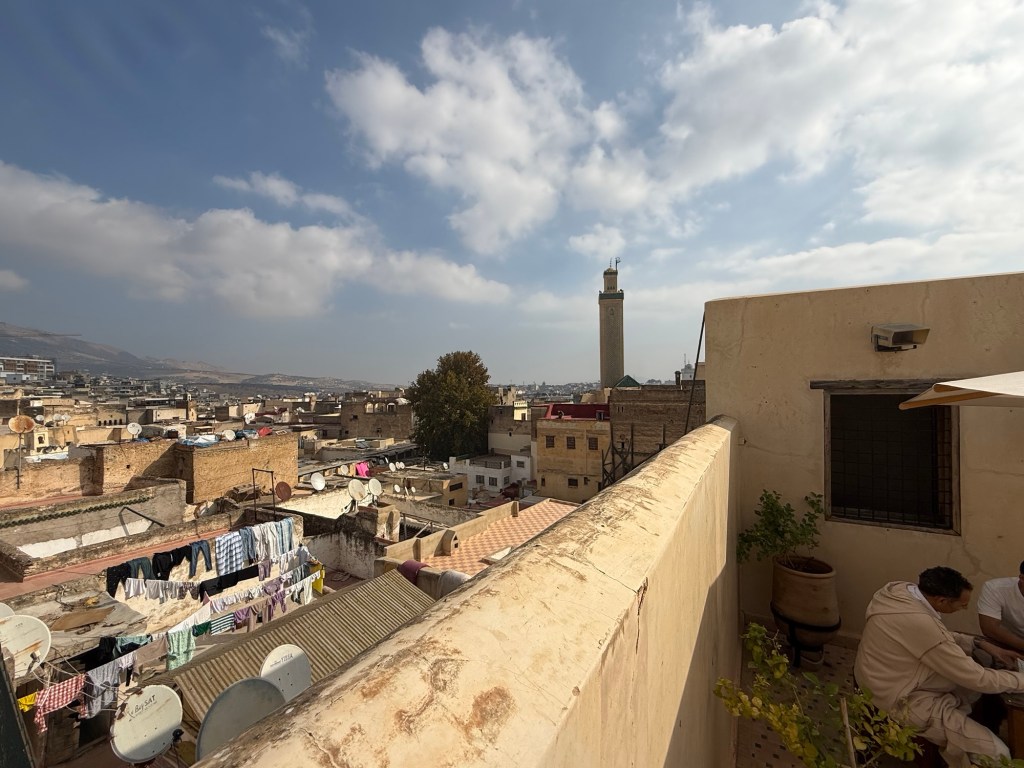
Rooftop view

This is a fantastic museum with numerous relatable items that are well-labeled and described.

Mausoleum of Moulay Idriss II:
The mausoleum contains the tomb of Idris II (or Moulay Idriss II when including his sharifian title), who ruled Morocco from 807 to 828 and is considered the main founder of the city of Fez. It is considered one of the holiest shrines in Morocco.

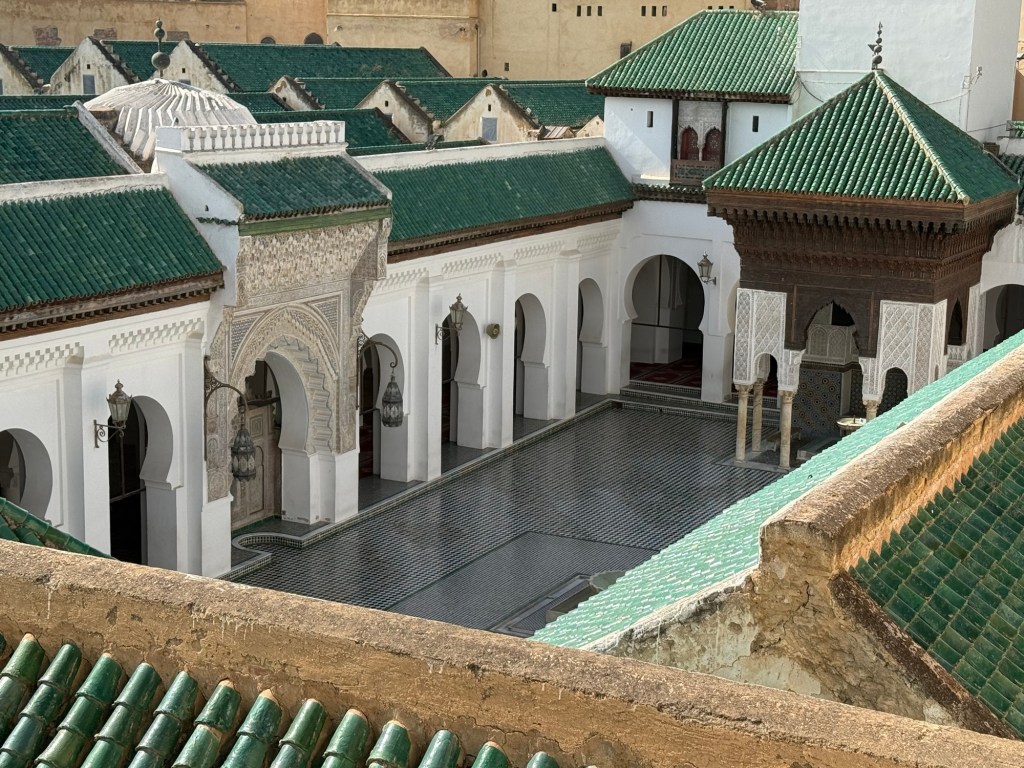
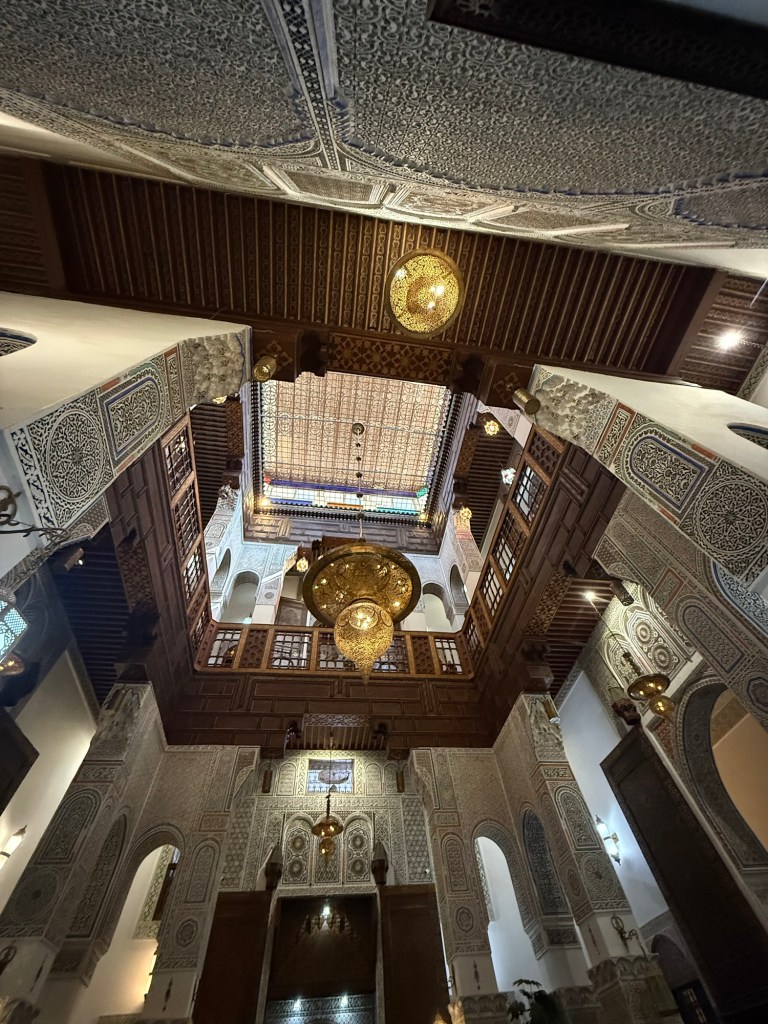
Kairaouine Mosque and the University of al-Qarawiyyin:
This is the oldest continuously functioning university in the world and was founded by a woman.

Chouara Tannery:
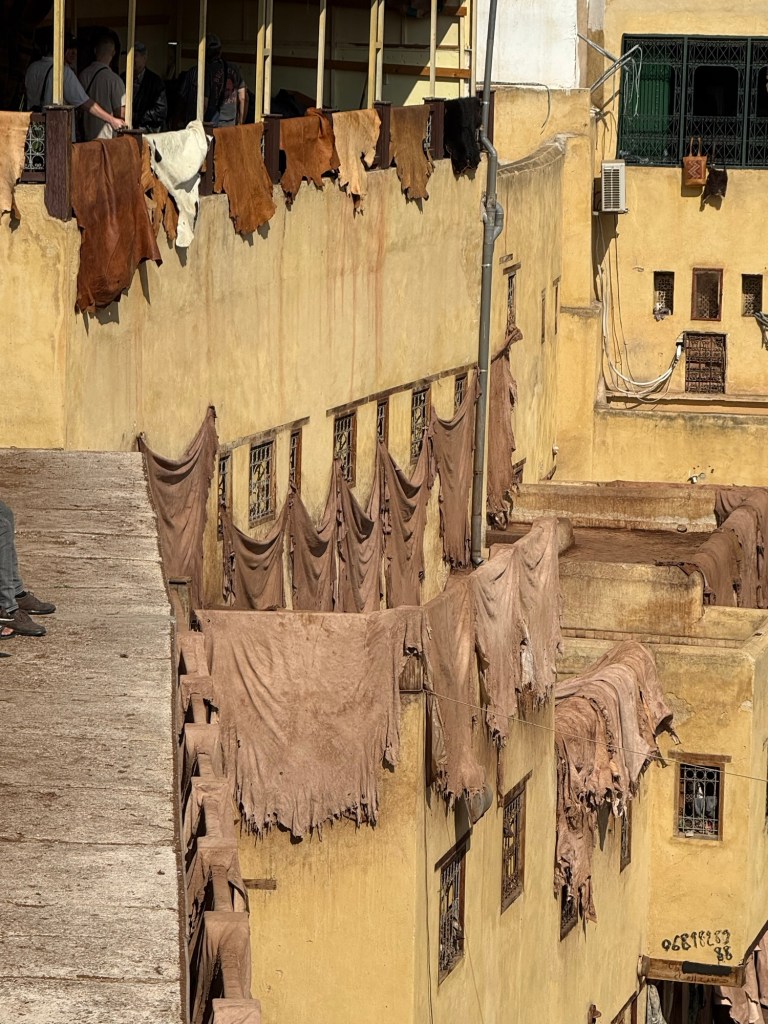
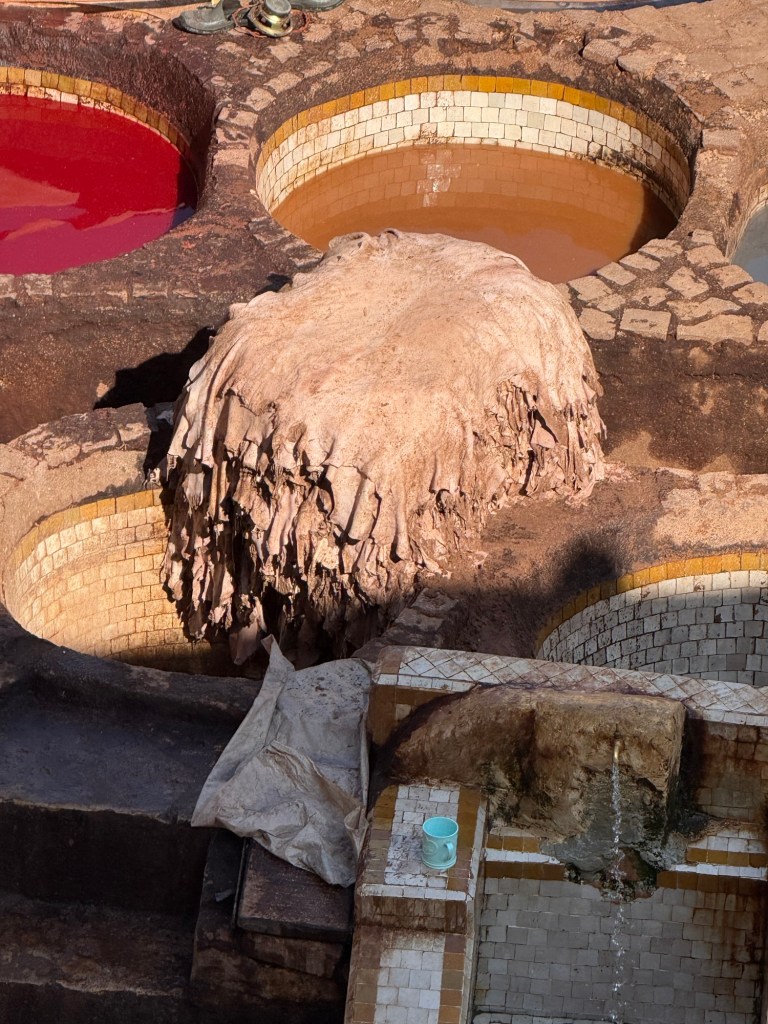
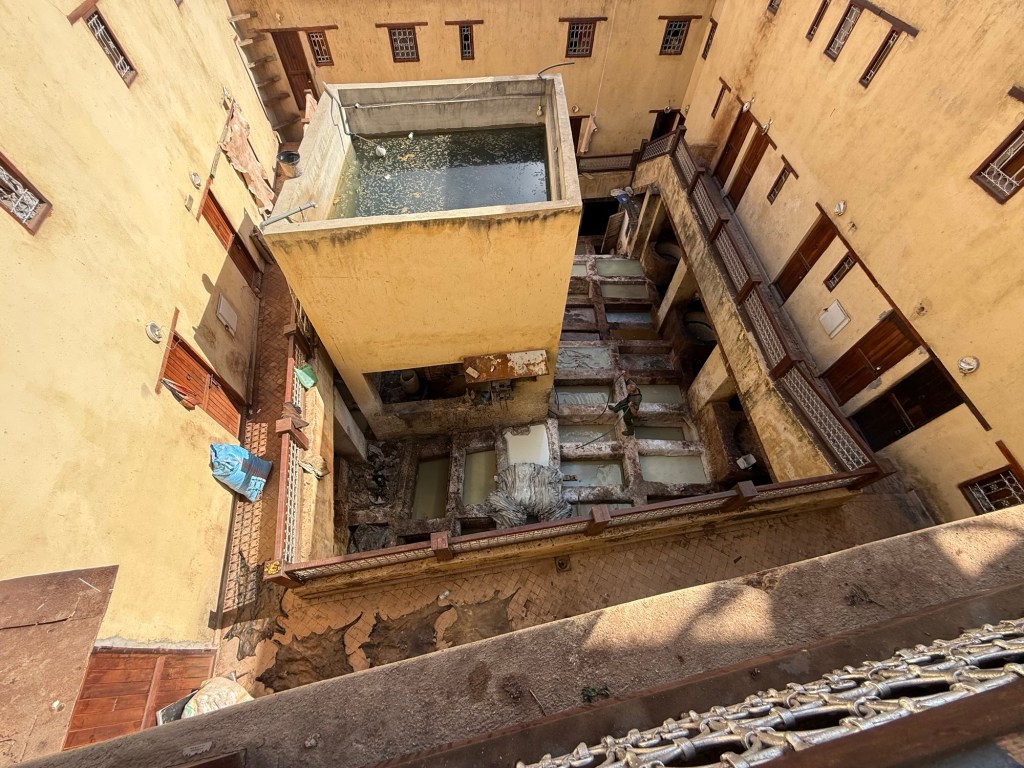
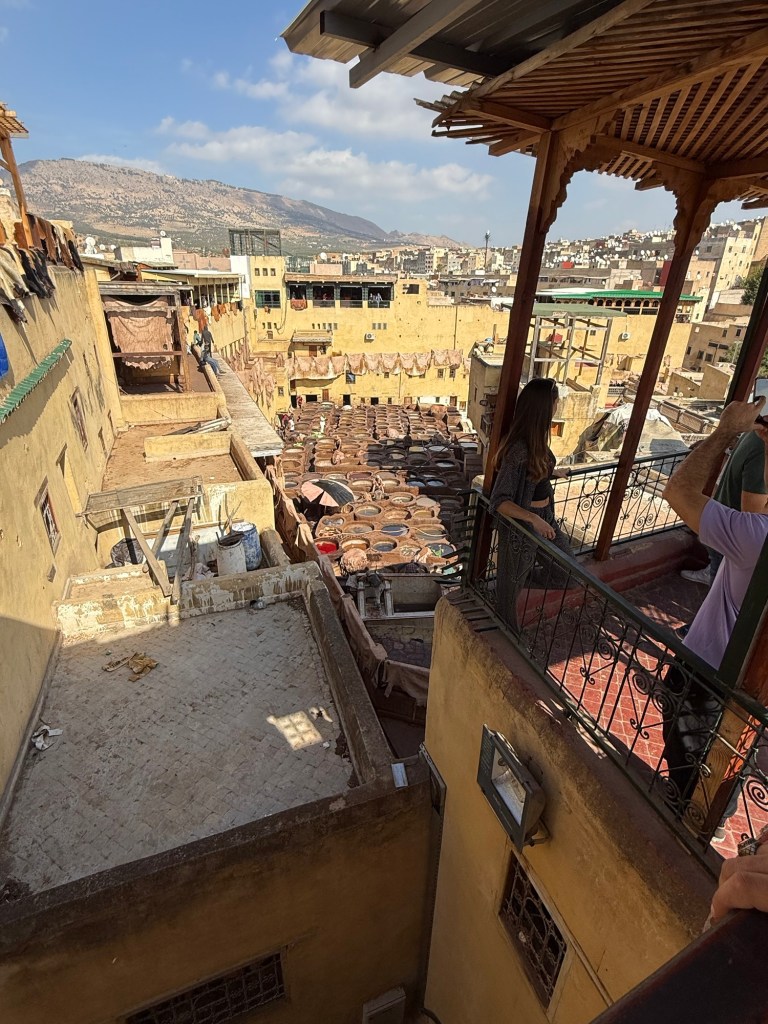
This has got to be one of the most unpleasant places I’ve ever visited. There are thousands of animal skins at various stages in the process of becoming leathery skins.

The traditional Moroccan leather tanning process involves soaking animal hides in vats of pigeon excrement and cow urine to soften them. The stench from the soaking vats is overwhelming, despite the mint leaves stuffed up your nose.

Following a hand-trampling step, the hides are then dyed using natural colorants from plants and spices like saffron, indigo, and henna, before being dried under the sun.

This method utilizes traditional, manual techniques to transform raw hides into high-quality leather.

I felt sympathy for the workers who do this day after day…

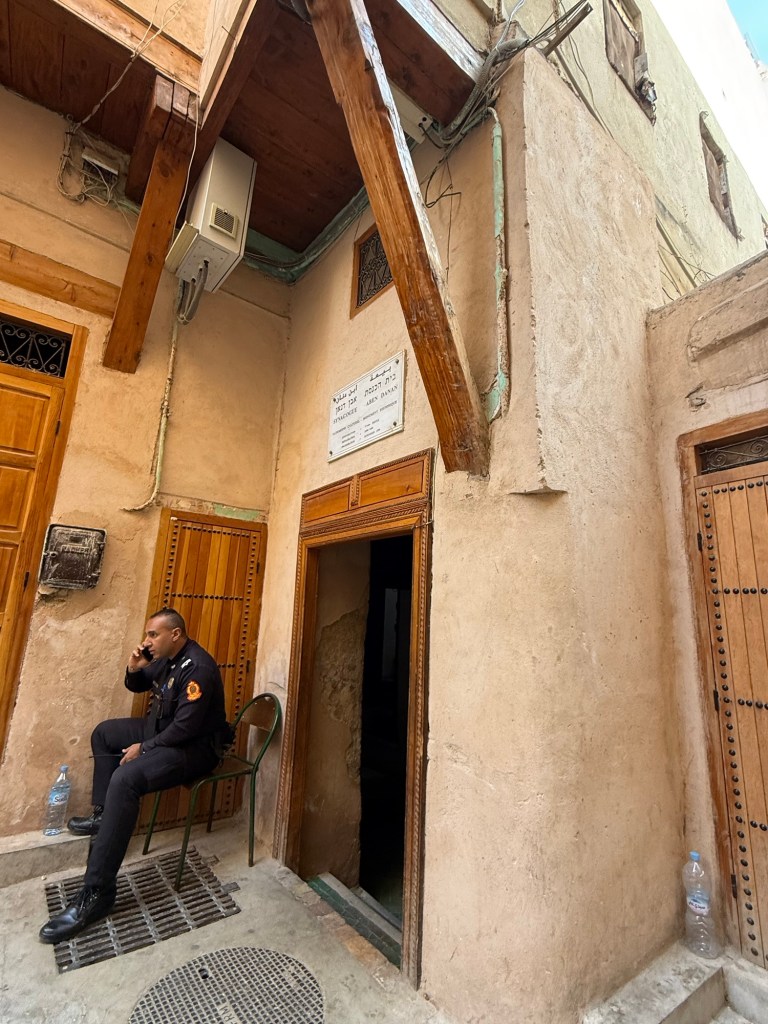
Jewish Quarter:

The Jewish Quarter was interesting if for nothing else that no Jews lived there anymore – those that still lived in Fez lived in the hills in their palaces.

Mosaics:

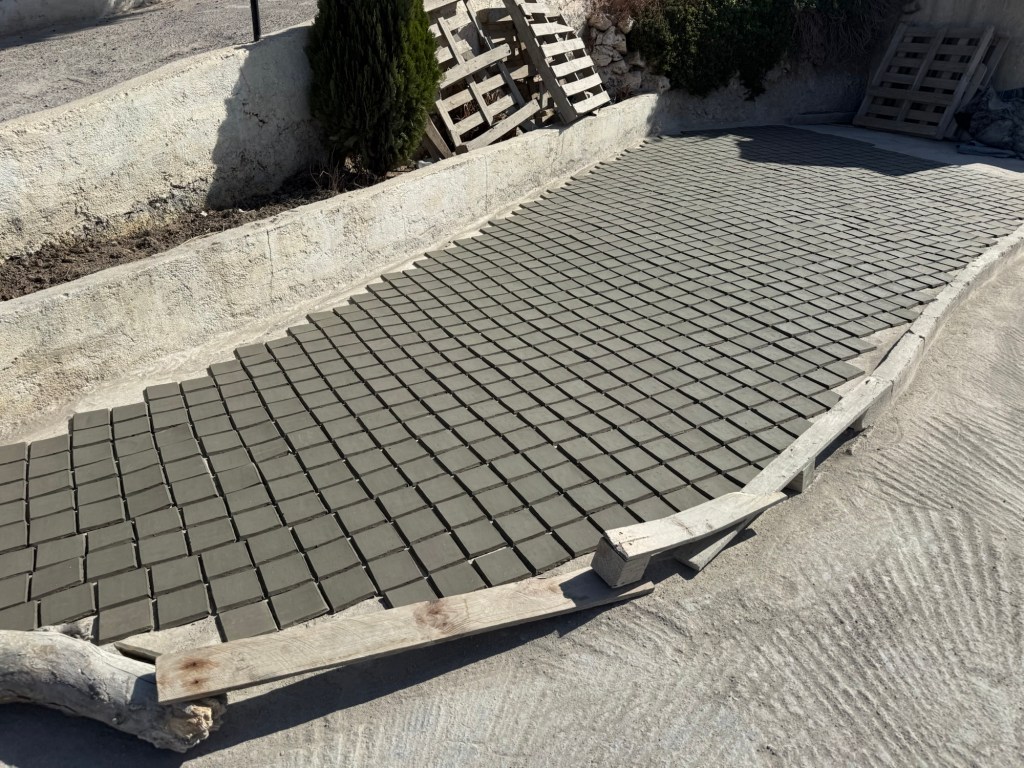
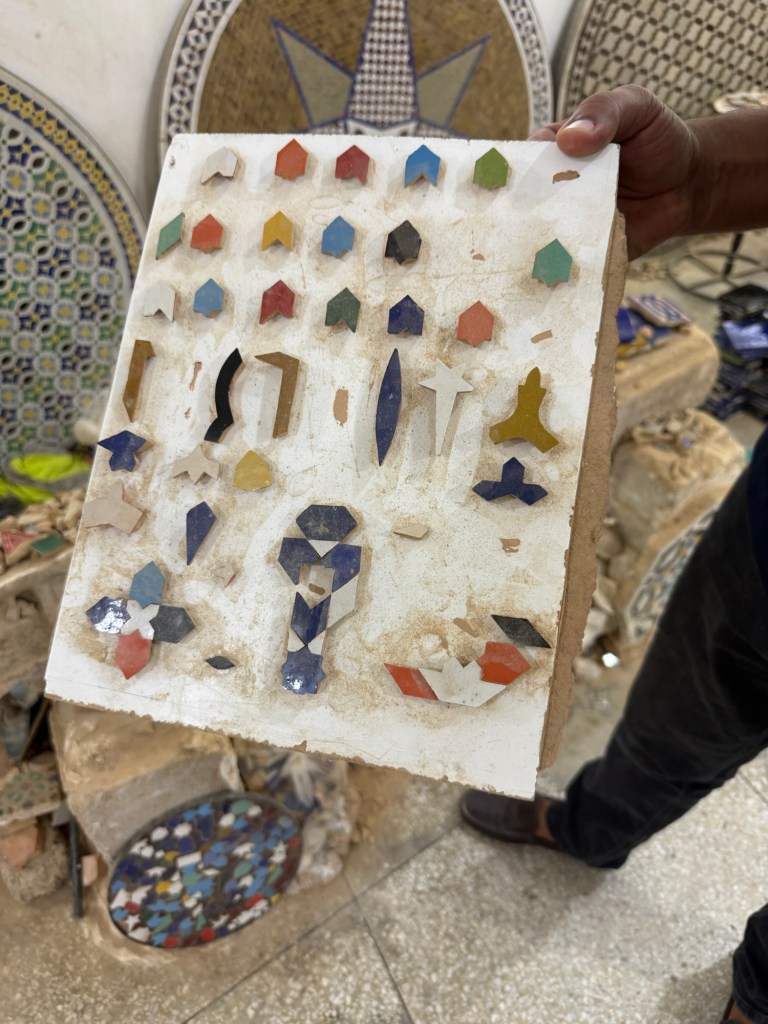
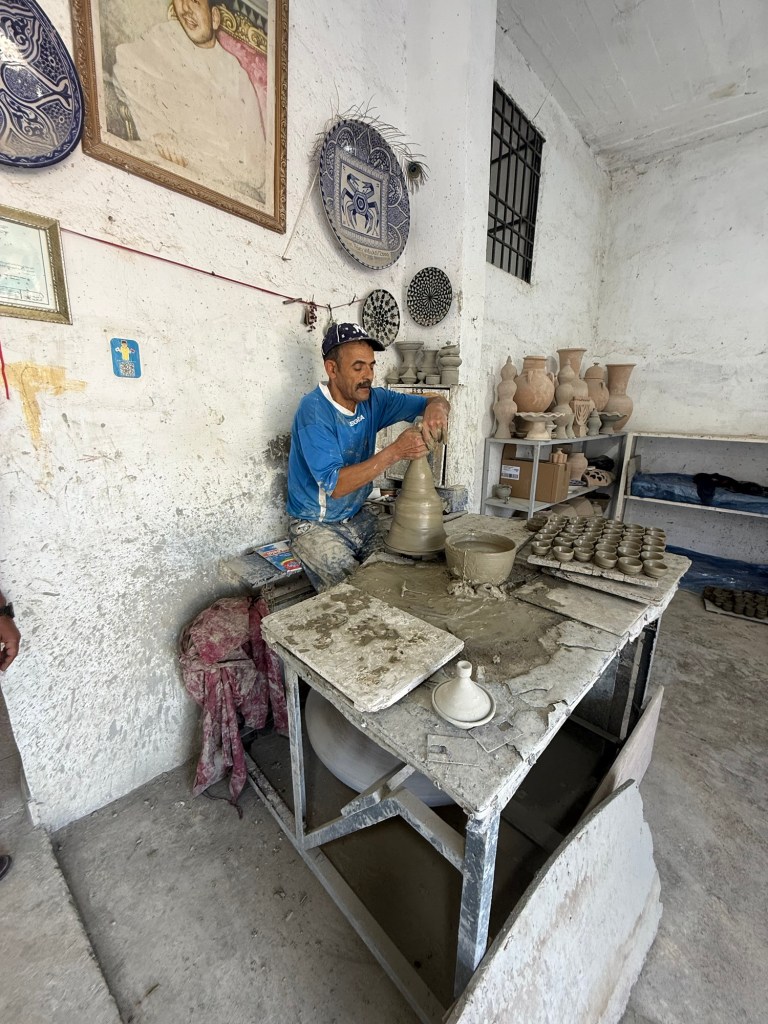
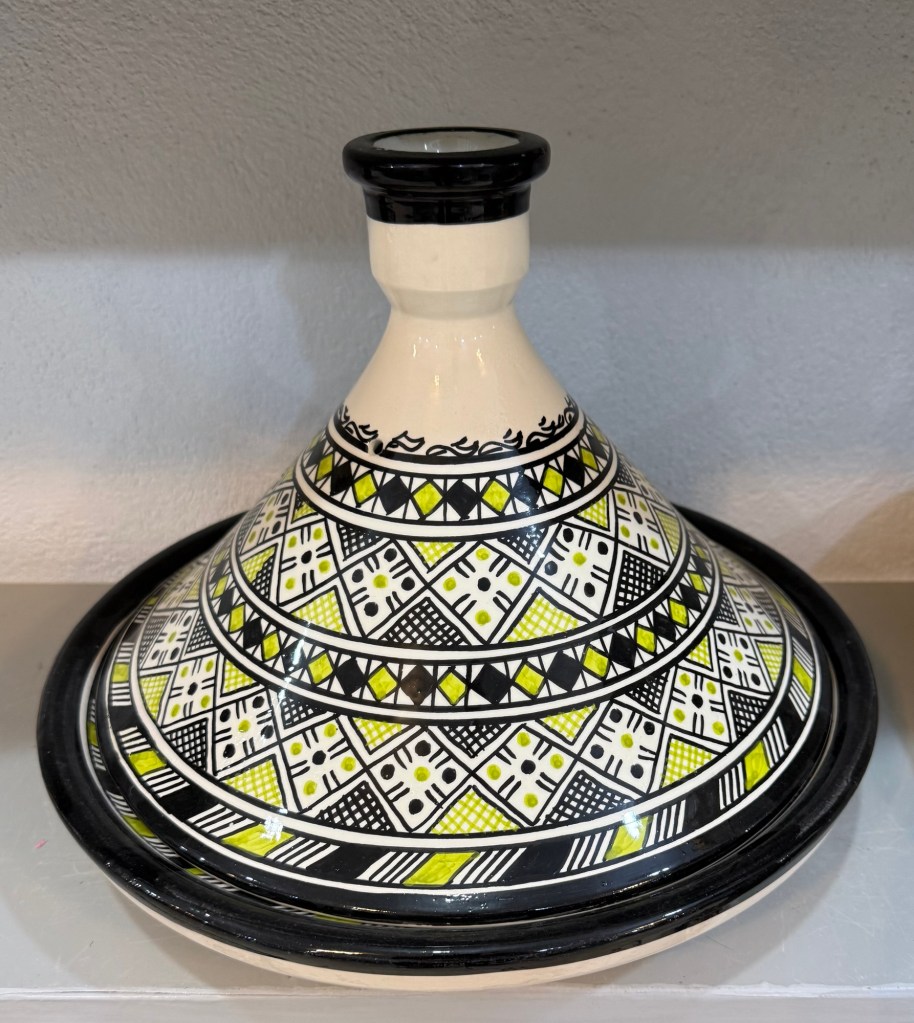
Reluctantly I was taken to a government controlled mosaic business. The process from raw clay to finished tile ready for cutting to make mosaics and the pottery making and glazing was interesting.

I could not keep my wee pennies in my pockets…..

Oven or stove top Tajine

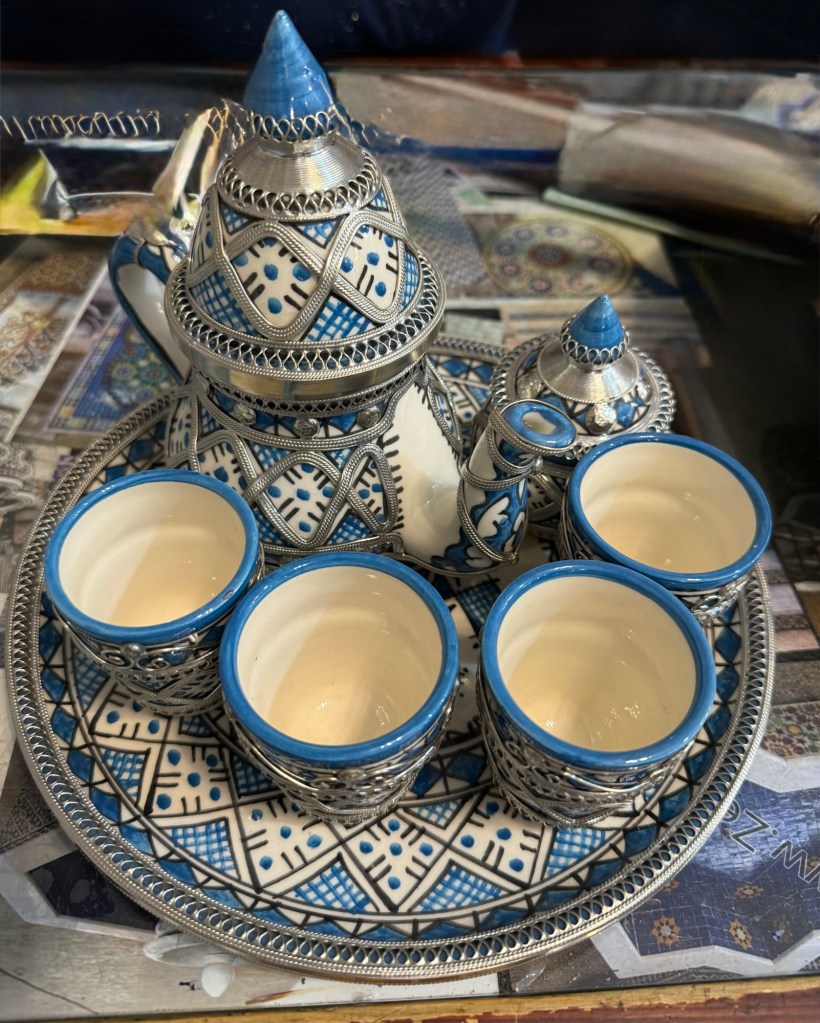
Green tea with Mint and Sugar Bowl Set

Meals:

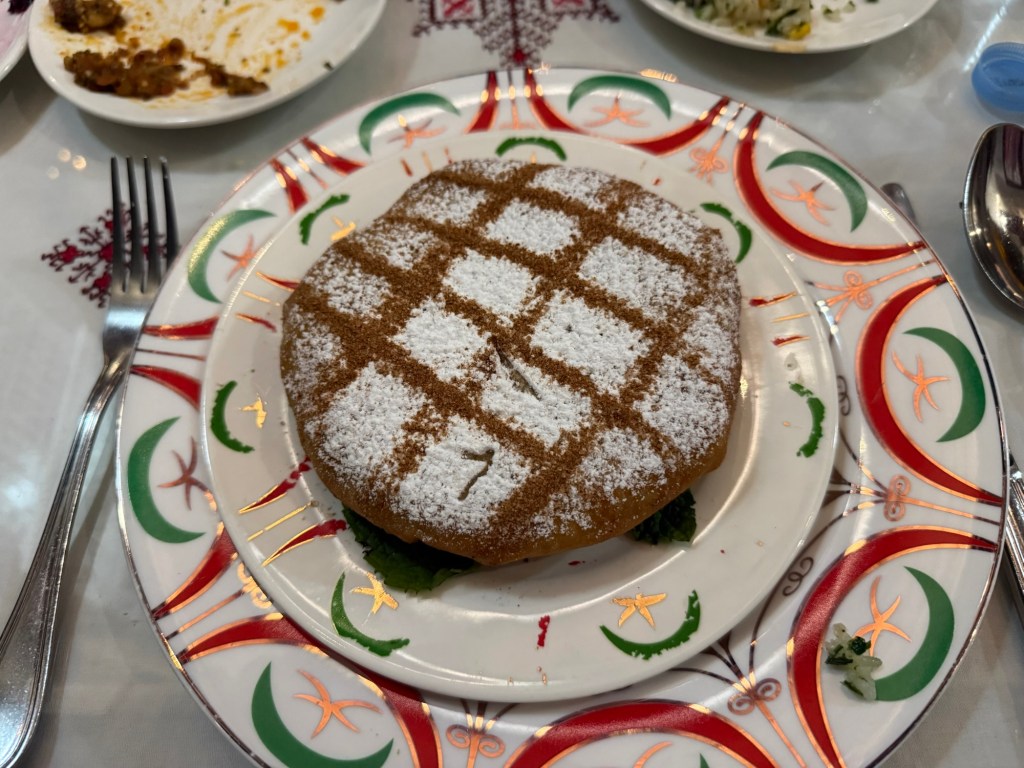
Fatigued after bargaining, lunch at Palais Bab Sahra was wonderful. After six salads, I had Chicken Pastilla, a regional delicacy. Shredded or minced chicken is wrapped in flaky pastry finished with a generous dusting of cinnamon and powdered sugar. The Spanish brought it to North Africa, but nomadic Berbers and native Arabic people have shaped its composition through the years. Known by many names, B’stilla/Pastilla/Bistilla is traditionally made with pigeon meat stewed in onions and aromatic spices, then wrapped in paper-thin crepes called warqa, which means leaf in Arabic. I would have opted for the pigeon as it tastes like chicken, and you know it’s contributed to the production of quality leather.

Guide:

Amine ^ was an excellent guide, and it was refreshing to hear a Muslim speak positively about past Jewish contributions to Muslim culture, architecture, clothing, etc. He is a fine fellow….

^ Supplied via Luxury Tours Morocco.

Day 9 (2): Morocco – 14 Days Private Land Tour

By Paul Bryers

  • Afternoon Itinerary: Volubilis – Moulay Idriss – Meknes – Fez
  • Accommodation: Riad Almakan, Fez
  • Meals: PALAIS ISMAILIA, Meknes

Moulay Idriss:
On the way to Meknes, we drive past the the pilgrimage town of Moulay Idriss in the hills opposite, whose outline is reminiscent of a dromedary. This is reported to be a labyrinth of centuries-old cement buildings, where the walls are splashed in shades of mint, coral, lemon, violet and emerald. The spectrum of pastel hues even from s distance rivals the vibrant blues of Chefchaouen.

Yet, historically closed to non-Muslims and lacking a direct train line, Moulay Idriss has remained largely off the tourist radar.

Moulay Idriss

Meknes:
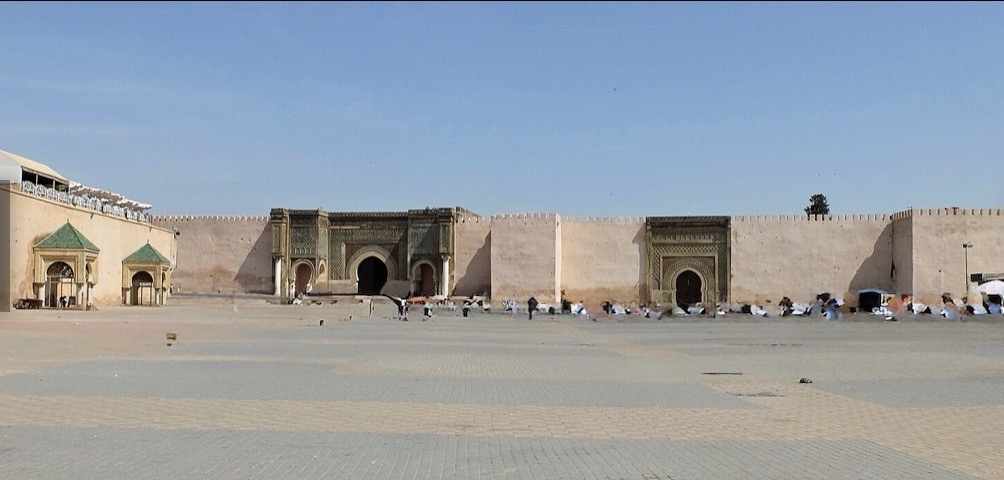
The city is situated on a fertile plateau and is known for its 40 km long city wall with its magnificent city gates, as well as for its beautiful, authentic souks.

Gates of Meknes
Gates of Meknes
Gates of Meknes
Gates of Meknes

Unfortunately, I was only able to lunch in the city and not do a guided tour; my labyrinth canals had other plans for me.

The lunch was at Palais Ismailia and was good.

Eventually we arrived in Fez and that was that for the day.

Fez from hilltop

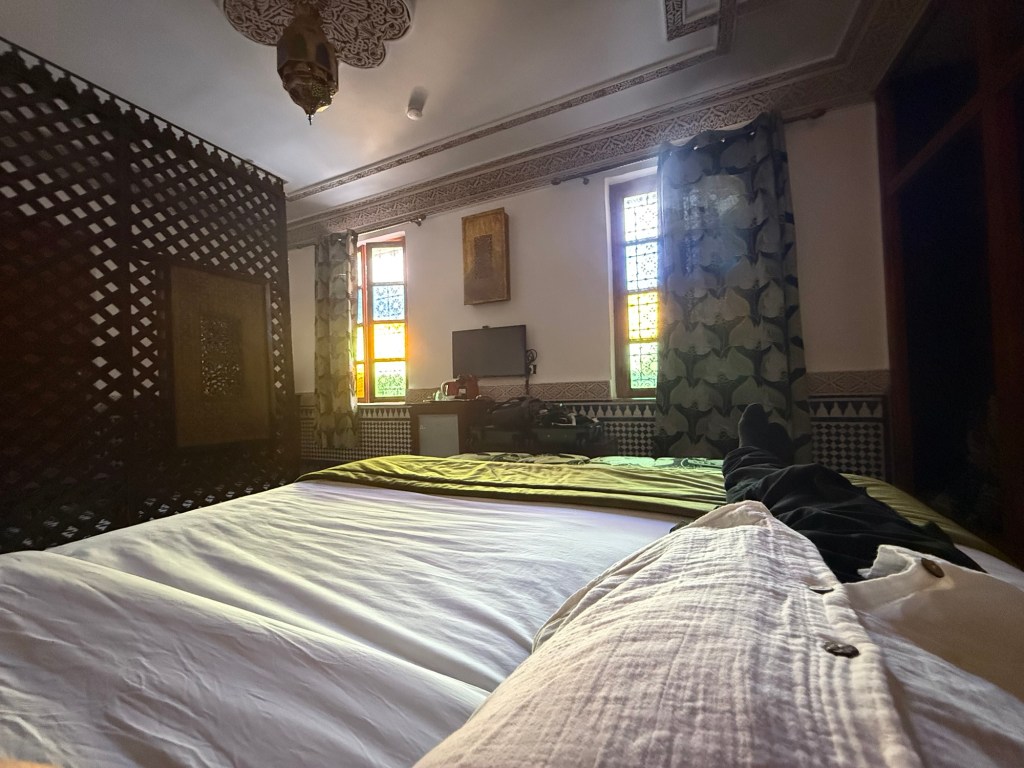
Riad Almakan in Fez was a welcome site. The room was palatial on the top floor with a Sky Balcony.

Day 9 (1): Morocco – 14 Days Private Land Tour

By Paul Bryers

  • Morning Itinerary: Drive Chefchaouen – Volubilis
  • Guide: Moulad ^

Upon departing Chefchaouen in the morning, we were treated to a lovely view of the old Jewish City.

Chefchaouen
Chefchaouen

As we continued driving towards Meknes/Fez, the soil transformed into rich, black earth due to previous volcanic eruptions. The landscape was dotted with wheat and barley fields, and hills covered with fruit trees and other vegetation – a stark contrast to what I had anticipated in Northern Morocco.

Hills leaving Chefchaouen
Rich, black earth near Volubilis
Trees near Volubilis

Volubilis:
Our first stop was Volubilis, a Berber-Roman city, where we explored the ruins in detail. Notably, this city marked the westernmost point of the Roman Empire, much like Hadrian’s Wall in Scotland denoted the empire’s northernmost boundary.

Román City of Volubilis

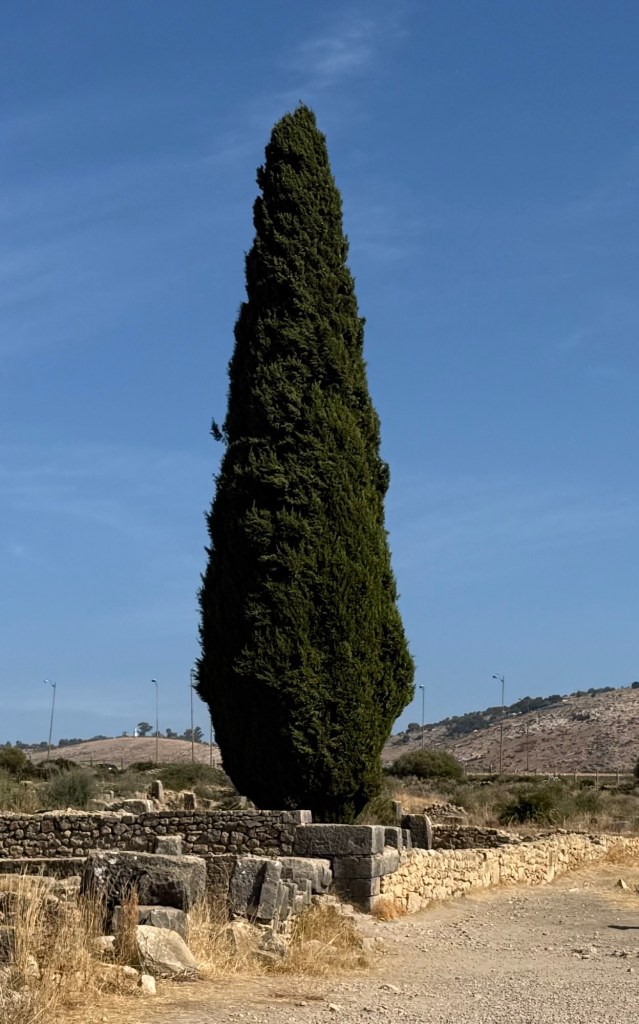
Upon entering the site, I was immediately drawn to a solitary tree, which I mentioned to Moulad resembled the one from the movie Gladiator, where Russell Crowe’s character reunites with his deceased wife and son. Interestingly, it was indeed the same tree!

Gladiator I Tree at end of film

Located in a fertile agricultural area, Volubilis originated as a Berber settlement in the 3rd century BC and expanded rapidly under Roman rule from the 1st century AD onwards. The city eventually spanned approximately 42 hectares (100 acres) with a 2.6 km (1.6 mi) circuit of walls.

I have included a site map for orientation purposes.

Map of Volubilis Site

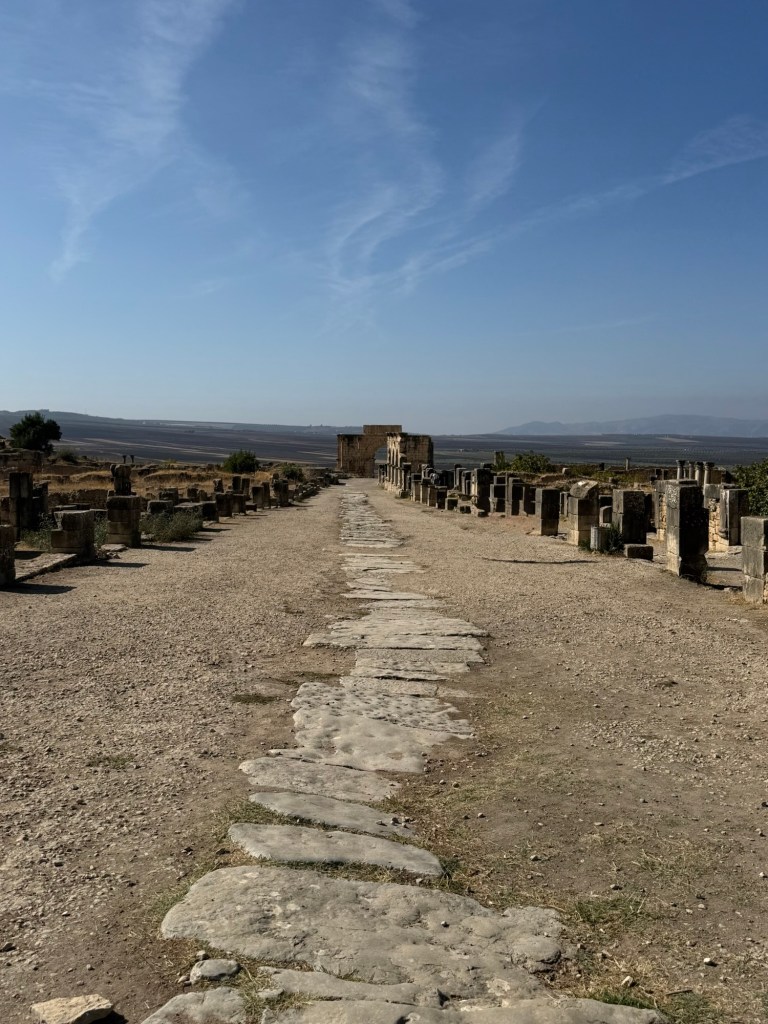
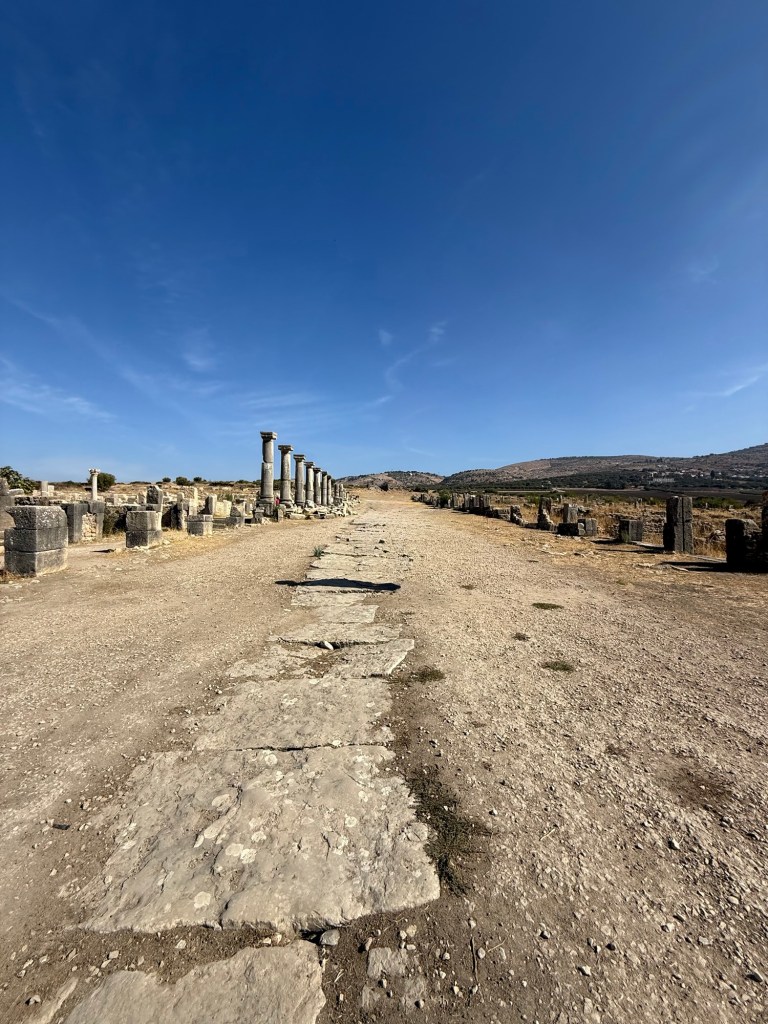
The city was designed along a main thoroughfare, the decumanus maximus. The city gates and porticos led to adjacent houses on both sides of the road, forming a near-perfect straight line from the Tangier Gate to the Caracalla arch.

Decumanus maximus to Tangier Gate
Decumanus maximus to Caracalla Arch

During the 2nd century, this thoroughfare was lined with columns and arches for shade …..

Columns along Decumanus maximus
Arches along Decumanus maximus

….with major public buildings, including a basilica,…

Basilica along Decumanus maximus

and a triumphal arch….

Triumphal Arch on Decumanus maximus

There was also a small aqueduct whereby fresh water came from the mountainss into the city.

Aqueduct running along Decumanus maximus

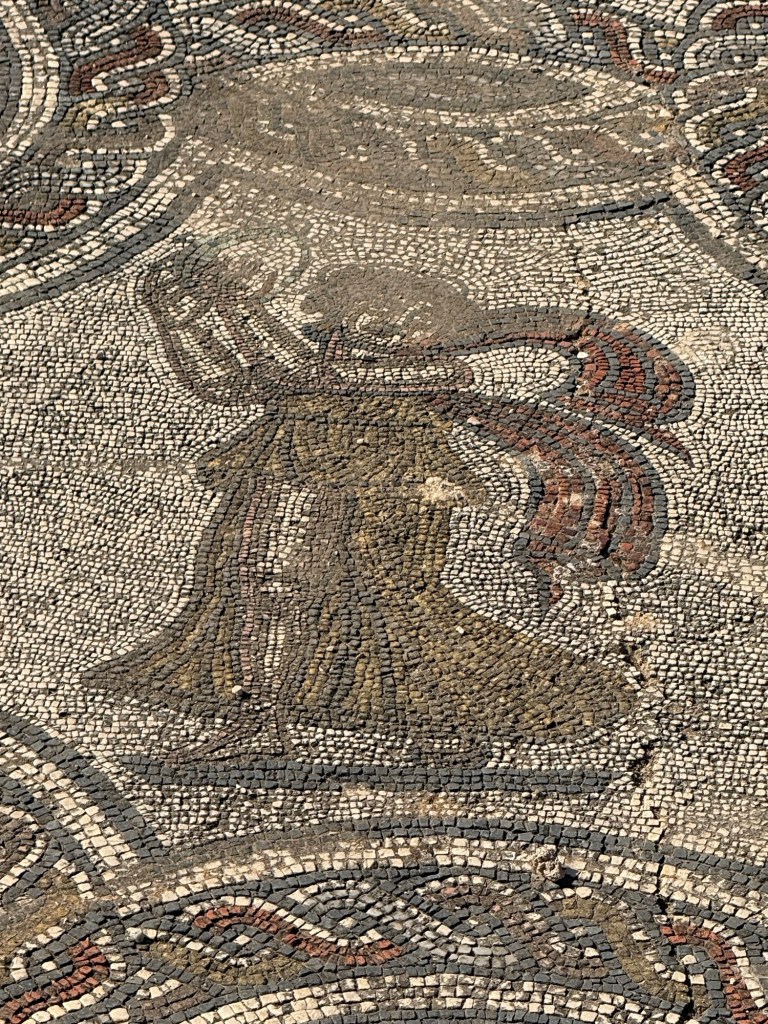
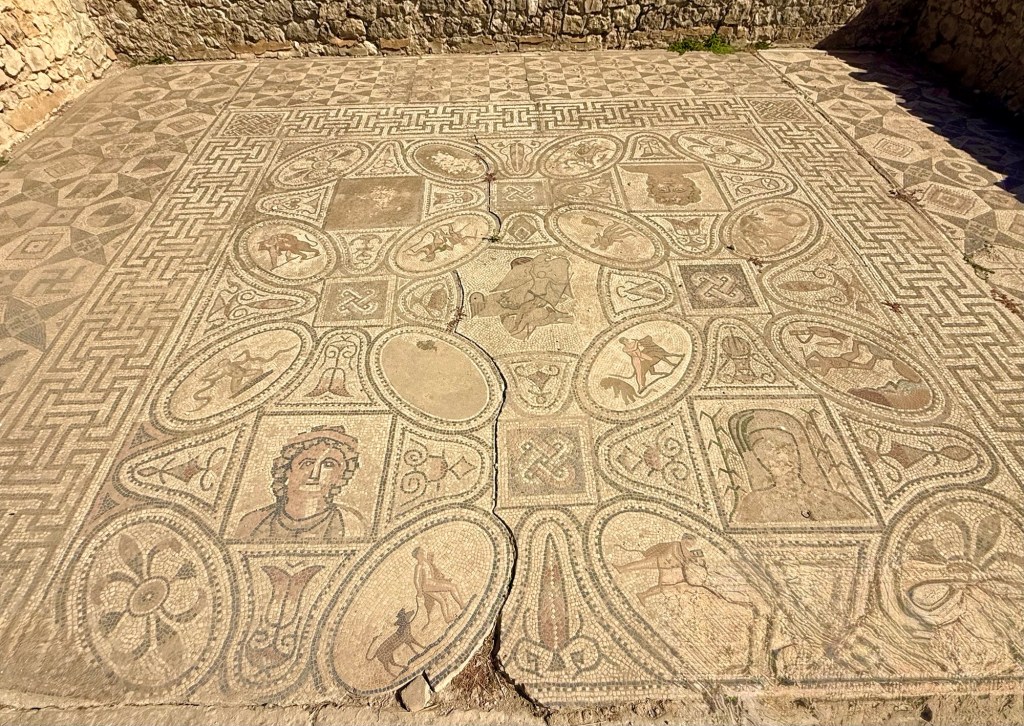
Volubilis is renowned for its impressive peristyle houses in the northeast area. The city’s prosperity, primarily derived from olive cultivation, led to the construction of numerous fine townhouses featuring large mosaic floors. Many of these floors have been meticulously restored.

Among these houses, the House of the Labours of Hercules stands out as a masterpiece. With an irregular layout, this house opens onto a secondary cardo, distinguishing it from other houses in the northeast district. The reception room boasts a stunning mosaic depicting various subjects, including the kidnapping of Ganymede, the twelve labours of Hercules, and the Four Seasons.

Map of Hercules House
Baths at Hercules House
Main room flour in Hercules House

The Temple of Venus, complete with a sacrificial altar, left a lasting impression. I jokingly advised the cat on the altar to vacate the premises promptly.

Temple of Venus

Today, Volubilis is recognized as a UNESCO World Heritage Site, distinguished as “an exceptionally well-preserved example of a large Roman colonial town on the fringes of the Empire”.

Day 8: Morocco – 14 Days Private Land Tour

By Paul Bryers

  • Day Itinerary: Lazy, Ponderous Puppy Day in Chefchaouen

And on the 7th day, the Blogger rested.

Actually, I’ve been posting every day for 25 days straight. I know not many read the posts, but it keeps a good record for me to review in later life when I’m an old fart…

So, just providing a few photos of this lovely hill town and that’s it.

Day 7: Morocco – 14 Days Private Land Tour

By Paul Bryers

  • Day Itinerary: Drive from Casablanca – Rabat – Chefchaouen
  • Accommodation: Iguana Azul, Chefchaouen
  • Guide: Sofioan ^
  • Driver: Said ^
  • Meals: Kenzi Basma Hotel, Casablanca and Dar Naji, Rabat

This morning, we headed out to what will I think, from my research, be the most interesting part of the 14 days.

Governance of Morocco:
Before I discuss Rabat, the captial and official residence of the Monarchy, its worth mentioning its governance.

Morocco is a Constitutional Monarchy, like the UK. However, while there are democratic institutions and an elected parliament, the monarch maintains a commanding position and exercises considerable control over the state’s strategic direction and its people. The monarch holds significant power in areas like defense, security, diplomacy, and religious affairs, but also shares authority with the government, and recent reforms have been passed through a public referendum.

I’m sure King Charles III would like this type of power.

The current monarch is His Majesty King Mohammed VI, who ascended the throne in 1999 and belongs to the Alawi dynasty. He is very popular.

Rabat:
As with most capitals, Rabat is unlike other parts of the country – lots of green grass and trees, clean, slower pace, light rail, etc.

I met my guide, Sofioan, and we visited the most important sights of the city…

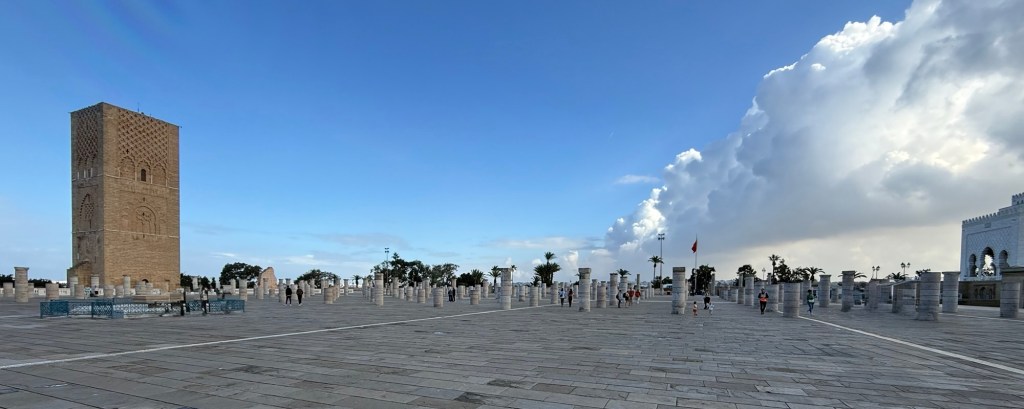
Hassan Tower and Mausoleum of Mohammed V –
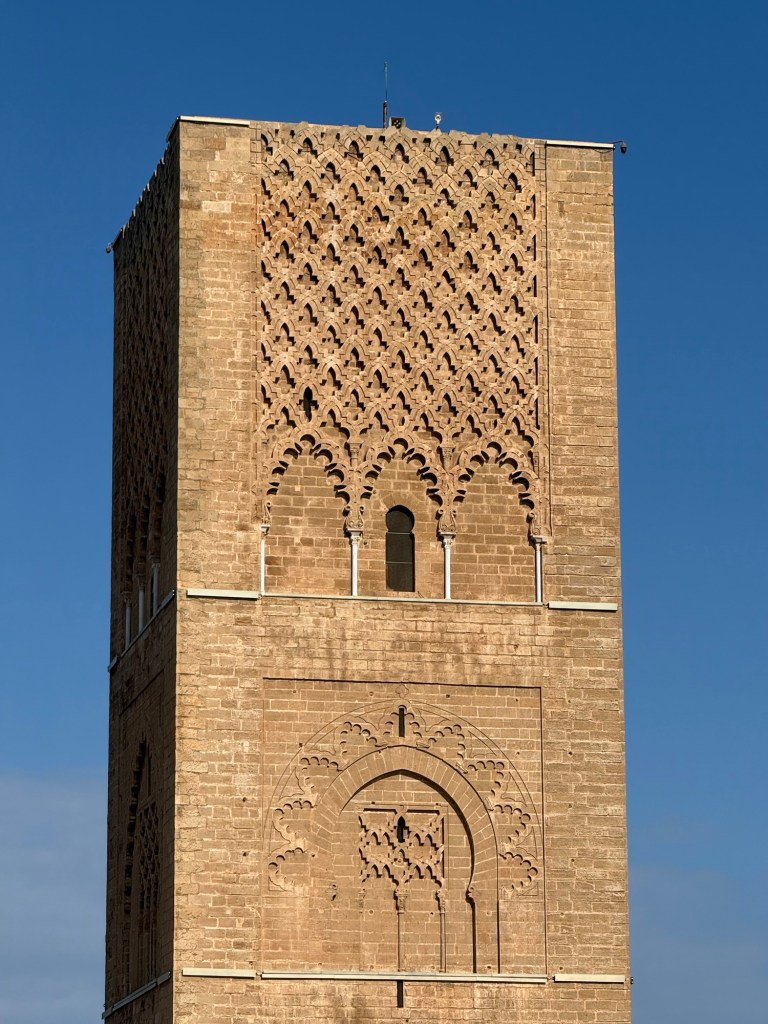
Hassan Tower is the minaret of an incomplete mosque. It was commissioned by Abu Yusuf Yaqub al-Mansur, the third caliph of the Almohad Caliphate, near the end of the 12th century. The tower was intended to be the largest minaret in the world and the mosque, if completed, would have been the largest in the western Muslim world.

When al-Mansur died in 1199, construction on the mosque stopped as there was a war ongoing and funds were short. The minaret was left standing at a height of 44 meters (144 ft). The rest of the mosque was also left incomplete, with only the beginnings of several walls and 348 columns being constructed.

Unfortunately, due to being a favored suicide spot, you can no longer enter or climb the tower.

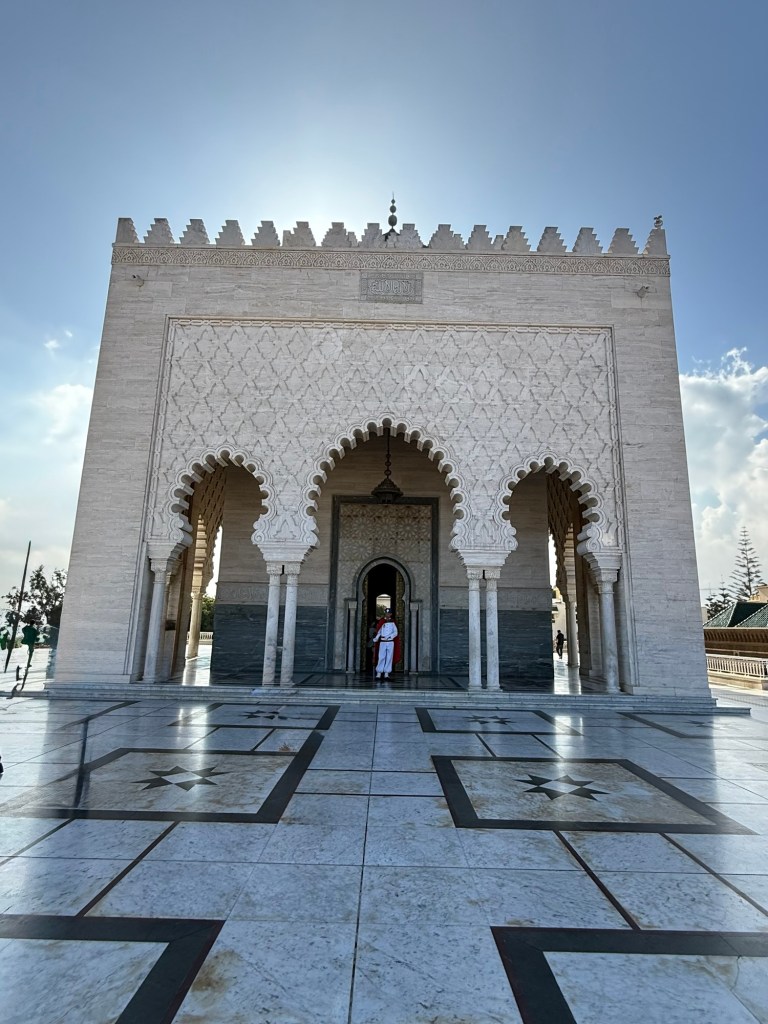
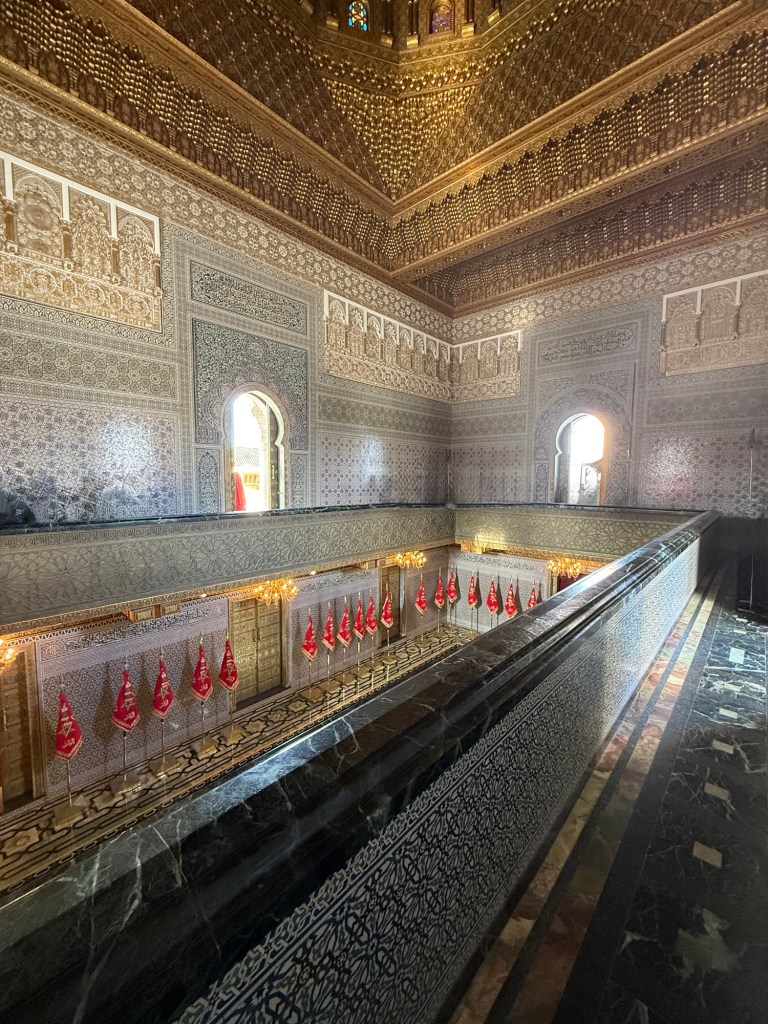
In the 1960s the site of mosque’s ruins was transformed to accommodate the construction of the Mausoleum of Mohammed V at its southeastern corner, alongside a modern mosque and another pavilion which occupy the rest of the southern side of the complex.

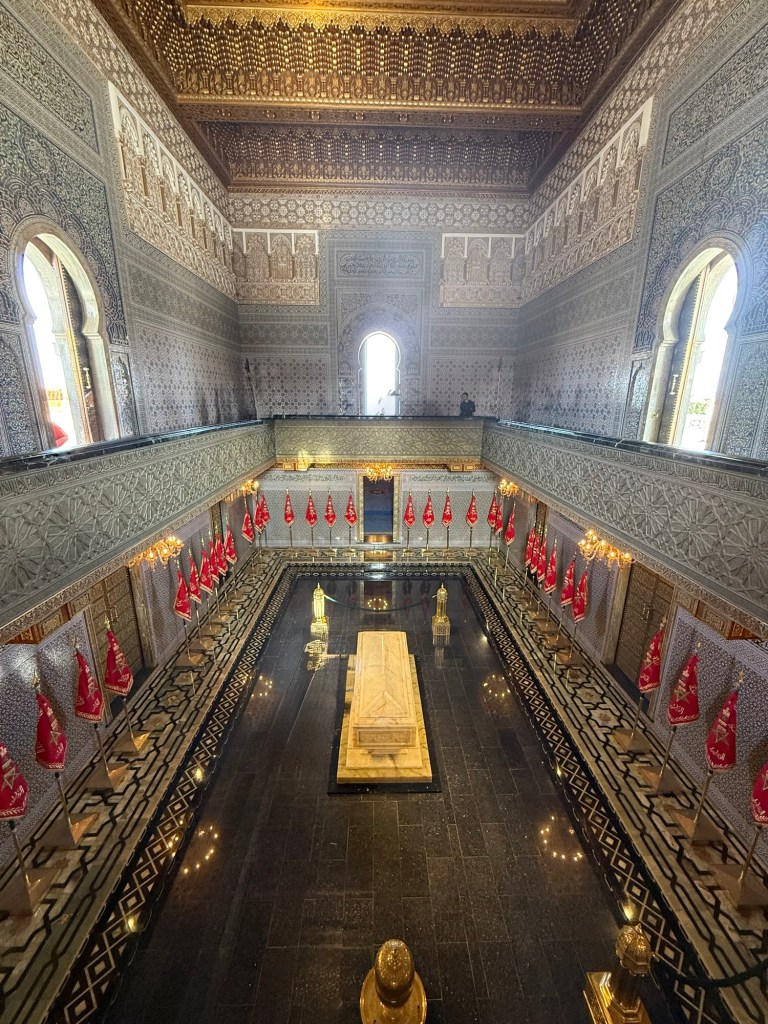
The modern mausoleum and mosque were designed by Vietnamese architect Cong Vo Toan and completed in 1971 – they could not find any Moroccan architects to deliver the envisaged design.

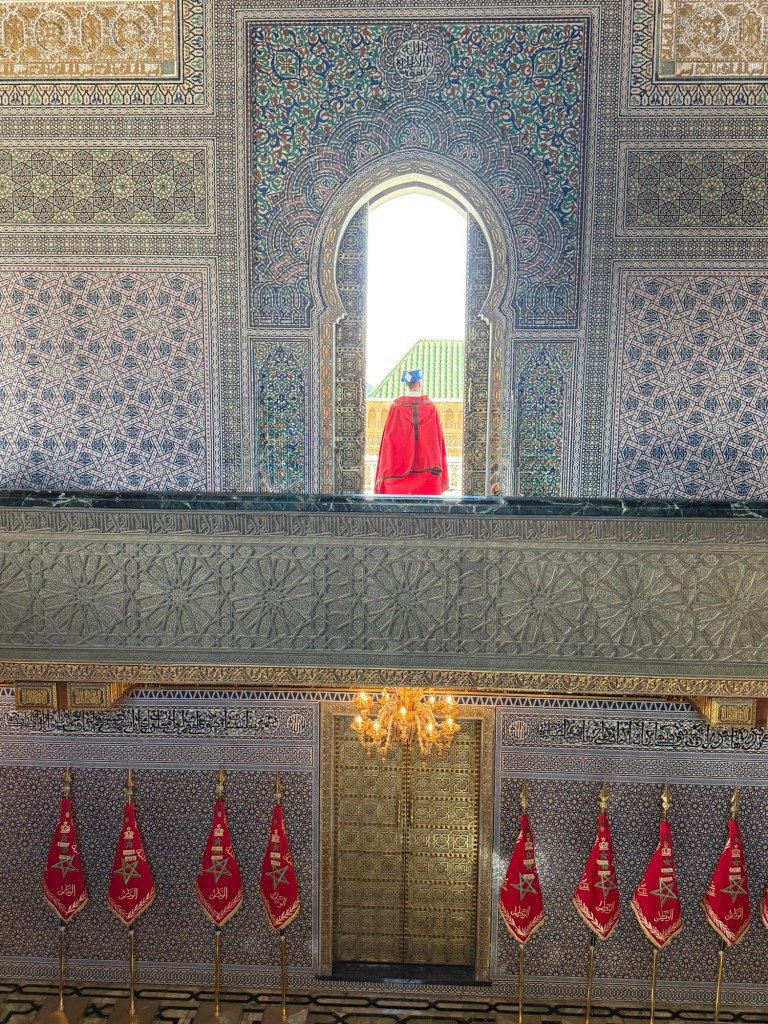
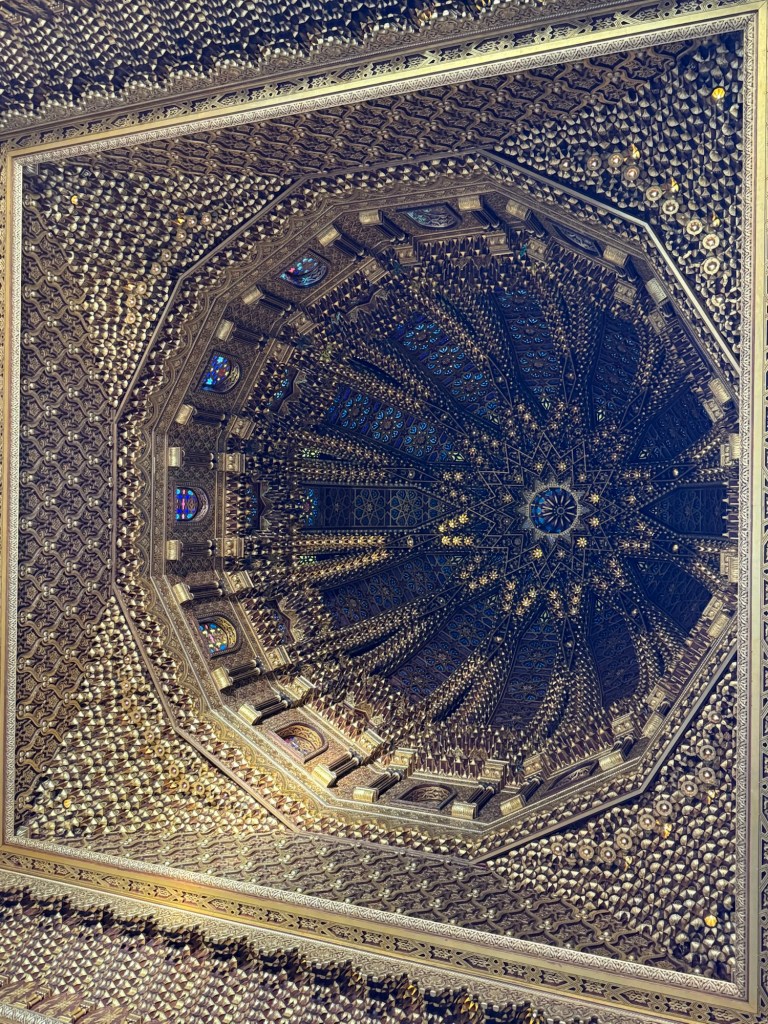
The Mausoleum is beautiful with the tomb being below the viewing gallery.

The tower and the site of the mosque were granted World Heritage Status in 2012.

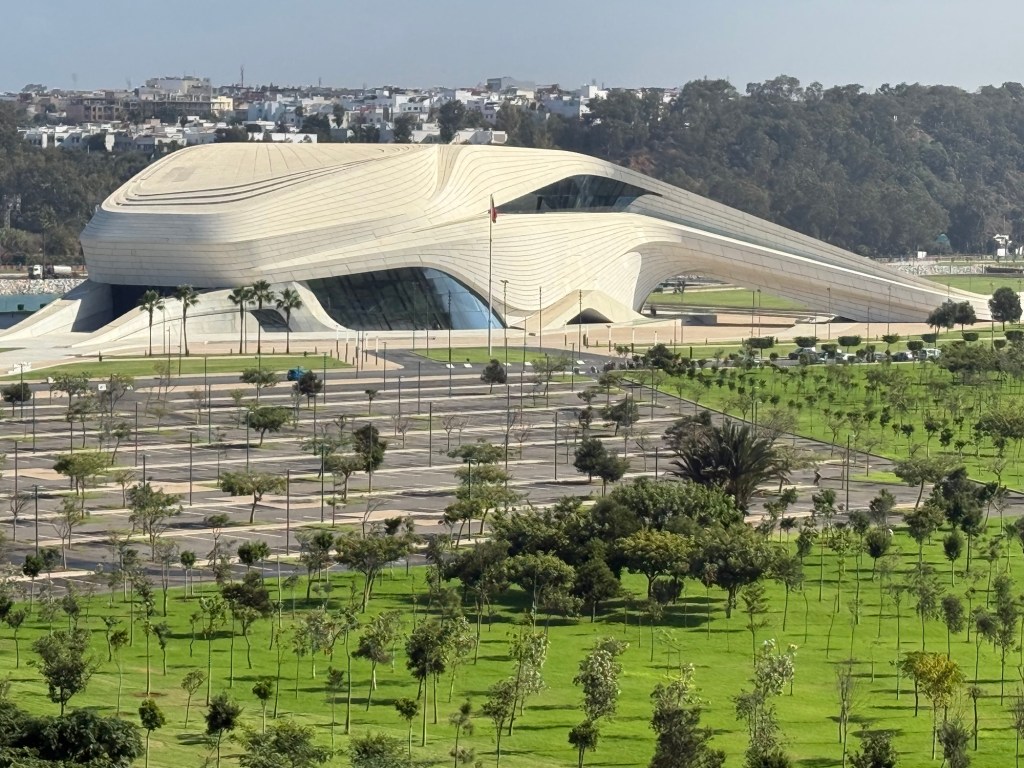
From the Mausoleum you get an excellent view of the opera house, known as the Grand Theatre, which was designed by Iraqi-British architect Zaha Hadid; yes, she who designed the Glasgow Transport Museum on the Clyde. The design is reminiscent of a cobra’s head. Sadly, the project was one of her last major works and represents her firm’s first project in Africa. 

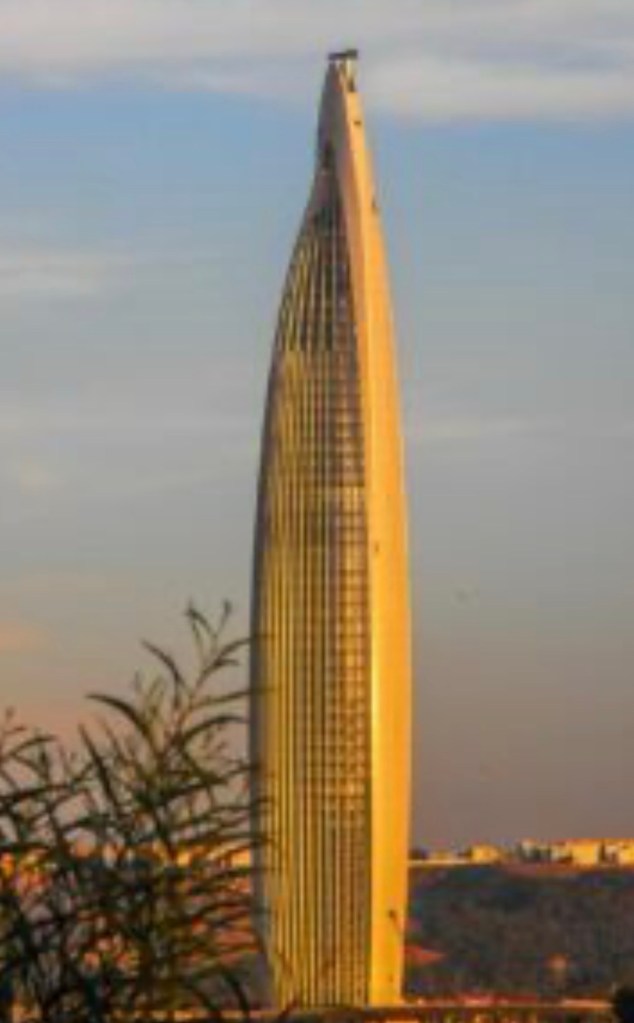
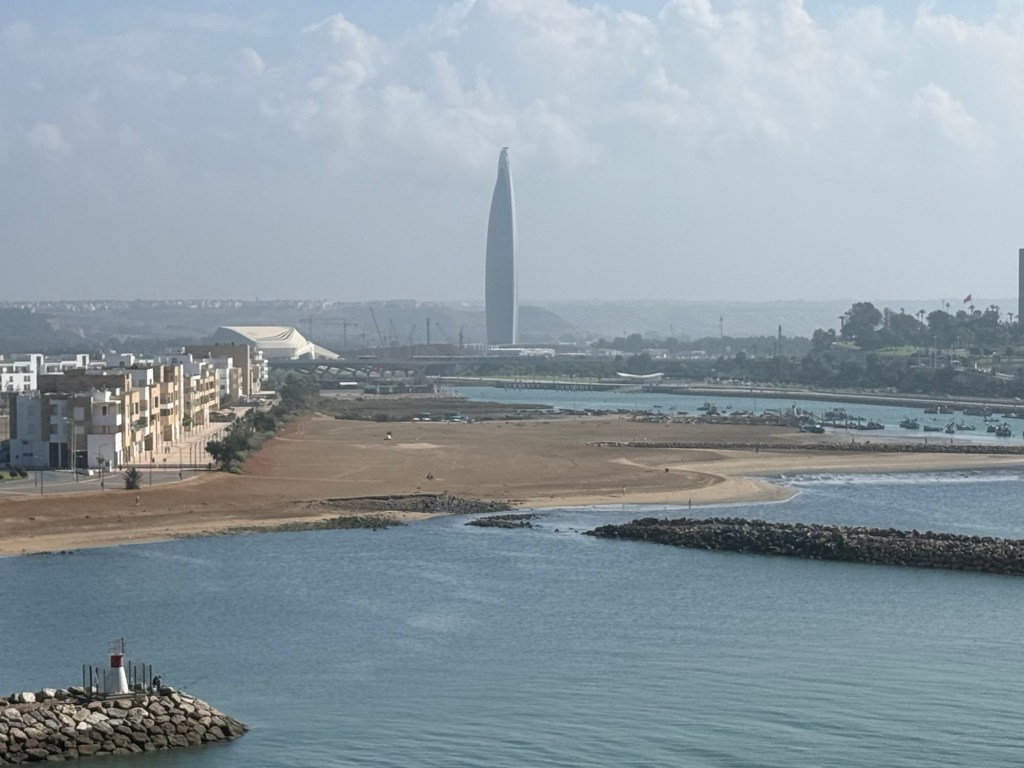
You also get a great view of the tallest building in the Rabat area, the Mohammed VI Tower, a 250-meter skyscraper in the neighboring city of Salé. It is the tallest building in Morocco and the third-tallest in Africa, housing a mix of hotels, offices, and residences. 

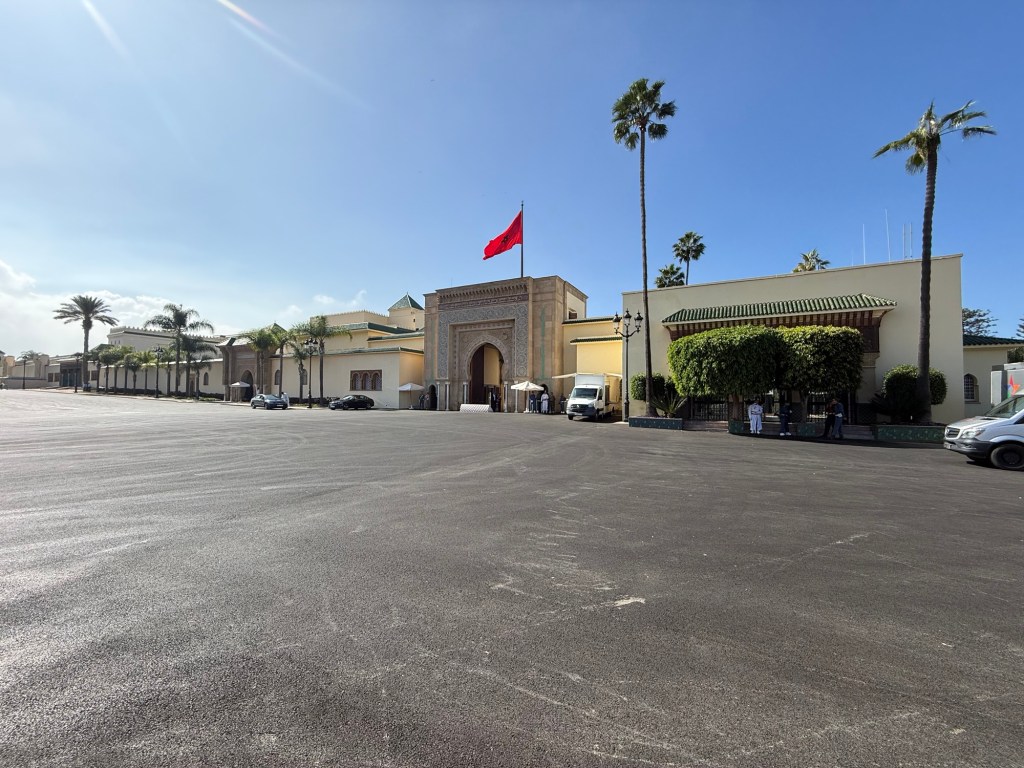
Royal Palace and Gardens –
His Majesty King Mohammed VI, the country’s Monarch and leader, has the official Royal Palace here but he actually lives most of the time across the Oued Bouregreg in Sale, within a forest.

The official Royal Palace is really an administrative government complex – secuity was tight.

When Macron popped in earlier today for Green tea with Mint he was received at the official Royal Palace.

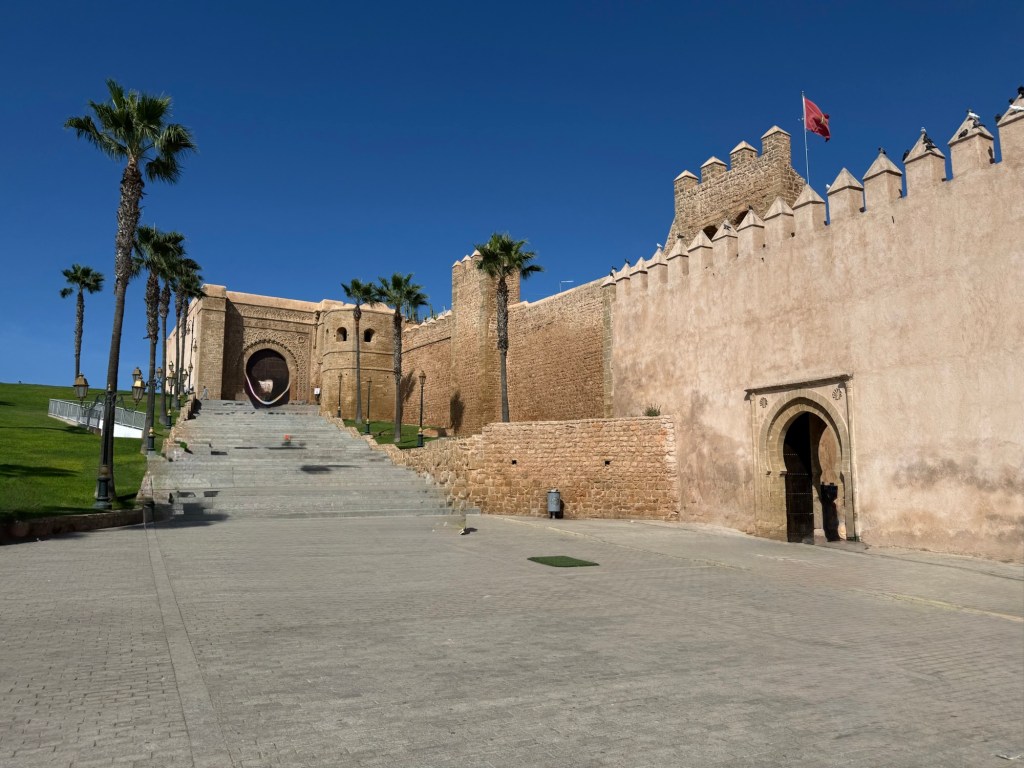
Kasbah des Oudaias –
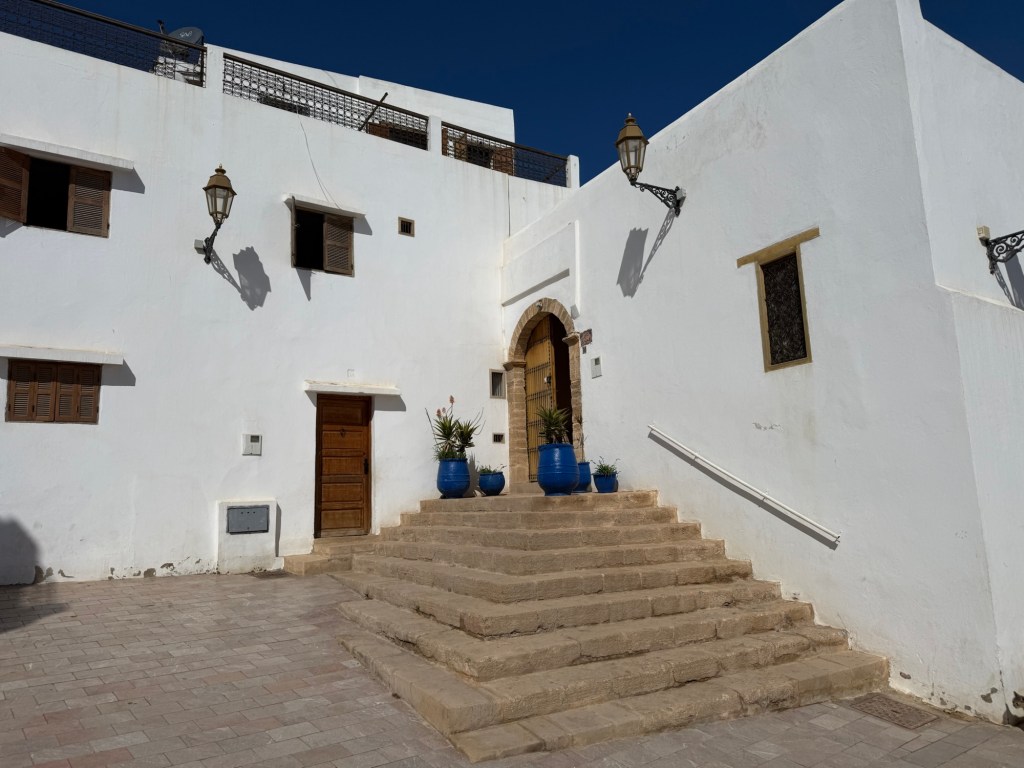
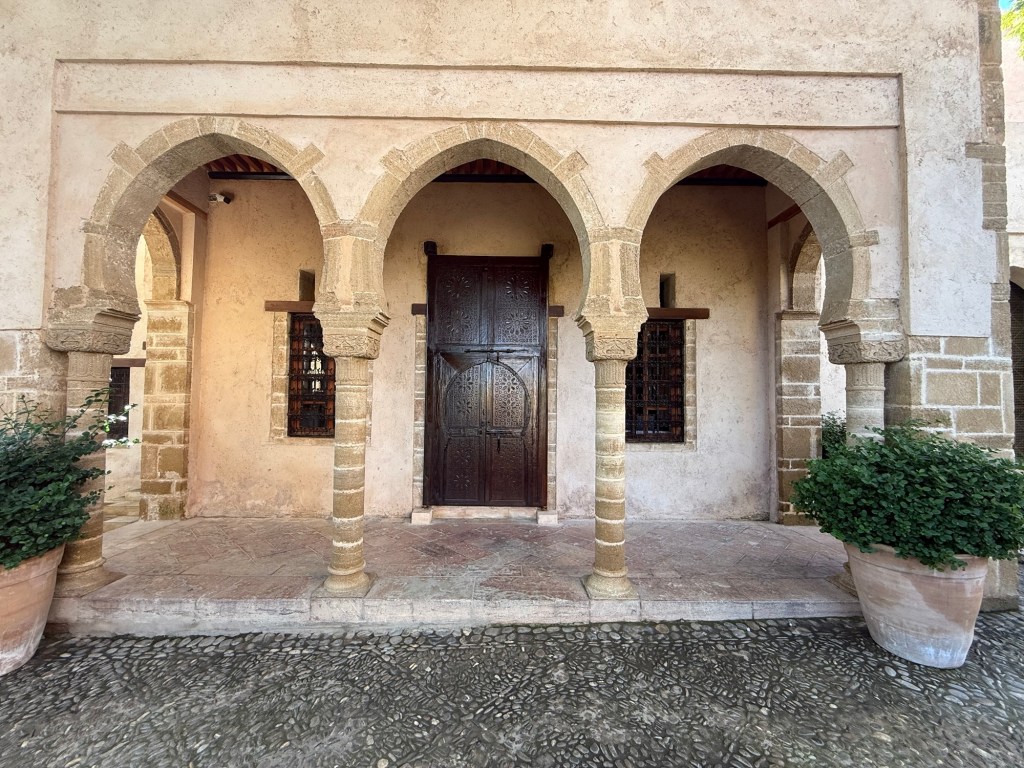
The medina with its towering walls, winding streets, beautiful tarnished wooden doors and terraces overlooking the Bouregreg River was lovely.

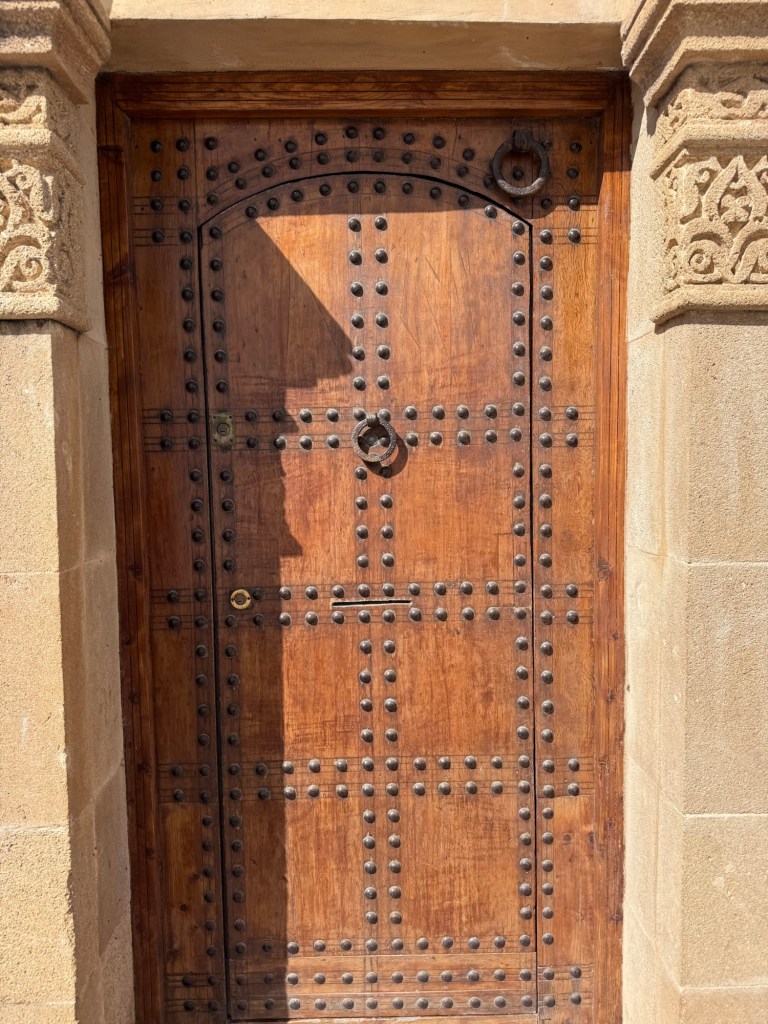
Sofioan pointed out to knockers on doors – one alerts to a family member arriving and the other a more formal guest. In the case of the latter, the women of the house would veil up before opening the door.

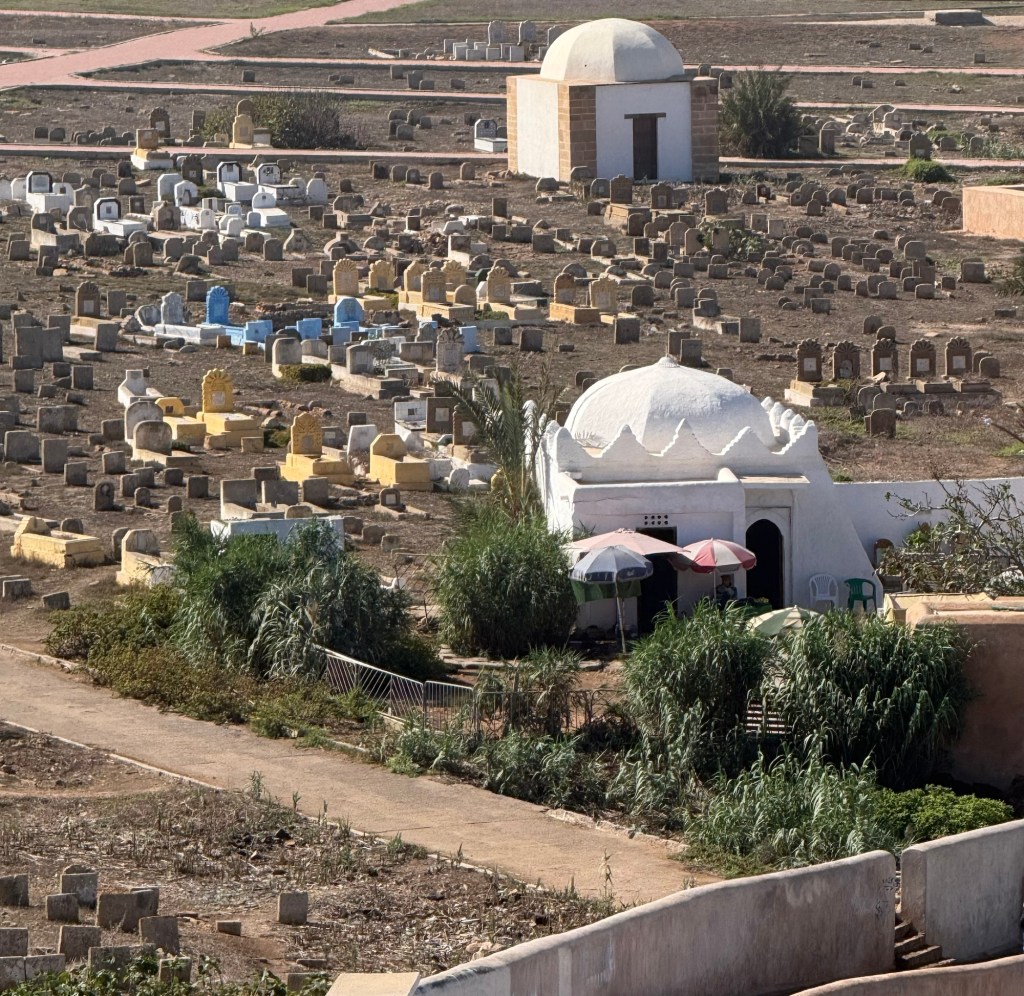
The cemetery next to the sea was very old.

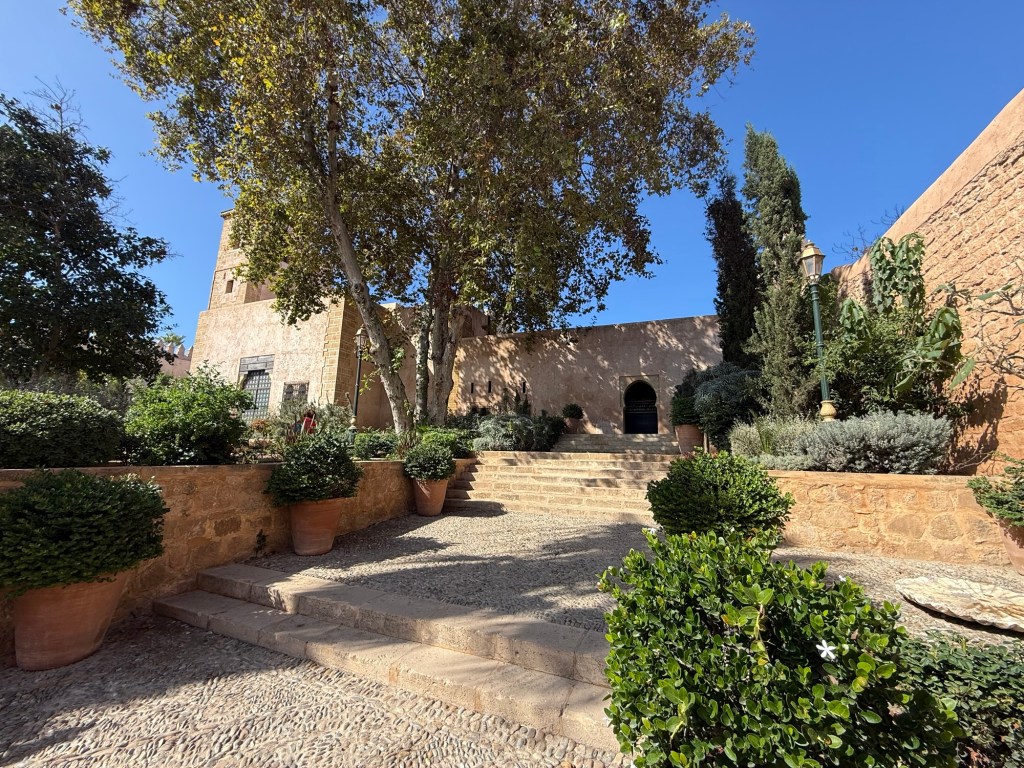
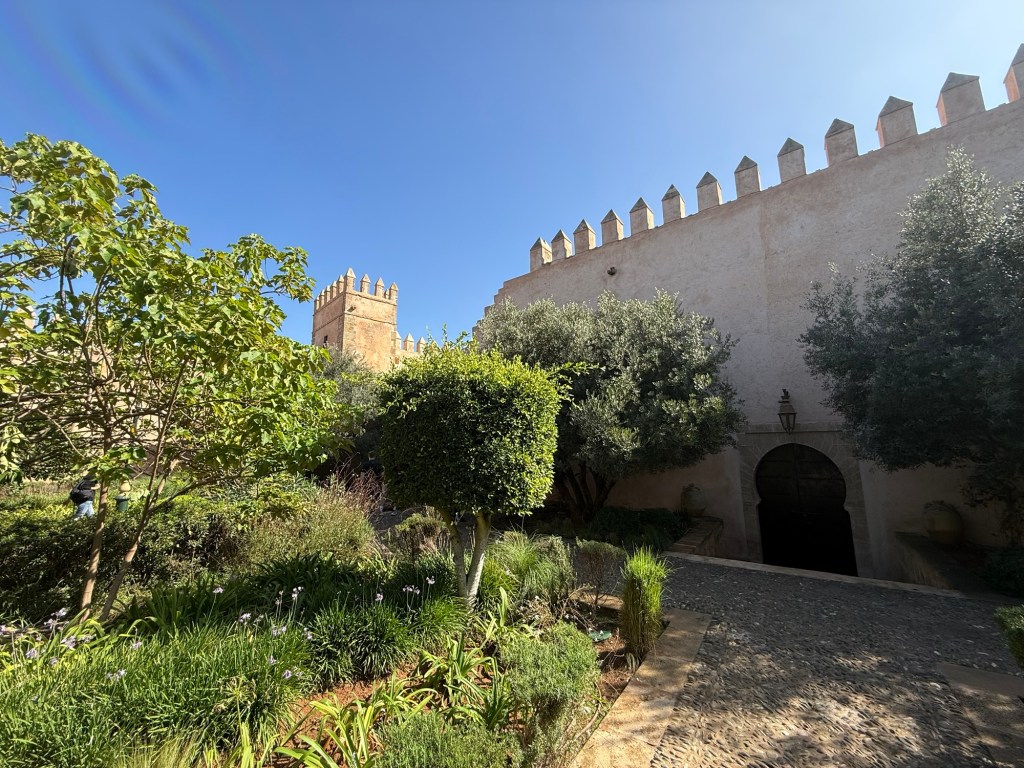
The gardens within the Kasbah were lovely with a Moorish flavor.

Chefchaouen:
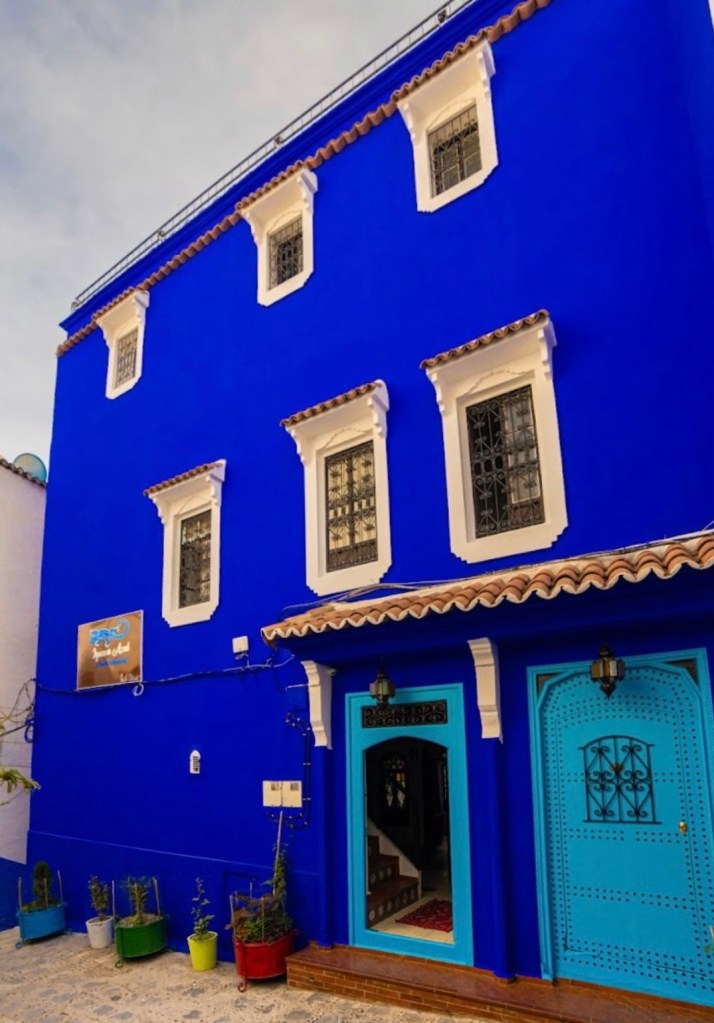
After the 4 hrs drive through the Riff Mountains from Rabat, we finally got to Chefchaouen, the Blue City (an old Jewish Town), which was a welcome sight for both Said and I. It looks lovely and I have the whole day to explore tomorrow as we stay here tomorrow night as well.

Guide:

Sofioan ^ was a nice guy, very charismatic and knowledgeable. We had coffee and wandered round the sites. We talked a bit about ME/African politics and current areas of conflit and I got an interesting perspective.

Driver:

I really would not recommend driving here. Its amost as bad as Sicily or Florida when the Old Canadians are snow-birding. Said ^ did a wonderful job driving the narrow, winding roads. He gets tomorrow off as it’s Friday.

Accommodation:
Iguana Azul was a good walk up the narrow streets to a quiet part of town.

I have a nice wee room and a good bathroom.

The common areas are small but sweet.

There is a 3rd floor for breakfast and a rooftop area with great views over the city.

Meals:

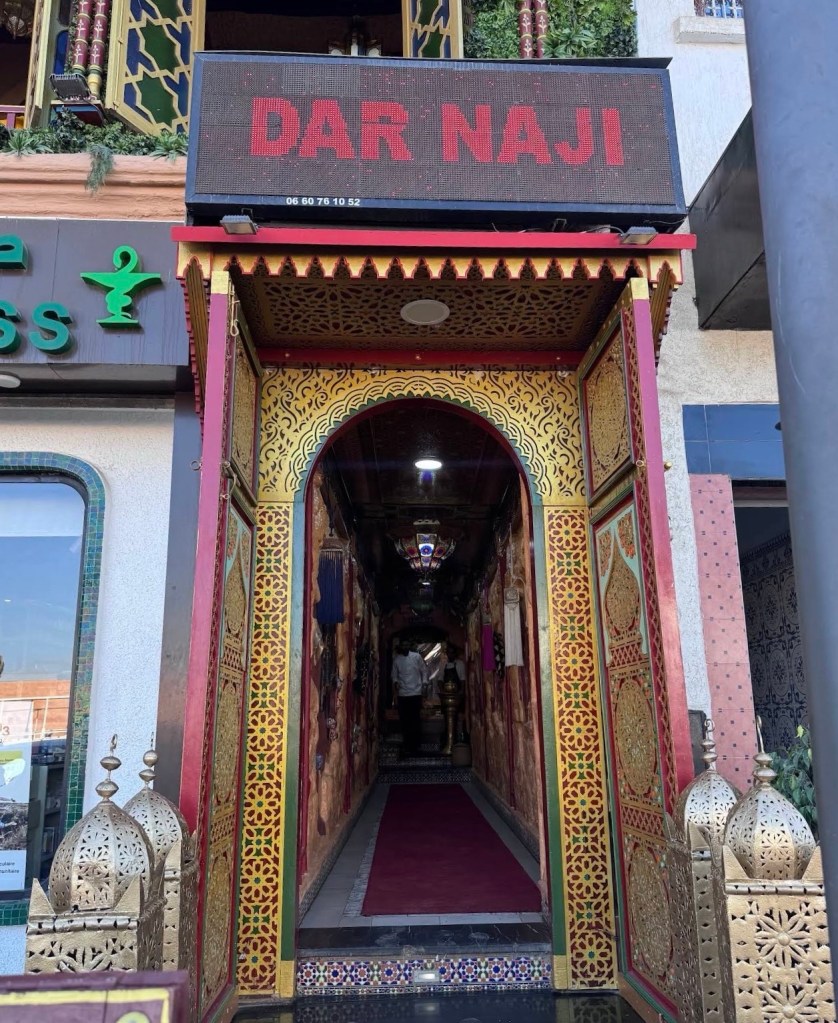
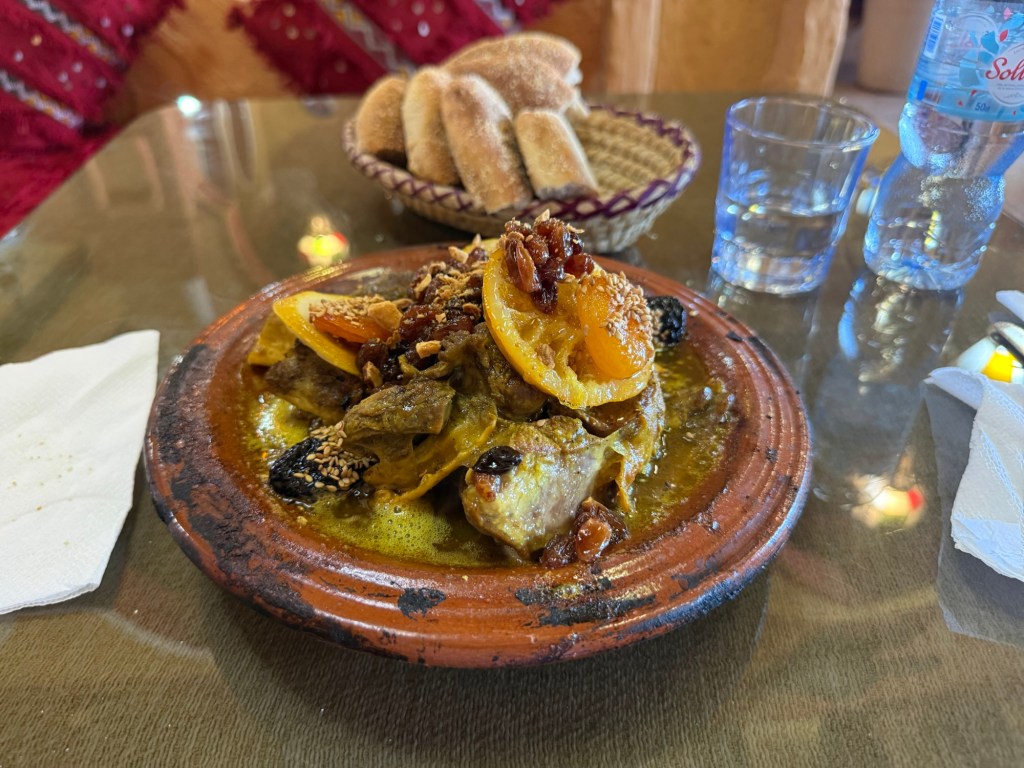
Breakfast at Kenzi Basma Hotel, Casablanca Hotel was poor; Lunch at Dar Naji, Rabat – Goat Tajine – was really good and far too much, as usual.

^ Supplied via Luxury Tours Morocco

Day 6: Morocco – 14 Days Private Land Tour

Paul Bryers

  • Day Itinerary: Drive from El Jadida to Casablanca
  • Accommodation: Kenzi Basma Hotel, Casablanca
  • Driver/Guide: Said
  • Meals: Riad Soleil d’Orient, El Jadida and Kenzi Basma Hotel, Casablanca

Drive El Jadida to Casablanca:
Our drive from El Jadida to Casablanca was quite eventful, as we encountered a sandstorm that worsened as we approached our destination. Despite the clouds of sand and dust, the blue sky was still visible. Unfortunately, my contact lenses were not comfortable in these conditions.

Casablanca was not what I had expected. The last 20 miles of our approach along the coast seemed to be a vast construction site for new 3-4 story identical apartments, rivaling even Fort Lauderdale in terms of growth.

Guide/Driver: Said was, as usual, a very careful driver keeping his eyes ahead. He was even patient with a wee cat as it slowly crossed the road.

Said looking for danger

Hassan II Mosque:
However, my first stop in Casablanca was a very pleasant surprise – the magnificent Hassan II Mosque.

It was truly astounding. I was lucky to gain entry – in fact I was the last person in before they stopped entry for imminent prayers, so I had the place largely to myself.

As the second largest functioning mosque in Africa and the 14th largest in the world, it is an impressive structure.

The mosque is situated on a promontory overlooking the Atlantic Ocean, allowing worshippers to pray over the sea.

Completed in 1993, the mosque was designed by Michel Pinseau under the guidance of King Hassan II and built by skilled Moroccan artisans from across the kingdom.

The mosque can accommodate a maximum of 105,000 worshippers, with 25,000 inside the mosque hall and another 80,000 on the outside grounds.

Its minaret, standing at 210 meters (689 ft), is the world’s second tallest. The minaret is topped by a laser that directs its light towards Mecca. Hopefully, I will have the opportunity to see this tonight, as my bedroom window faces the minaret.

The outer walls of the mosque are made of intricately crafted marble, and the roof is retractable.

Many ornate doors lead into the prayer hall. They seem to be made of titanium.

Inside, the Mosque is breathtaking.

Notable architectural features include the striking columns, horseshoe arches, and intricate muqarnas adorning the ceilings. The dome, arches, and walls create a grand ambiance within the mosque. The state-of-the-art sound system is discreetly concealed.
The basement houses an ablution room and a vast public hammam, with its own entrance.
Accommodation:
The Kenzi Basma Hotel is modern and looks onto the Mosque. It was quite nice to be in a modern hotel although I do like the Riads.
My room was nice and big and light and, as I mentioned, had a great view of the Mosque.

^ Supplied via Luxury Tours Morocco.